MARS - Methane Alert Response System - Environment Notes
Methane is a colourless and odourless gas found in abundance in nature as well as as a byproduct of certain human activities. The Methane Alert and Response System (MARS) was launched at the United Nations Framework Convention on Climate Change's 27th Conference of Parties (COP27) in Sharm El-Sheikh, Egypt. The new project seeks to accelerate the execution of the Global Methane Pledge by openly expanding up global efforts to identify and address significant methane emission sources. MARS will monitor big point pollution sources, primarily in the fossil fuel sector, but will eventually be able to identify emissions from coal, waste, livestock, and rice farms as well. This article explains that the MARS - Methane Alert Response System is important for UPSC IAS exam preparation.
Table of Contents
MARS - Methane Alert Response System
- The Methane Alert and Response System (MARS) is a satellite-based system that allows governments to identify and handle methane leaks.
- This data-to-action tool is part of a worldwide effort to combat climate change by reducing greenhouse gas emissions.
- It was established as part of the United Nations Environment Programme's International Methane Emissions Observatory (IMEO) plan to collect policy-relevant statistics for emission reductions.
- This will be the first openly accessible worldwide system that clearly connects methane detection and notification procedures.
- It will discover and pinpoint significant greenhouse emission events using cutting-edge satellite data and will inform worried parties. This information will also be used to assist and monitor the success of mitigation initiatives.
- MARS partners will provide technical or advisory services such as evaluating mitigation possibilities in particular areas.
Methane Alert Response System - Components
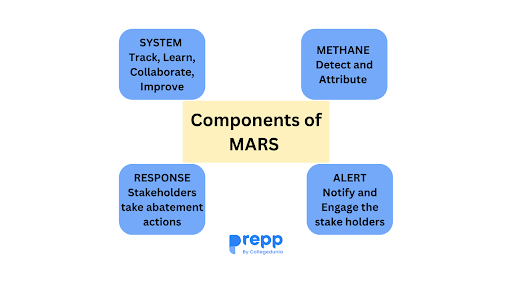
- Detect & Attribute: IMEO will collaborate with the Committee on Earth Observation Satellites and existing global mapping satellites to identify very large methane plumes and methane hot spots, as well as conduct additional analysis using other satellites and datasets to allow attribution of the event to a specific source.
- Notify and Engage: IMEO will work directly and through partners to tell pertinent governments and businesses of significant emission events occurring in or near their territories or activities, and this interaction will continue as more information becomes accessible.
- Stakeholders Take Action: It will be up to the informed stakeholders to decide how best to react to the notified pollution and share their actions with MARS to demonstrate initiative. MARS partners will be available to provide support services at this point as needed, such as assistance with evaluating mitigation possibilities and help with mitigation activities.
- Track, Learn, Collaborate, Improve: As mitigation measures progress, IMEO will continue to watch the event site for future releases. When the MARS system is completely functioning, IMEO and partners will make data and analysis accessible to the public 45 to 75 days after detection. IMEO will encourage collaboration across the MARS ecosystem in order to take insights from these reported events that can be used to enhance MARS and methane action in general.
Concerns about Methane
- Methane is the most basic of the paraffin family of hydrocarbons and one of the most powerful greenhouse gases.
- Methane is the second-most prevalent of the six main greenhouse gases, but its capacity to cause global warming is far greater than that of carbon dioxide.
- Methane is cited for causing at least 25%- 30% of the temperature increase since pre-industrial periods, accounting for about 17% of contemporary world greenhouse gas emissions.
- In comparison to carbon dioxide, it makes for a tiny portion of human-induced greenhouse gas emissions.
- However, in the 20 years following its release, it is believed to be 80 times more effective than carbon dioxide at storing atmospheric heat.
Indian Initiatives to Cut Methane Emission
- Harit Dhara (HD): The Indian Council of Agricultural Research (ICAR) has created an anti-methanogenic feed supplement called 'Harit Dhara,' which can reduce methane emissions from livestock by 17-20% while also increasing milk output.
- India Greenhouse Gas Program (IGGP): It is an industry-led voluntary system to monitor and control greenhouse gas pollution that is headed by the World Resources Institute (WRI) India (non-profit organisation), the Confederation of Indian Industry (CII), and The Energy and Resources Institute (TERI).
- The project develops complete assessment and management strategies to reduce pollution and create more lucrative, competitive, and sustainable companies and groups in India.
- National Action Plan on Climate Change (NAPCC): The NAPCC was established in 2008 with the goal of raising consciousness among members of the public, government agencies, academics, business, and communities about the danger presented by climate change and how to combat it.
Conclusion
The Methane Alert and Response System (MARS), which was introduced at COP27, will scale up worldwide efforts to identify and respond to significant emissions sources, as well as expedite execution of the worldwide Methane Pledge. MARS will track major pollution sources, mainly in the fossil fuel industry, but it will ultimately be able to detect emissions from coal, garbage, cattle, and rice fields as well.
FAQs
Question: What is the Mars Methane Alert Response System (MMARS)?
Answer: MMARS is a system designed to monitor and analyze methane emissions on Mars, aiming to understand the planet's atmosphere and potential for life.
Question: Why is methane significant on Mars?
Answer: Methane is significant on Mars because its presence could indicate biological activity or geological processes. Understanding methane helps scientists explore potential signs of life.
Question: How does MMARS detect methane on Mars?
Answer: MMARS detects methane using advanced sensors onboard spacecraft like the Curiosity rover and the Mars Science Laboratory, which analyze atmospheric samples for methane concentrations.
Question: What role does methane play in understanding Mars’ potential for life?
Answer: Methane is a potential biosignature, and its detection could suggest microbial life or chemical processes that could support life. It is a key indicator in the search for life on Mars.
Question: How does MMARS contribute to future missions to Mars?
Answer: MMARS provides crucial data for future Mars missions by offering insights into the planet's atmospheric composition, which is vital for mission planning and the search for life.
MCQs
1. What is the primary purpose of the Mars Methane Alert Response System (MMARS)?
A) To study the atmosphere of Venus
B) To monitor methane emissions on Mars
C) To search for water on Mars
D) To map the surface of Mars
Answer: (B) See the Explanation
Explanation: MMARS is specifically designed to monitor and analyze methane emissions on Mars, which can provide insights into the planet's atmosphere and possible signs of life.
2. Why is methane an important component in the study of Mars?
A) It helps in detecting Mars' temperature
B) It can indicate the presence of life or geological processes
C) It increases the planet’s oxygen level
D) It is a major greenhouse gas
Answer: (B) See the Explanation
Explanation: Methane's presence on Mars could suggest microbial life or geological activity, making it crucial for understanding the planet’s potential to support life.
3. Which NASA mission plays a key role in detecting methane on Mars?
A) Voyager
B) Curiosity Rover
C) Apollo Mission
D) Mars Orbiter Mission
Answer: (B) See the Explanation
Explanation: The Curiosity Rover, part of NASA’s Mars Science Laboratory mission, plays a significant role in detecting and analyzing methane in Mars' atmosphere.
4. How does the detection of methane on Mars contribute to the search for life?
A) It is a biosignature that could indicate biological processes
B) It indicates Mars' age
C) It affects the planet’s weather
D) It helps scientists measure Mars’ temperature
Answer: (A) See the Explanation
Explanation: Methane is considered a potential biosignature, meaning its presence may indicate microbial life or processes that could support life on Mars.
5. What is the role of MMARS in the future exploration of Mars?
A) It maps the planet’s surface
B) It studies the planet’s history
C) It helps in planning future missions and understanding the planet’s atmosphere
D) It analyzes the composition of Martian soil
Answer: (C) See the Explanation
Explanation: MMARS contributes vital data on Mars' atmosphere, which is crucial for future mission planning, especially in terms of landing sites and identifying areas with potential for life.
GS Mains Questions and Model Answers
Q1: Discuss the significance of methane detection on Mars in the context of astrobiology. How does the Mars Methane Alert Response System contribute to this objective?
Answer: The detection of methane on Mars is significant in astrobiology as it could indicate the presence of microbial life or subsurface geological activity. Methane is a potential biosignature, and its fluctuations in Mars' atmosphere are of great interest to scientists. MMARS plays a crucial role in this by using advanced instruments to monitor methane levels, providing data that could offer insights into the planet's habitability and guide future missions aimed at life detection.
Q2: What challenges do scientists face in detecting methane on Mars, and how does the Mars Methane Alert Response System address these challenges?
Answer: Detecting methane on Mars is challenging due to the planet’s thin atmosphere and the variability of methane emissions. Additionally, methane could have multiple sources, both biological and geological. MMARS addresses these challenges by employing highly sensitive sensors and sophisticated data analysis techniques to differentiate between natural and potential biological methane sources. It helps provide accurate data for the scientific community to understand methane's role in Mars' atmosphere.
Q3: Evaluate the implications of methane detection on Mars for future planetary exploration missions. How does MMARS shape the objectives of these missions?
Answer: The detection of methane on Mars significantly impacts future planetary exploration, as it could alter our understanding of the planet's potential to support life. MMARS plays a crucial role by offering real-time data that helps determine high-priority areas for exploration. By detecting methane hotspots, MMARS helps shape the objectives of future Mars missions, such as selecting landing sites and determining where life detection instruments should be deployed.
Previous Year Questions on Environmental Issues
1. UPSC CSE Mains 2022 (GS Paper 3):
Question: "Discuss the role of methane in climate change. How can monitoring methane emissions on Mars aid in planetary exploration?"
Answer: Methane is a potent greenhouse gas that contributes to climate change on Earth. Monitoring methane on Mars helps scientists understand potential biological processes, contributing to the search for life. It aids in determining the planet's suitability for future exploration and the existence of life.
2. UPSC CSE Mains 2021 (GS Paper 3):
Question: "Analyze the scientific challenges in detecting methane on Mars. What technologies are employed to detect and analyze methane emissions?"
Answer: Detecting methane on Mars is challenging due to the planet's thin atmosphere and fluctuating methane levels. Technologies such as the Curiosity Rover's sensors and the Mars Methane Alert Response System (MMARS) are employed to detect and analyze methane emissions, enhancing our understanding of Mars' atmosphere and its potential for life.
Download the PREPP App and attempt FREE IAS Exam Mock Tests and get complete study material!
UPSC IAS : CSAT - Mini Live Test

Live Test : UPSC CSE Prelims CSAT (Paper-II) (Oct 20 - 23)
Full Test - 04: UPSC CSE Prelims CSAT (Paper-II)
Full Test - 03: UPSC CSE Prelims CSAT (Paper-II)
UPSC CSE Prelims 2026 GS Paper 1 Question Paper (24-May-2026)
UPSC CSE Prelims 2026 CSAT Paper 2 Question Paper (24-May-2026)

17 February 2025 | The Hindu Must Read Articles | Current Affairs

16 February 2026 | The Hindu Must Read Articles | Current Affairs

13 February 2026 | The Hindu Must Read Articles | Current Affairs









Comments