Global Methane Assessment 2030:Baseline Report - Environment Notes
Global Methane Assessment: 2030 Baseline Report was released at the Climate and Clean Air Ministerial Meeting at COP27, emphasising that methane emissions will increase by 5-13% by 2030. This report is a product of the Global Methane Assessment (GMA), which details projections of anthropogenic methane emissions through 2030 under various baseline scenarios and compares the climate benefits of meeting the Global Methane Pledge target to the impacts of those baseline emissions. This article explains that the Global Methane Assessment 2030:Baseline Report is important for UPSC IAS exam preparation.
Table of Contents
Global Methane Assessment 2030 : Baseline Report
- The Global Methane Assessment: 2030 Baseline Report was released at the Climate and Clean Air Ministerial Meeting at the United Nations Framework Convention on Climate Change's 27th Conference of Parties (COP27).
- The study assessed the baseline (what would happen if no attempts were made), such as the Global Methane Pledge.
- The Global Methane Pledge was unveiled at CoP26 last year. By 2030, the aim is to reduce worldwide methane emissions by at least 30% from 2020 levels.
- Keeping the promise could prevent more than 0.2 degrees Celsius of heat between 2040 and 2070.
- This report is a product of the Global Methane Assessment (GMA), which details projections of anthropogenic methane emissions through 2030 under various baseline scenarios and compares the climate benefits of meeting the Global Methane Pledge target to the impacts of those baseline emissions.
- One of the GMA's important findings was that presently available technical measures and policies could decrease emissions from the three major anthropogenic methane emitting industries by up to 45 percent of baseline levels by 2030. (approximately 180 Mt per year in 2030).
Global Methane Assessment 2030 : Baseline Report - Key Highlights
- The quantity of methane in the atmosphere is rising at an alarming pace. The year 2021 saw the highest annual rise since worldwide monitoring started four decades ago.
- Concentrations are now 26% higher than pre-industrial values. These rises are almost entirely the result of human action.
- According to the Sixth Assessment Report of the Intergovernmental Panel on Climate Change (IPCC), human-caused methane emissions account for roughly 45 percent of present net warming.
- The IPCC has repeatedly emphasised the crucial importance of lowering human emissions - of methane and other climate pollutants - if the world is to remain below 1.5° and 2° Celsius goals.
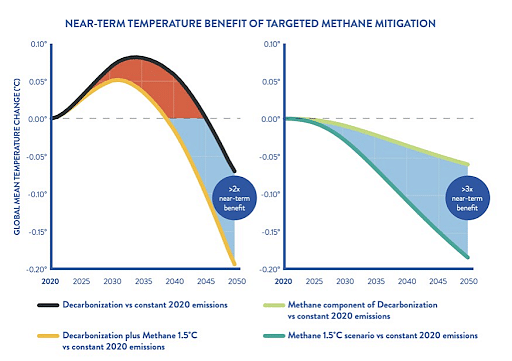
- Reducing methane emissions over the next decade will keep the earth considerably cooler than reducing carbon dioxide emissions alone, owing to the fact that CO2 emission reductions also eliminate cooling aerosols.
- Because near-term deep decarbonization will result in higher temperature decreases after 2050, instant methane reduction policies, such as the Global Methane Pledge (GMP), must be enacted in tandem with net-zero CO2 efforts.
- Evaluating the success of methane reduction efforts, including the Global Methane Pledge, necessitates a description of what would happen in the lack of such efforts, which we refer to as "baseline scenarios."
- This report analyses baseline methane emission estimates for the next decade, as well as the consequences for the Global Methane Pledge goal.
- The Global Methane Pledge was unveiled at CoP26 last year. By 2030, the aim is to reduce worldwide methane emissions by at least 30% from 2020 levels.
- Achieving the promise could prevent more than 0.2 degree Celsius of heat between 2040 and 2070.
- The commitment was signed by 150 countries at CoP27. India and China have yet to make a pledge.
- Approximately 95% of Nationally Determined Contributions (NDC) now include methane or will do so in updated forms.
- In 2021, methane levels in the atmosphere hit a new peak of 1908 parts per billion. This is equivalent to 262 percent of pre industrial values.
- Methane is produced primarily by agriculture, fossil fuels, solid refuse, and drainage.
- Human actions emit 350-390 million tonnes of methane per year. Agriculture and fossil fuel energy industries emit approximately 120-140 million tonnes of CO2 per year, nearly twice that of the waste sector.
- Under a business-as-usual situation, agricultural emissions are expected to increase by about 11 million tonnes per year by 2030.
- Under the same situation, emissions from fossil fuels and garbage are expected to rise by 10 million tonnes and 9 million tonnes, respectively, by the end of the decade.
- However, using presently known means, the world could decrease emissions from these industries by approximately 180 million tonnes per year (45%) by 2030.
- The Report emphasised significant uncertainties in tracing emissions to particular sub-sectors like cattle or hydrocarbons.
- The United Nations introduced the Methane Alert and Response System (MARS) at CoP27 to monitor methane pollution. It will be operational in January 2023.
- According to the study, these advances will help direct mitigation efforts more effectively while also tracking changes in emissions over time as methane reduction policies are enacted.
Methane Emissions
- Methane (CH4) is a molecule found primarily in natural gas.
- Methane is produced when organic matter decomposes in an oxygen-depleted habitat, such as undersea or in an animal's intestine as food is digested, a process known as enteric fermentation.
- Furthermore, methane is emitted during the research, extraction, and refining of fossil fuels, such as oil, coal, and gas.
- Methane is a greenhouse gas (GHG), which means that its presence in the atmosphere affects the earth's temperature.
- It has a much shorter atmospheric lifetime than CO2 (around 12 years compared to centuries for CO2), but it is a much more potent greenhouse gas, absorbing much more energy while it exists in the atmosphere.
- It traps heat in the atmosphere more than 25 times more effectively than carbon dioxide.
- Furthermore, methane has an impact on air quality because it contributes to the creation of ground-level (tropospheric) ozone, a hazardous air pollutant.
Measures to limit Methane Emissions
- As part of the Decade of Action to accomplish the Sustainable Development Goals by 2030, the United Nations held a Food Systems Summit in 2021 with the goal of initiating daring new actions to change the way the world creates and uses food.
- The Koronivia Joint Work on Agriculture project of the United Nations promotes the reform of farming and food systems, with an emphasis on how to sustain output in the face of climate change.
- The Global Methane Pledge, launched at CoP 26 in 2021, seeks to keep the 1.5 degrees Celsius target intact.
- Over 100 nations have pledged to lower worldwide methane emissions by at least 30% from 2020 levels by 2030. This decrease could prevent more than 0.2 C of heat by 2050.
- In addition, the Global Methane Hub, a philanthropic fund dedicated to methane mitigation, has collected $70 million to finance crucial research into lowering methane emissions from enteric fermentation.
Conclusion
The Global Methane Assessment: 2030 Baseline Report was presented at the Climate and Clean Air Ministerial Meeting at the United Nations Framework Convention on Climate Change's 27th Conference of Parties (COP27). The study assessed the baseline, or what would happen if no attempts like the Global Methane Pledge were made. Last year, at CoP26, the Global Methane Pledge was unveiled. The aim is to reduce worldwide methane emissions by at least 30% from 2020 levels by 2030.
FAQs
Question: What is the Global Methane Assessment Report?
Answer: The Global Methane Assessment Report provides an evaluation of global methane emissions and offers strategies for reducing them. It aims to help countries mitigate methane emissions, which are a significant contributor to climate change.
Question: Why is methane considered a critical greenhouse gas?
Answer: Methane is a potent greenhouse gas because it has a much higher global warming potential than carbon dioxide over a short period. It is responsible for a substantial portion of the warming experienced in recent decades.
Question: What is the significance of the 2030 baseline in the Global Methane Assessment?
Answer: The 2030 baseline in the Global Methane Assessment serves as a target year for measuring reductions in methane emissions, guiding global efforts towards achieving climate goals and assessing progress in mitigating methane-related environmental impacts.
Question: How does the Global Methane Assessment help countries in reducing emissions?
Answer: The report provides countries with policy recommendations, strategies, and best practices to reduce methane emissions. It focuses on sectors like agriculture, energy, and waste management to achieve meaningful reductions.
Question: What are the key sectors contributing to methane emissions?
Answer: The key sectors contributing to methane emissions include agriculture (especially livestock), fossil fuel extraction and transportation, waste management (landfills), and wastewater treatment.
MCQs
1. What is the primary focus of the Global Methane Assessment Report?
A) To evaluate global carbon dioxide emissions
B) To reduce methane emissions and mitigate climate change
C) To analyze water pollution trends
D) To propose solutions for reducing plastic pollution
Answer: (B) See the Explanation
Explanation: The primary focus of the Global Methane Assessment Report is to reduce methane emissions, which play a significant role in climate change and global warming.
2. Which sector contributes most to global methane emissions?
A) Transportation
B) Agriculture
C) Construction
D) Manufacturing
Answer: (B) See the Explanation
Explanation: Agriculture, especially livestock, is the leading sector responsible for methane emissions due to processes like enteric fermentation in ruminants.
3. What is the global warming potential of methane compared to carbon dioxide?
A) Less than that of carbon dioxide
B) Same as carbon dioxide
C) 25 times more than carbon dioxide over a 100-year period
D) 100 times less than carbon dioxide
Answer: (C) See the Explanation
Explanation: Methane is approximately 25 times more effective at trapping heat in the atmosphere than carbon dioxide over a 100-year period, making it a more potent greenhouse gas.
4. When is the target year for measuring methane emissions reductions according to the Global Methane Assessment?
A) 2040
B) 2030
C) 2025
D) 2028
Answer: (B) See the Explanation
Explanation: The target year for measuring methane emissions reductions is 2030, as outlined in the Global Methane Assessment Report, to assess progress towards global climate goals.
5. What role do landfills play in methane emissions?
A) They are a significant source of methane emissions
B) They contribute to reducing methane in the atmosphere
C) They are unrelated to methane emissions
D) They absorb methane from the atmosphere
Answer: (A) See the Explanation
Explanation: Landfills are a significant source of methane emissions, as organic waste decomposes anaerobically, releasing methane into the atmosphere.
GS Mains Questions and Model Answers
Q1: Discuss the role of methane in global warming and explain the importance of the Global Methane Assessment Report in combating climate change.
Answer: Methane is a potent greenhouse gas, with a global warming potential 25 times higher than carbon dioxide over a 100-year period. Its role in accelerating global warming has made it a key target for climate change mitigation. The Global Methane Assessment Report highlights the urgent need to reduce methane emissions from various sectors, including agriculture, waste management, and fossil fuel extraction. The report offers actionable strategies for governments and industries to reduce methane emissions, making it a vital tool in the global fight against climate change. By providing a baseline for methane emissions and proposing effective mitigation strategies, the report helps guide countries toward achieving climate goals and ensuring a sustainable future.
Q2: How can countries effectively reduce methane emissions based on the recommendations from the Global Methane Assessment Report?
Answer: The Global Methane Assessment Report provides recommendations for reducing methane emissions across key sectors. In agriculture, shifting to sustainable farming practices, reducing livestock methane emissions through dietary changes, and improving waste management can significantly reduce methane output. In the energy sector, capturing methane from oil and gas production facilities and reducing leaks in pipelines and storage can also mitigate emissions. The waste management sector can adopt better landfill management practices, including the capture and utilization of methane gas. Additionally, promoting the use of methane-reducing technologies and encouraging international collaboration can help countries achieve their methane reduction targets.
Q3: Evaluate the environmental and economic impacts of methane emission reduction strategies as outlined in the Global Methane Assessment Report.
Answer: Reducing methane emissions can have significant positive environmental impacts, including mitigating global warming and improving air quality. Methane is a major contributor to short-term climate change, and reducing its concentration in the atmosphere will have a direct effect on reducing the overall global temperature rise. Economically, the implementation of methane reduction strategies can promote the growth of green technologies, create new job opportunities in renewable energy and waste management sectors, and reduce the long-term costs of climate change mitigation. Moreover, industries and governments can save money by adopting energy-efficient technologies and reducing methane leaks, contributing to economic growth while benefiting the environment.
Previous Year Questions on Methane Emissions
1. UPSC CSE Mains 2020 (GS Paper 3):
Question: "Analyze the role of methane in global warming and discuss the strategies for its reduction as outlined in the Global Methane Assessment."
Answer: Methane is a significant contributor to global warming, with a global warming potential much higher than carbon dioxide over a short period. The Global Methane Assessment highlights various strategies for reducing methane emissions, including improving agricultural practices, capturing methane from landfills, and implementing advanced technologies to reduce emissions in the energy sector. It emphasizes the need for global cooperation and the adoption of regulations and technologies to reduce methane emissions, particularly in sectors like agriculture, waste management, and fossil fuel production.
2. UPSC CSE Mains 2019 (GS Paper 3):
Question: "What are the key sectors responsible for methane emissions, and how can they be mitigated according to the Global Methane Assessment?"
Answer: Key sectors responsible for methane emissions include agriculture, fossil fuel extraction, and waste management. In agriculture, methane emissions can be reduced by improving livestock management practices and adopting sustainable agricultural practices. In the fossil fuel sector, better management of oil and gas extraction processes, including the capture and utilization of methane, can significantly reduce emissions. For waste management, adopting better landfill management practices and methane recovery technologies can help mitigate methane release. The Global Methane Assessment provides detailed strategies for addressing these sectors to achieve global methane reduction goals.
Download the PREPP App and attempt FREE IAS Exam Mock Tests and get complete study material!

Live Test : UPSC CSE Prelims CSAT (Paper-II) (Oct 20 - 23)
Full Test - 04: UPSC CSE Prelims CSAT (Paper-II)
Full Test - 03: UPSC CSE Prelims CSAT (Paper-II)
UPSC CSE Prelims 2026 GS Paper 1 Question Paper (24-May-2026)
UPSC CSE Prelims 2026 CSAT Paper 2 Question Paper (24-May-2026)

17 February 2025 | The Hindu Must Read Articles | Current Affairs

16 February 2026 | The Hindu Must Read Articles | Current Affairs

13 February 2026 | The Hindu Must Read Articles | Current Affairs









Comments