India's Green House Gas(GHG) Emissions - Environment Notes
Greenhouse gas emissions from human activities strengthen the greenhouse effect, contributing to climate change. Globally, behind China and the United States, India is the third greatest emitter of greenhouse gases, emitting around 2.6 billion tonnes CO2 equivalent each year. However, India's per capita emissions are just 1.8 tonnes, well below the global average of 4.4 tonnes. India has promised in its Nationally Determined Contributions (NDCs) to "reduce the emission intensity of its GDP by 33 to 35% by 2030 from 2005 levels." This article explains about India's Green House Gas(GHG) Emissions which is important for UPSC IAS exam preparation.
Table of Contents
India's GreenHouse Gas Emissions
- Human-caused greenhouse gas emissions amplify the greenhouse effect and contribute to climate change.
- The majority is carbon dioxide from the combustion of fossil fuels such as coal, oil, and natural gas.
- According to a recent research issued by the United Nations Environment Programme (UNEP), India's per capita greenhouse gas emissions in 2020 were 2.4 tCO2e (tonne carbon dioxide equivalent), much below the world average of 6.3 tCO2e.
- To remain within its fair-share range consistent with global 1.5°C IPCC scenarios, India's emissions must be limited to less than 4.597 MtCO2 e by 2030 and less than 3.389 MtCO2 e by 2050.
- However, India's 2030 NDC merely commits to limiting emissions to between 6,034 and 6,203 MtCO2e.
- India might become a worldwide leader if it abandons plans to build new coal-fired power plants and eliminates the usage of coal for electricity generation by 2040.
- All statistics exclude emissions from land use and are based on forecasts prior to COVID-19.
- The Paris Agreement commitments envisioned a 33-35% reduction in this intensity by 2030
- India's yearly emissions per person are lower than the world average, and the UNEP expects them to reach between 3 and 4 tonnes by 2030.
- China is predicted to have released 27% of global GHG in 2019, followed by the US at 11% and India at 6.6%.
- The nationwide carbon trading programme in India may be established in 2023.
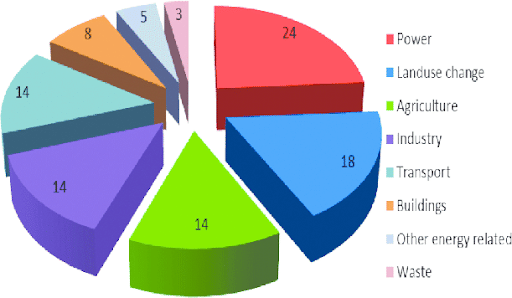
(Sector wise GHG emission)
| Other Relevant Links | |
|---|---|
| Net Zero Pledges | Carbon Leakage |
| Karakoram Anomaly | HPCL - Cow Dung to Compressed Biogas Project |
| Triple Planetary Crisis | Arctic Amplification |
| CO2 Equivalent | Carbon Dioxide Levels -Keeling Curve |
| Updated NDCs | Panchamrit |
| UNEP Production Gap Report | UN World Water Conference |
| Global Alliance for Industry Decarbonisation | Green Coal |
Greenhouse Gas Emissions
- A greenhouse gas is defined as a gas that absorbs and emits radiant energy in the thermal infrared spectrum, causing the greenhouse effect.
- Atmospheric gases such as carbon dioxide, methane, nitrous oxide (N2O), water vapour, and chlorofluorocarbons may trap incoming infrared radiation from the earth's surface, resulting in the greenhouse effect.
- As a result, these gases are referred to as greenhouse gases, and the heating impact is referred to as the greenhouse effect.
- Human activities have nearly doubled the atmospheric quantity of carbon dioxide since the beginning of the Industrial Revolution (about 1750), from 280 ppm in 1750 to 419 ppm in 2021.
- According to the Intergovernmental Panel on Climate Change (IPCC), if greenhouse gas emissions continue at current rates, temperatures might rise by 2 degrees Celsius (3.6 degrees Fahrenheit) by 2050.
- The burning of fossil fuels, chiefly coal, petroleum (including oil), and natural gas, accounts for the great bulk of anthropogenic carbon dioxide emissions, with small additions from cement manufacturing, fertiliser production, deforestation, and other land use changes.
Indian Efforts to Reduce Emissions
- The Paris Agreement was adopted at the COP21 in Paris, in which all countries pledged to work together to keep global temperature rise well below 2 degrees Celsius.
- Increasing the capability of carbon sinks, such as reforestation, to remove more CO2 from the atmosphere.
- Using low-carbon energy sources like renewables and nuclear power.
- Improving energy efficiency through measures such as improved building insulation.
- Another option for preventing climate change is geoengineering.
- Reducing the sources of the gases (for example, using fossil fuels for power, heating, or transportation) or enhancing the sinks that gather and store these gases (for example, oceans, forests, and soil).
- The country has vowed to reduce its economy's "emissions intensity" by 33-35% by 2030, compared to 2005 levels.
- Increase tree cover by 2030 to provide an extra cumulative carbon sink of 2,500-3,000Mt CO2.
- In addition, India intends to construct 5GW of offshore wind by 2022 and 30 GW by 2030. None have been installed as of yet.
- According to the Climate Policy Initiative (CPI), the country may incorporate 390GW of low-cost wind and solar production into its system by 2030.
- According to India's climate commitment, around 70% of the country's population is dependent on conventional biomass energy, which is inefficient and creates significant levels of indoor air pollution.
- By 2022, India hopes to have 10GW of such bioenergy.
- India now has around 4.5GW of small hydro plants (less than 25MW), with a 5GW goal for 2022.
Global Initiatives to Reduce Emissions
- Intergovernmental Panel on Climate Change (IPCC): The World Meteorological Organisation (WMO) and the United Nations Environment Programme (UNEP) formed the IPCC in 1988 to offer policymakers with annual evaluations of the scientific foundation of climate change, its consequences and future risks, as well as choices for adaptation and mitigation.
- Climate Change Framework Convention: It was signed in 1992 and went into effect in 1994 to achieve "stabilisation of atmospheric greenhouse gas concentrations at a level that would prevent dangerous anthropogenic intervention with the climate system."
- Kyoto Protocol: It is an international agreement that was approved at the third COP in 1997.
- Its major objective was to reduce global greenhouse gas emissions by at least 5% from 1990 levels by 2012.
- Among the greenhouse gases to be lowered were CO2, CH4, N2O, Hydrofluorocarbons (HFCs), Perfluorocarbons (PFCs), and Sulphur Hexafluoride (SF6).
- Greenhouse Gas Protocol (GHGP): The World Resources Institute and the World Business Council for Sustainable Development (WBCSD) collaborated to create the Greenhouse Gas Protocol (GHGP) in 1990.
- The GHG Protocol establishes global standardised frameworks for monitoring and controlling GHG emissions from corporate and public sector activities, value chains, and mitigation initiatives.
- It is a global accounting tool that helps governments and businesses analyse, measure, and control greenhouse gas emissions.
- The GHG Protocol is creating rules, tools, and online training to help governments, cities, and organisations measure their progress towards meeting their climate obligations.
Conclusion
The greenhouse effect is a natural phenomenon generated by greenhouse gases in the atmosphere. This process is crucial in warming the Earth's surface and converting it to a livable state. If India wants to reach its mitigation objectives in the future, it must emphasise methods that increase the implementation of existing regulations. These methods involve providing enough financial and institutional capability, as well as increasing vertical coordination across national, state, and municipal governments, as well as horizontal coordination within relevant line ministries and agencies.
FAQs
Question: What are the main sources of India's GHG emissions?
Answer: The main sources of India's GHG emissions include the energy sector, agriculture, transportation, and industrial processes. The burning of fossil fuels is the largest contributor, especially coal used for power generation.
Question: How does India's GHG emissions compare to other countries?
Answer: India ranks third in global GHG emissions, following China and the United States. However, its per capita emissions are much lower compared to developed nations due to its large population.
Question: What measures is India taking to reduce its GHG emissions?
Answer: India is focusing on renewable energy adoption, energy efficiency measures, afforestation, and carbon markets to reduce GHG emissions. The country is committed to meeting its climate targets under the Paris Agreement.
Question: How does agriculture contribute to India's GHG emissions?
Answer: Agriculture contributes significantly to India's GHG emissions, primarily through methane from livestock and rice paddies, and nitrous oxide from the use of fertilizers.
Question: What role does renewable energy play in reducing India's GHG emissions?
Answer: Renewable energy, particularly solar and wind, plays a crucial role in reducing GHG emissions by replacing fossil fuel-based power generation, thus contributing to India's carbon neutrality goals.
MCQs
1. What is the largest contributor to India's GHG emissions?
A) Agriculture
B) Transportation
C) Industrial Processes
D) Energy Sector
Answer: (D) See the Explanation
Explanation: The energy sector, particularly the burning of coal for power generation, is the largest contributor to India's GHG emissions, accounting for a significant portion of total emissions.
2. Which of the following gases contributes most to India's GHG emissions?
A) Carbon Dioxide
B) Methane
C) Nitrous Oxide
D) Chlorofluorocarbons
Answer: (A) See the Explanation
Explanation: Carbon dioxide (CO2) is the largest contributor to India's GHG emissions, primarily due to the combustion of fossil fuels in the energy and industrial sectors.
3. What is the primary source of methane emissions in India?
A) Landfills
B) Rice paddies
C) Livestock
D) Transportation
Answer: (C) See the Explanation
Explanation: Livestock, especially cattle, are the primary source of methane emissions in India, due to enteric fermentation during digestion, which releases methane into the atmosphere.
4. Which of the following is a major strategy for reducing GHG emissions in India?
A) Increasing coal production
B) Promoting renewable energy
C) Reducing industrial activity
D) Increasing petroleum imports
Answer: (B) See the Explanation
Explanation: Promoting renewable energy, especially solar and wind, is a major strategy for reducing GHG emissions in India. This helps decrease reliance on fossil fuels for power generation.
5. What is India's target for renewable energy capacity by 2030?
A) 100 GW
B) 150 GW
C) 175 GW
D) 500 GW
Answer: (C) See the Explanation
Explanation: India has set a target of 175 GW of renewable energy capacity by 2030, aiming to increase its clean energy share in the power sector and reduce GHG emissions.
GS Mains Questions and Model Answers
Q1: Explain the contribution of the energy sector to India's GHG emissions and discuss the steps taken by India to mitigate these emissions.
Answer: The energy sector is the largest contributor to India's GHG emissions, primarily due to the use of coal for power generation. The sector's contribution is significant, with fossil fuel-based electricity accounting for the majority of emissions. India has committed to expanding renewable energy sources such as solar and wind, aiming to achieve 175 GW of renewable energy capacity by 2030. Additionally, the country is implementing energy efficiency measures, such as the Perform, Achieve and Trade (PAT) scheme, and promoting cleaner technologies in industrial and transport sectors.
Q2: Discuss the role of agriculture in contributing to India's GHG emissions and suggest measures to reduce these emissions.
Answer: Agriculture contributes significantly to India's GHG emissions, primarily through methane emissions from livestock and rice paddies, and nitrous oxide from fertilizers. Measures to reduce emissions include promoting sustainable farming practices, such as better manure management, reduced use of synthetic fertilizers, and alternate wetting and drying techniques for rice cultivation. Additionally, improving livestock feed efficiency and adopting agroforestry can help sequester carbon and reduce emissions from the agricultural sector.
Q3: How can India's commitment to the Paris Agreement help reduce GHG emissions, and what are the challenges in achieving these goals?
Answer: India's commitment to the Paris Agreement involves reducing the carbon intensity of its GDP by 33-35% by 2030 and achieving net-zero emissions by 2070. This includes scaling up renewable energy, improving energy efficiency, and reducing dependence on fossil fuels. However, challenges include financial constraints, the large share of coal in India's energy mix, and the need for technology transfer and international support to meet these ambitious goals.
Previous Year Questions on Environment and Climate Change
1. UPSC CSE Mains 2021 (GS Paper 3):
Question: "Discuss the role of energy in contributing to India's GHG emissions and evaluate the measures adopted to mitigate these emissions."
Answer: Energy, primarily through coal-based power generation, is the largest contributor to India's GHG emissions. To mitigate this, India has focused on expanding renewable energy capacity, improving energy efficiency, and promoting cleaner technologies in industries. Schemes like the PAT and the National Action Plan on Climate Change (NAPCC) support the transition towards a low-carbon economy. India also aims to reduce energy intensity through better technology and infrastructure.
2. UPSC CSE Mains 2020 (GS Paper 3):
Question: "What are the challenges India faces in reducing GHG emissions, and how can international cooperation support its efforts?"
Answer: India faces challenges like a heavy reliance on coal, rapid industrialization, and inadequate financial resources to support green technologies. International cooperation through technology transfer, climate finance, and capacity building can help India overcome these barriers. Additionally, global agreements like the Paris Accord play a critical role in setting clear targets and encouraging collective action to address climate change.
Download the PREPP App and attempt FREE IAS Exam Mock Tests and get complete study material!
UPSC IAS : CSAT - Mini Live Test

Live Test : UPSC CSE Prelims CSAT (Paper-II) (Oct 20 - 23)
Full Test - 04: UPSC CSE Prelims CSAT (Paper-II)
Full Test - 03: UPSC CSE Prelims CSAT (Paper-II)
UPSC CSE Prelims 2026 GS Paper 1 Question Paper (24-May-2026)
UPSC CSE Prelims 2026 CSAT Paper 2 Question Paper (24-May-2026)

17 February 2025 | The Hindu Must Read Articles | Current Affairs

16 February 2026 | The Hindu Must Read Articles | Current Affairs

13 February 2026 | The Hindu Must Read Articles | Current Affairs









Comments