Updated NDCs - Environment Notes
Nationally Determined Contributions (NDCs) are plans presented by countries to achieve their climate objectives. India's Nationally Determined Contribution (NDC) to combat climate change has been formally amended. India also acknowledged this to the United Nations. Every five years, NDCs are presented to the secretariat of the United Nations Framework Convention on Climate Change (UNFCCC). India formally amended its NDC to the UNFCCC in August 2022, which was approved by the Union Cabinet. The updated NDC represents an important step towards India's objective of reaching net-zero emissions by 2030. This article explains about the Updated NDCs which are important for UPSC IAS exam preparation.
Table of Contents
What are India's Updated NDCs?
- Emission intensity: It is defined as the total quantity of emissions emitted for each unit of GDP.
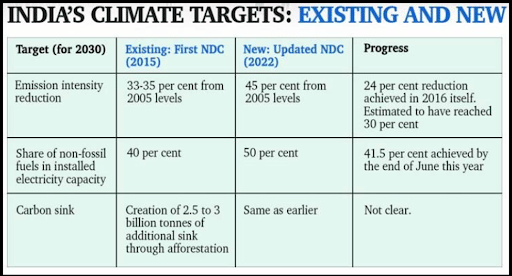
- India has vowed to cut its emissions intensity by 45% by 2030, compared to 2005 levels.
- The objective of lowering emissions intensity and increasing energy efficiency is not sectoral.
- Status: By 2020, India claimed to have attained 21% of its emissions intensity as a percentage of GDP, in accordance with its promise.
- Share of non-fossil-based energy: India intends to reach around 50% of total installed electric power capacity from non-fossil fuel-based energy resources by 2030.
- India intends to attain this goal through low-cost foreign financing, notably the Green Climate Fund (GCF).
- GCF: It was established as part of the Paris Agreement to assist developing nations in meeting their Nationally Determined Contributions and working to reduce emissions. It is the largest climate fund in the world.
- Sustainable living: To address climate change, India will encourage sustainable living based on traditions, conservation, and moderation.
- LIFE: It has sparked a worldwide movement for "LIFE" - a sustainable existence. LIFE is a public campaign that urges people to support the environment.
Other contributions
- Choosing a more sustainable route for economic growth
- Increasing forest and tree cover to create extra carbon sinks of 5 to 3 billion tonnes of CO2 equivalent.
- Adapting to climate change through increasing investments in vulnerable sectors' development schemes
- Obtaining financing from wealthy nations in order to carry out improved mitigation and adaptation measures
- Creating an architectural framework for rapid solutions and improved climate technology research and development.
| Other Relevant Links | |
|---|---|
| Net Zero Pledges | Carbon Leakage |
| Karakoram Anomaly | HPCL - Cow Dung to Compressed Biogas Project |
| Triple Planetary Crisis | Arctic Amplification |
| CO2 Equivalent | Carbon Dioxide Levels -Keeling Curve |
| Panchamrit | India's GreenHouse Gas Emissions |
| UNEP Production Gap Report | UN World Water Conference |
| Global Alliance for Industry Decarbonisation | Green Coal |
Updated NDCs - Significance
- The updated Nationally Determined Contributions (NDCs) seek to boost India's contributions to the Paris Agreement's goal of enhancing global response to the threat of climate change.
- NDCs represent each country's efforts to decrease national emissions and adapt to the effects of climate change.
- Such measures would also assist India in ushering in low-emission growth paths.
- New NDCs will indicate India's greatest degree of commitment to decoupling economic growth from greenhouse gas emissions.
- As a result of the increased NDCs, Indian Railways' Net Zero objective by 2030 would reduce emissions by 60 million tonnes per year.
Climate Change Initiatives in India
- Transport Sector Reforms: With the Faster Adoption and Manufacturing of (Hybrid &) Electric Vehicles Scheme, India is hastening its e-mobility transition.
- A voluntary car scrapping policy to phase out old and inoperable automobiles supplements current programmes.
- India's EV Support: India is one of a few nations that back the worldwide EV30@30 campaign, which aspires for at least 30% of new vehicle sales to be electric by 2030.
- India's "Panchamrit" support of five factors for climate change at the UNFCCC COP26 in Glasgow is a commitment to the same.
- The Role of Industries in the Low-Carbon Transition: India's public and private sectors are already playing critical roles in addressing the climate crisis, aided by increased consumer and investor awareness, as well as increased regulatory and transparency obligations.
- Hydrogen Energy Mission: Focus on producing hydrogen using renewable energy sources.
- PAT (Perform, Achieve, and Trade): It is a market-based system for increasing and incentivizing energy efficiency in major energy-intensive enterprises.
Conclusion
The Union Cabinet has accepted India's Nationally Determined Contribution (NDC) to the UNFCCC, which is an update to its initial NDC, which was filed on October 2, 2015. NDCs are submitted to the United Nations Framework Convention on Climate Change (UNFCCC) secretariat every five years. In August 2022, India formally amended its NDC to the UNFCCC, which was accepted by the Union Cabinet. The amended NDC is a step closer to India's aim of reaching net-zero emissions by 2070.
FAQs
Question. What are Nationally Determined Contributions (NDCs)?
Answer: NDCs are country-specific climate action plans that outline the efforts each nation will undertake to reduce greenhouse gas emissions and combat climate change. These commitments are a key part of the Paris Agreement.
Question. Why are NDCs important in the fight against climate change?
Answer: NDCs serve as the framework for global cooperation on climate change mitigation. They represent the commitment of countries to limit global warming and contribute to achieving the targets of the Paris Agreement.
Question. How often should countries update their NDCs under the Paris Agreement?
Answer: Countries are required to update their NDCs every five years, with each update reflecting increased ambition compared to previous submissions, aiming to limit global temperature rise to well below 2°C, preferably to 1.5°C.
Question. What is the role of the UNFCCC in relation to NDCs?
Answer: The United Nations Framework Convention on Climate Change (UNFCCC) is responsible for tracking and reviewing the progress of NDCs submitted by countries, ensuring transparency and accountability in global climate action.
Question. What challenges do countries face in enhancing their NDCs?
Answer: Some of the key challenges include financial constraints, lack of technology, political resistance, and the need for international cooperation. Many developing countries also face challenges in balancing economic growth with environmental sustainability.
MCQs
- What does NDC stand for in the context of climate change?
A) Nationally Defined Contributions
B) Nationally Determined Contributions
C) National Development Cooperation
D) Non-Domestic Commitments
Answer: (B) See the Explanation
NDCs refer to the climate action commitments made by countries under the Paris Agreement. Each country determines how it will contribute to limiting global warming and reducing emissions.
- Which of the following is the main objective of the Paris Agreement?
A) To prevent deforestation
B) To achieve carbon neutrality by 2050
C) To limit global temperature rise to below 2°C, aiming for 1.5°C
D) To increase global agricultural production
Answer: (C) See the Explanation
The Paris Agreement aims to limit global temperature rise and prevent dangerous climate change impacts, with a target of keeping the rise well below 2°C, and ideally limiting it to 1.5°C.
- Which organization tracks the progress of countries’ NDCs?
A) WHO
B) UNFCCC
C) UNEP
D) IPCC
Answer: (B) See the Explanation
The United Nations Framework Convention on Climate Change (UNFCCC) tracks and reviews the NDCs submitted by countries under the Paris Agreement, ensuring transparency and accountability in global climate efforts.
- What is the purpose of updating NDCs every five years?
A) To keep track of national development
B) To ensure increasing ambition in climate action
C) To adjust financial contributions
D) To maintain environmental standards
Answer: (B) See the Explanation
The periodic update of NDCs every five years is designed to raise the level of ambition in combating climate change, ensuring that each country's actions become more robust in line with the evolving scientific understanding of climate change.
- Which of the following is a key challenge in enhancing the ambition of NDCs for developing countries?
A) Technological innovation
B) High emissions from developed countries
C) Limited financial resources
D) International political agreements
Answer: (C) See the Explanation
Developing countries often face financial constraints when it comes to enhancing their NDCs. They require financial support and technology transfer from developed countries to meet their climate goals.
GS Mains Questions and Model Answers
Q1: Discuss the significance of Nationally Determined Contributions (NDCs) in the context of international climate change agreements. What challenges do countries face in enhancing their NDCs?
Answer: Nationally Determined Contributions (NDCs) are central to the Paris Agreement, representing the pledges made by countries to reduce greenhouse gas emissions and mitigate climate change. They are significant because they reflect national-level commitments to global climate targets, particularly the goal of limiting global warming to well below 2°C, preferably to 1.5°C.
However, countries face several challenges in enhancing their NDCs, including financial constraints, the need for technology transfer, political resistance, and the ongoing balance between economic development and environmental sustainability. For developing nations, the issue of capacity-building and access to climate finance is crucial. Strengthening global cooperation and increasing financial and technological support are vital to overcoming these challenges.
Q2: Evaluate India’s role in enhancing its NDCs under the Paris Agreement. How can India meet its climate commitments while balancing developmental priorities?
Answer: India, as a developing country, faces a unique challenge in enhancing its NDCs while ensuring its socio-economic development. India's NDCs include targets for reducing the carbon intensity of its GDP, increasing the share of renewable energy in its energy mix, and enhancing the forest cover.
The challenge lies in balancing these commitments with the need for economic growth and poverty reduction. India’s large population and reliance on fossil fuels for energy make the transition to a low-carbon economy complex. However, through technological innovation, energy efficiency measures, and international cooperation, India can progressively increase its climate ambition. Financial support from developed countries will be crucial to meeting its targets while ensuring equitable growth.
Q3: What role does international climate finance play in achieving the targets set by countries under the Paris Agreement?
Answer: International climate finance plays a critical role in helping developing countries achieve the targets set under the Paris Agreement. These countries often lack the financial resources and technological capacity to implement ambitious climate action plans. The provision of financial assistance, technology transfer, and capacity-building from developed nations is essential to bridge this gap.
The Green Climate Fund (GCF) is one such mechanism that helps direct funds to the most vulnerable countries. Effective use of climate finance will not only support the achievement of NDCs but also ensure that developing countries can transition to low-carbon economies while adapting to the inevitable impacts of climate change.
Previous Year Questions on NDCs
1. UPSC CSE 2019
Question: "What are the key elements of the Paris Agreement?"
Answer: The Paris Agreement primarily aims to limit global warming to below 2°C, with efforts to limit the rise to 1.5°C. It also emphasizes transparency, accountability, climate finance, and adaptation measures for vulnerable countries.
2. UPSC CSE 2020
Question: "Discuss the implications of the United Nations Framework Convention on Climate Change (UNFCCC) and the Paris Agreement on global climate governance."
Answer: The UNFCCC and the Paris Agreement have played a significant role in global climate governance by fostering international cooperation. The Paris Agreement introduced the concept of Nationally Determined Contributions (NDCs) and established a framework for accountability and financial support. The challenge lies in balancing the varying priorities of developed and developing countries while ensuring meaningful progress towards reducing global emissions.
Download the PREPP App and attempt FREE IAS Exam Mock Tests and get complete study material!

Full Test - 04: UPSC CSE Prelims CSAT (Paper-II)
Full Test - 03: UPSC CSE Prelims CSAT (Paper-II)
UPSC CSE Prelims 2026 GS Paper 1 Question Paper (24-May-2026)
UPSC CSE Prelims 2026 CSAT Paper 2 Question Paper (24-May-2026)

17 February 2025 | The Hindu Must Read Articles | Current Affairs

16 February 2026 | The Hindu Must Read Articles | Current Affairs

13 February 2026 | The Hindu Must Read Articles | Current Affairs









Comments