Panchamrit - Environment Notes
India recently set new climate objectives as part of its 'Panchamrit strategy' at COP26. It has made a major step towards reaffirming its commitment to sustainable energy and informing the world about its future strategy for combating climate change. The five-pronged policy to combat climate change, dubbed Panchamrit, was revealed by the Indian Prime Minister during the COP26 summit in Glasgow. A goal year for attaining Net Zero is also included in the strategy. This article explains about the Panchamrit which is important for UPSC IAS exam preparation.
Table of Contents
What is Panchamrit strategy?
- India's Updated Nationally Determined Contribution has been accepted by the Union Cabinet for submission to the United Nations Framework Convention on Climate Change.
- The Updated NDC aims to increase India's contributions to the Paris Agreement's goal of strengthening the global response to the challenge of climate change.
- This update transforms PM's 'Panchamrit,' or five-point plan, outlined at COP26 into improved climate objectives.
- The Indian Prime Minister made the world recognise India's leadership initiative-building capacity by launching the 'Panchamrit' plan at the COP 26 meeting.
- The Panchamrit programme is essentially a technique that India would use to maintain the global temperature far below 1.5 degrees Celsius.
| Other Relevant Links | |
|---|---|
| Net Zero Pledges | Carbon Leakage |
| Karakoram Anomaly | HPCL - Cow Dung to Compressed Biogas Project |
| Triple Planetary Crisis | Arctic Amplification |
| CO2 Equivalent | Carbon Dioxide Levels -Keeling Curve |
| Updated NDCs | India's GreenHouse Gas Emissions |
| UNEP Production Gap Report | UN World Water Conference |
| Global Alliance for Industry Decarbonisation | Green Coal |
New climate targets have been pledged by India at COP26
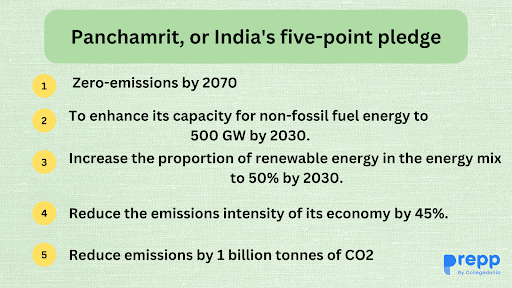
- At the Glasgow climate change conference, India made five major announcements:
- First, by 2030, India will boost its non-fossil energy capacity to 500GW (it had previously increased its objective to 450GW, of which 100GW is already installed).
- Second, by 2030, India will have met 50% of its energy needs using renewable energy.
- Renewable energy sources differ from non-fossil energy sources. Scalable nuclear power and hydroelectricity are additional non-fossil sources.
- Third, from now until 2030, India will cut overall anticipated carbon emissions by one billion tonnes.
- Fourth, by 2030, India will have reduced its carbon intensity by 45%.
- India has reduced its emission intensity by 25% between 2005 and 2016, and it is on track to reduce it by more than 40% by 2030.
- Fifth, India will reach the Net Zero objective by 2070.
India’s efforts at present
- India's renewable energy capacity is now ranked fourth in the world and is rapidly expanding.
- In the previous four years, India's renewable energy capacity has increased by roughly 25%.
- Indian railroads, one of the top polluters, has pledged to achieve net-zero emissions by 2030, which will save 60 million tonnes of CO2.
- India has established worldwide climate action organisations such as the worldwide Solar Alliance (ISA) and the Coalition for Disaster Resilient Infrastructure (CDRI).
- India, the United Kingdom, and Australia will establish the Infrastructure for Resilient Island States (IRIS) for island states and poor countries.
- India will also take part in the launch of the Green Grids Initiative.
Conference of Parties 26 (COP26)
- The COP26 conference brought together parties to accelerate action towards the Paris Agreement and the UN Framework Convention on Climate Change (UNFCCC) goals.
- The conference started with a bang but finished on a more sombre note. Regardless, it made some progress, but considerably less than was required.
- The summit had to cope with the troubling prospect that the globe will be almost +3°C warmer by the end of the century, exceeding the 2015 Paris Agreement target of "well below 2°C" and ideally 1.5°C over pre-industrial levels.
- The Global Methane Pledge, signed by 103 nations, including 15 major polluters, intends to reduce methane emissions by 30% by 2030 compared to 2020 levels. Methane, one of the most powerful greenhouse gases, is responsible for one-third of current human-caused warming.
- The world's three greatest polluters, wealthy countries, and probably India, have yet to play a significantly greater part in this global crisis of climate change.
Conclusion
The Union Cabinet has approved India's updated Nationally Determined Contribution to be notified to the United Nations Framework Convention on Climate Change. The updated NDC aims to increase India's contributions to the Paris Agreement's goal of strengthening global response to the threat of climate change. This update transforms PM Modi's 'Panchamrit,' or five-point plan, unveiled at COP26 into more ambitious climate ambitions.
FAQs
Question: What is Panchamrit in the context of climate change?
Answer: Panchamrit refers to the five key climate commitments made by India during the COP26 summit in 2021 to combat climate change and reduce carbon emissions.
Question: What are the key components of Panchamrit?
Answer: The five key components of Panchamrit include increasing renewable energy capacity to 500 GW by 2030, meeting 50% of energy needs from renewables, reducing carbon emissions by 1 billion tonnes, reducing carbon intensity by 45%, and achieving Net Zero by 2070.
Question: By when does India aim to achieve Net Zero emissions?
Answer: India has committed to achieving Net Zero emissions by the year 2070.
Question: How does Panchamrit contribute to reducing carbon emissions?
Answer: Panchamrit contributes by increasing the use of renewable energy, reducing carbon intensity, enhancing energy efficiency, and promoting sustainable practices to lower emissions.
Question: What are the challenges India faces in achieving the Panchamrit goals?
Answer: Key challenges include securing green financing, transitioning to renewable energy, promoting technological innovation, and managing the socio-economic impacts of moving away from fossil fuels.
MCQs
1. Under the Panchamrit goals, by what year does India plan to achieve Net Zero emissions?
A) 2050
B) 2060
C) 2070
D) 2080
Answer: (C) See the Explanation
Explanation: India has committed to achieving Net Zero emissions by 2070 as part of its climate commitments outlined during COP26.
2. What is the target for India's non-fossil energy capacity under Panchamrit by 2030?
A) 300 GW
B) 500 GW
C) 750 GW
D) 1000 GW
Answer: (B) See the Explanation
Explanation: India has set a target to increase its non-fossil energy capacity to 500 GW by 2030.
3. By what percentage does India aim to reduce its carbon intensity by 2030 under the Panchamrit initiative?
A) 35%
B) 45%
C) 50%
D) 55%
Answer: (B) See the Explanation
Explanation: India aims to reduce its carbon intensity by 45% by 2030 compared to 2005 levels.
4. How much reduction in projected carbon emissions has India pledged by 2030 under Panchamrit?
A) 500 million tonnes
B) 750 million tonnes
C) 1 billion tonnes
D) 1.5 billion tonnes
Answer: (C) See the Explanation
Explanation: India has pledged to reduce its projected carbon emissions by 1 billion tonnes by 2030 under the Panchamrit initiative.
5. What is the goal for India’s energy needs to be met by renewable sources under Panchamrit by 2030?
A) 25%
B) 40%
C) 50%
D) 60%
Answer: (C) See the Explanation
Explanation: Under Panchamrit, India aims to meet 50% of its energy needs from renewable energy sources by 2030.
GS Mains Questions and Model Answers
Q1: Discuss the significance of India's Panchamrit commitments made during COP26 in addressing global climate change.
Answer: India’s Panchamrit commitments, made during the COP26 Climate Change Conference, represent a significant step in the global fight against climate change. By committing to a Net Zero target by 2070, increasing renewable energy capacity to 500 GW, and reducing carbon intensity by 45%, India is taking a leadership role among developing nations. These goals align with the principles of sustainable development, balancing economic growth with environmental responsibility. India’s commitments are also aligned with the Paris Agreement and signal its intention to be a key player in global climate negotiations. However, achieving these targets will require significant investment in renewable energy, green technologies, and policy reforms.
Q2: Analyze the challenges India faces in achieving the Panchamrit targets by 2030.
Answer: India faces several challenges in achieving the Panchamrit targets by 2030. First, there is a need for substantial investment in renewable energy infrastructure and the development of technologies like energy storage and grid management. Additionally, securing green financing from international sources is crucial to support large-scale projects. Another major challenge is the just transition for communities reliant on coal and other fossil fuels, as moving towards renewables may lead to job losses in these sectors. Moreover, addressing energy intermittency and maintaining a stable energy supply while increasing the share of renewables will require technological innovation and effective policymaking.
Q3: Evaluate the role of international cooperation and green financing in helping India achieve its Panchamrit climate goals.
Answer: International cooperation and green financing will play a critical role in helping India achieve its Panchamrit climate goals. India’s transition to a low-carbon economy will require significant funding, and partnerships with international organizations and countries can provide both the financial resources and technical expertise needed to expand renewable energy infrastructure. Initiatives such as the Green Climate Fund and bilateral agreements on climate technology can help India access affordable financing for projects related to solar energy, wind power, and sustainable agriculture. Moreover, technology transfer and collaboration in research and development can accelerate the deployment of innovative solutions like carbon capture and energy storage, essential for meeting India’s climate targets.
Previous Year Questions on Panchamrit
1. UPSC CSE Prelims 2021
Question: Which of the following is part of India's Panchamrit initiative?
A) Achieving carbon neutrality by 2050
B) Reducing projected carbon emissions by 1 billion tonnes by 2030
C) Meeting 100% energy needs from renewables by 2040
D) Phasing out coal by 2030
Answer: B
Explanation: Under the Panchamrit initiative, India has committed to reducing projected carbon emissions by 1 billion tonnes by 2030. The initiative also includes other significant targets, such as achieving Net Zero by 2070 and increasing the share of renewable energy.
2. UPSC CSE Mains 2020 (GS Paper 3)
Question: How can India’s Panchamrit commitments contribute to global climate change mitigation efforts? Discuss the potential challenges in implementing these commitments.
Answer: India’s Panchamrit commitments are crucial for global climate change mitigation, as India is the third-largest emitter of greenhouse gases. By focusing on increasing renewable energy capacity and reducing carbon intensity, India contributes to reducing global emissions and promoting sustainable development. These commitments align with the Paris Agreement goals and demonstrate India’s willingness to act on climate change. However, implementation challenges include securing green financing, overcoming technological barriers, and ensuring that the transition is socially and economically just. The government will need to invest heavily in renewable infrastructure and policies to ensure that these ambitious targets are met.
Download the PREPP App and attempt FREE IAS Exam Mock Tests and get complete study material!

Full Test - 04: UPSC CSE Prelims CSAT (Paper-II)
Full Test - 03: UPSC CSE Prelims CSAT (Paper-II)
UPSC CSE Prelims 2026 GS Paper 1 Question Paper (24-May-2026)
UPSC CSE Prelims 2026 CSAT Paper 2 Question Paper (24-May-2026)

17 February 2025 | The Hindu Must Read Articles | Current Affairs

16 February 2026 | The Hindu Must Read Articles | Current Affairs

13 February 2026 | The Hindu Must Read Articles | Current Affairs









Comments