EMIT Mission - Environment Notes
EMIT (Earth Surface Mineral Dust Source Investigation) was created by NASA to assist experts in understanding how dust influences climate. It can also identify the source of the dangerous carbon gas. The Earth Surface Mineral Dust Source Investigation (EMIT) project of NASA is mapping the distribution of important minerals in the planet's dust-producing deserts. This is critical knowledge that will help us comprehend the effects of airborne dust on climate. This article explains that the EMIT Mission is important for UPSC IAS exam preparation.
Table of Contents
EMIT Mission
- NASA's Earth Surface Mineral Dust Source Investigation instrument, or EMIT, has aided scientists from the National Aeronautics and Space Administration (NASA) in identifying methane in the Earth's atmosphere.
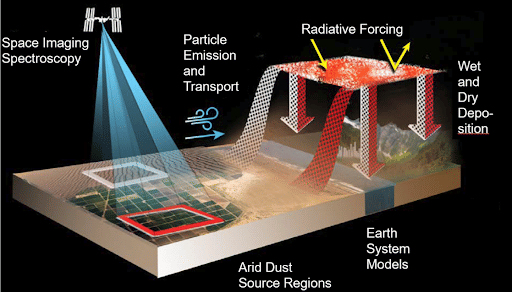
- The Earth Surface Mineral Dust Source Investigation (EMIT) is an Earth Ventures-Instrument (EVI-4) Mission that uses imaging spectroscopy in the visible and short-wave infrared ranges to characterise the mineral makeup of arid dust source areas.
- The source area maps are used to simulate the function of mineral dust in radiative forcing (warming or cooling) of the atmosphere. From outside the International Space Station, the device watches Earth.
- In July 2022, EMIT was deployed on the International Space Station. It has since been tracking the chemical makeup of dust in the world's regions.
- It is capable of focusing on regions as tiny as a football pitch.
- EMIT was created to investigate how pollution affects temperature. However, it has proven another critical capability: the detection of methane, a powerful greenhouse gas in the Earth's atmosphere.
EMIT Mission - Objectives
- To collect remote-sensing measurements of the abundance of surface minerals — specifically, hematite, goethite, illite, vermiculite, calcite, dolomite, montmorillonite, kaolinite, chlorite, and gypsum — in arid regions of Africa, Asia, North America, South America, and Australia between 50 degrees south and north latitudes.
- To provide a more accurate evaluation of mineral dust's heating and cooling impacts in the Earth's atmosphere.
- Improve forecasts of how future climate situations may affect the quantity and type of mineral dust released into the Earth's atmosphere.
Conclusion
NASA developed EMIT (Earth Surface Mineral Dust Source Investigation) to help specialists comprehend how dust affects climate. It would also help the Paris Agreement's goal of limiting world average temperature rise to 1.5°C. Restricting methane pollution is critical to restricting global warming. EMIT's latest discovery will help academics better identify methane breaches and provide insight into how to resolve them swiftly.
FAQs
Question: What is the EMIT Mission?
Answer: The EMIT (Earth Mineral Inventory and Tracking) Mission is a NASA-led initiative aimed at studying mineral dust emissions from Earth's deserts and their impact on climate, air quality, and ecosystems.
Question: What are the objectives of the EMIT Mission?
Answer: The mission seeks to analyze how mineral dust influences climate patterns, measure its effects on radiative forcing, and understand its role in carbon cycling and ocean fertilization.
Question: How does the EMIT Mission collect data?
Answer: EMIT uses an advanced imaging spectrometer mounted on the International Space Station (ISS) to capture high-resolution data on mineral composition and distribution on Earth’s surface.
Question: Why is mineral dust important in climate studies?
Answer: Mineral dust impacts the Earth's energy balance by either absorbing or reflecting sunlight. It also affects cloud formation, air quality, and nutrient deposition in oceans and forests.
Question: How does the EMIT Mission contribute to environmental policies?
Answer: The mission provides precise data on dust emissions, enabling better climate models and informed decision-making for policies addressing air quality, land use, and climate change.
MCQs
1. What does the acronym EMIT stand for?
A) Earth Monitoring and Impact Tracking
B) Earth Mineral Inventory and Tracking
C) Environmental Mapping for Impactful Trends
D) Ecosystem Monitoring and Integrated Technology
Answer: (B) See the Explanation
EMIT stands for Earth Mineral Inventory and Tracking, a mission designed to study mineral dust emissions and their impact on the environment.
2. Where is the imaging spectrometer of the EMIT Mission located?
A) Earth’s surface
B) International Space Station (ISS)
C) Low-Earth orbit satellite
D) Geostationary satellite
Answer: (B) See the Explanation
The EMIT Mission uses an imaging spectrometer mounted on the International Space Station (ISS) to collect high-resolution data on mineral dust.
3. How does mineral dust affect the Earth’s energy balance?
A) It traps carbon dioxide
B) It absorbs or reflects sunlight
C) It causes ocean acidification
D) It depletes ozone layers
Answer: (B) See the Explanation
Mineral dust affects Earth’s energy balance by absorbing or reflecting sunlight, influencing the climate system and temperature patterns.
4. Which organization is responsible for the EMIT Mission?
A) ESA
B) NASA
C) ISRO
D) NOAA
Answer: (B) See the Explanation
The EMIT Mission is a NASA-led initiative aimed at studying mineral dust emissions and their environmental impacts.
5. What is a key environmental role of mineral dust studied in the EMIT Mission?
A) Increasing forest carbon absorption
B) Fertilizing oceans with nutrients
C) Depleting ozone concentrations
D) Increasing greenhouse gas emissions
Answer: (B) See the Explanation
Mineral dust fertilizes oceans with nutrients like iron, promoting phytoplankton growth and supporting marine ecosystems, as studied in the EMIT Mission.
GS Mains Questions and Model Answers
Q1: Discuss the significance of the EMIT Mission in understanding climate dynamics.
Answer: The EMIT Mission plays a critical role in understanding climate dynamics by studying mineral dust emissions from Earth's deserts. Dust particles affect the Earth’s energy balance, cloud formation, and atmospheric chemistry by either reflecting or absorbing sunlight. The mission provides high-resolution data on dust composition and distribution using an imaging spectrometer. Insights from the EMIT Mission contribute to refining climate models and understanding carbon cycling and nutrient deposition in ecosystems. By addressing gaps in dust-related climate research, EMIT aids in devising policies for climate mitigation and sustainable development.
Q2: Evaluate the environmental implications of mineral dust emissions as studied under the EMIT Mission.
Answer: Mineral dust emissions have significant environmental implications. They influence radiative forcing, affect air quality, and fertilize oceans with nutrients like iron, promoting marine productivity. However, excessive dust can degrade ecosystems and harm human health by increasing particulate matter in the air. The EMIT Mission, through its precise data collection, highlights the dual role of dust as a climate regulator and a pollutant. This research aids in developing strategies for sustainable land use, mitigating dust storms, and addressing climate change challenges, making it an essential step in global environmental management.
Q3: How can data from the EMIT Mission influence global climate policies?
Answer: Data from the EMIT Mission can significantly influence global climate policies by improving climate models and understanding the role of mineral dust in atmospheric processes. Precise data on dust emissions, composition, and distribution enable targeted actions to mitigate climate impacts, such as reducing air pollution and enhancing carbon sequestration strategies. The mission’s insights support international agreements like the Paris Accord by providing actionable information for climate adaptation and mitigation. By bridging knowledge gaps, EMIT empowers policymakers to make informed decisions on land use, air quality, and sustainable development.
Previous Year Questions on Environmental Missions
1. UPSC CSE Prelims 2021:
Question: Which of the following is a key focus area of the EMIT Mission?
A) Monitoring deforestation
B) Studying mineral dust emissions
C) Mapping ocean currents
D) Tracking polar ice melting
Answer: (B)
The EMIT Mission focuses on studying mineral dust emissions and their impact on climate, ecosystems, and air quality using advanced imaging technologies.
2. UPSC CSE Mains 2020:
Question: Discuss the role of space missions like EMIT in addressing global environmental challenges.
Answer: Space missions like EMIT play a crucial role in addressing global environmental challenges by providing high-resolution data on key factors like mineral dust emissions, atmospheric chemistry, and climate dynamics. EMIT aids in understanding the dual role of dust as a climate regulator and pollutant, contributing to better climate models and sustainable policies. Such missions enhance international cooperation on climate change mitigation and adaptation strategies.
Download the PREPP App and attempt FREE IAS Exam Mock Tests and get complete study material!
UPSC IAS : CSAT - Mini Live Test

Live Test : UPSC CSE Prelims CSAT (Paper-II) (Oct 20 - 23)
Full Test - 04: UPSC CSE Prelims CSAT (Paper-II)
Full Test - 03: UPSC CSE Prelims CSAT (Paper-II)
UPSC CSE Prelims 2026 GS Paper 1 Question Paper (24-May-2026)
UPSC CSE Prelims 2026 CSAT Paper 2 Question Paper (24-May-2026)

17 February 2025 | The Hindu Must Read Articles | Current Affairs

16 February 2026 | The Hindu Must Read Articles | Current Affairs

13 February 2026 | The Hindu Must Read Articles | Current Affairs









Comments