Biomethanation - Environment Notes
Biomethanation is the microbiologic conversion of organic substance to biogas under anaerobic circumstances. Fermenting bacteria, organic acid oxidising bacteria, and methanogenic archaea are the three major physiological categories of microorganisms involved. Biomethanation has a high capacity for producing energy from organic wastes and leftovers. It will aid in reducing the use of natural fuels and thus CO(2) emissions. This article explains about Biomethanation, which is important for UPSC IAS exam preparation.
Table of Contents
Biomethanation
- Biomethanation is the microbiologic conversion of organic substance to biogas under anaerobic circumstances.
- Fermenting bacteria, organic acid oxidising bacteria, and methanogenic archaea are the three major physiological categories of microorganisms involved.
- In this process, the organic portion of refuse is separated and put into a confined receptacle (Biogas digester) where it experiences bio-degradation in the presence of methanogenic bacteria and under anaerobic circumstances, creating methane-rich biogas and effluent.
- Biogas is primarily composed of methane and carbon dioxide.
- Biogas can be used for cooking and warmth, or it can be used to generate motive power or energy via dual-fuel, gas engines, low pressure gas turbines or steam turbines.
- After stabilisation, anaerobic digestion sludge can be used as a soil conditioner or as manure, based on its makeup, which is primarily decided by the structure of the incoming refuse.
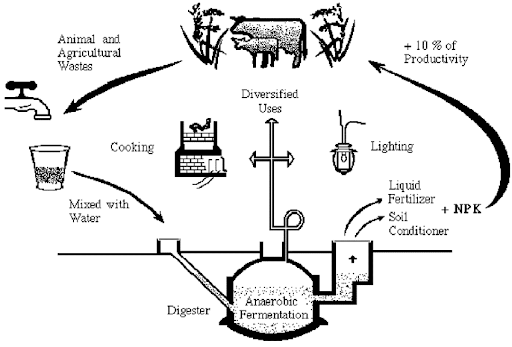
- Industrial organic waste-to-energy bio-methanation projects are typically capital demanding and monetarily susceptible to both running expenses and income, including refuse supply.
- Such projects' innovations aim to improve total energy production while lowering energy generation costs.
- In collaboration with the United Nations Industrial Development Organization (UNIDO) and the Global Environment Facility (GEF), the Ministry of New and Renewable Energy (MNRE) has introduced a loan interest subvention plan to provide financial help for creative waste-to-energy biomethanation projects.
Biomethanation - Process
- Organic matter is degraded by microorganisms through a series of metabolic transformations to methane and carbon dioxide.
- The process is dependent on syntrophic interactions between hydrogen makers (acetogens) and hydrogen scavengers (homoacetogens, hydrogenotrophic methanogens, etc.).
- A broad range of biomethanation process applications for wastewaters, slurries, and solid waste have been created.
- They use various reactor types and process circumstances (retention periods, loading rates, temperatures, and so on) to maximise waste energy production while also reducing retention time and improving process stability.
Biomethanation - Advantages
- Production of gaseous fuel.
- It is feasible on a modest basis.
- Unlike aerobic therapy, there is no need for external electricity.
- The enclosed system allows all of the gas generated to be gathered and used. Greenhouse gas emissions.
- No emissions are released into the environment.
- Free of foul odours, rodent and fly infestations, obvious waste, and societal opposition.
- Plant modularization and confined treatment require less ground area; and
- Biogas and high-quality soil conditioner production.
Biomethanation - Disadvantages
- Pathogenic organisms may be destroyed less effectively in digesters operating at mesophilic temps than in aerobic composting.
- There are, however, several digester devices that work at high thermophilic temps.
- It requires more money than recycling and landfill.
- Not appropriate for materials with a low Biodegradability.
Issues of Biomethanation
- In the nation, waste-to-energy is still a relatively new idea.
- Most established and profitable urban garbage technologies must be imported.
- The costs of projects, particularly those based on biomethanation technology, are expensive because essential tools for a project must be imported.
- Due to Municipal Corporations/Urban Local Bodies' poor level of conformance with MSW Rules 2000, separated municipal solid refuse is usually not accessible at the plant location, which may result in the non-availability of waste-to-energy plants.
- Municipal Corporations/Urban Local Bodies lack cash means.
- Lack of favourable policy guidelines from state governments in terms of land allocation, garbage supply, and electricity buy / evacuation facilities.
Way Forward
- The underdeveloped condition of waste handling in India motivates the study of environmentally favourable processes such as biomethanation and bioremediation.
- The installation of biogas plants at various research institutes in India, such as the Sardar Patel Renewable Energy Research Institute (SPRERI) in Gujarat, the Biogas Plant at Trombay, the Appropriate Rural Technology Institute (ARTI) in Pune, and the Bhabha Atomic Research Centre (BARC) in Mumbai, practise full-fledged biomethanation and yield a high rate of biogas fuel from waste materials.
- The methane generated is safe, cost-effective, and can be used commercially.
- However, the government should spend more on this technology so that it spreads to municipal governments.
Conclusion
Biomethanation is the anaerobic microbiologic change of organic substances to methane. The three main physiological groups of microorganisms involved are fermenting bacteria, organic acid oxidising bacteria, and methanogenic archaea. It has the ability to generate approximately 1700 MW of electricity from urban and local refuse, as well as approximately 1000 MW from industrial waste in the nation. With economic growth, the potential is expected to grow even more.
FAQs
Question: What is biomethanation?
Answer: Biomethanation is the biological process in which organic matter, such as agricultural waste, animal manure, and food waste, is converted into biogas (primarily methane and carbon dioxide) by microorganisms in an anaerobic environment. This process is commonly used for waste treatment and energy generation, offering a sustainable solution for managing organic waste and reducing greenhouse gas emissions.
Question: What are the benefits of biomethanation for the environment?
Answer: Biomethanation helps in waste management by converting organic waste into valuable biogas, which can be used as a renewable source of energy. This process reduces the reliance on fossil fuels, lowers greenhouse gas emissions, and decreases the volume of waste sent to landfills. Additionally, it reduces the release of methane from landfills, a potent greenhouse gas, contributing to climate change mitigation.
Question: How does biomethanation contribute to renewable energy generation?
Answer: Biomethanation produces biogas, a renewable energy source composed mainly of methane, which can be used for electricity generation, cooking, and heating. By harnessing organic waste for biogas production, biomethanation provides an alternative to conventional energy sources like coal and natural gas, supporting sustainable energy systems and reducing dependence on fossil fuels.
Question: What types of waste are suitable for biomethanation?
Answer: Biomethanation is effective for a variety of organic waste materials, including food waste, agricultural residues, livestock manure, sewage sludge, and biodegradable municipal solid waste. These materials contain organic compounds that can be broken down by microbes in anaerobic conditions to produce biogas.
Question: How is biomethanation implemented in waste management systems?
Answer: Biomethanation is implemented in waste management systems through anaerobic digestion, where organic waste is placed in digesters that create an oxygen-free environment for microbial activity. The digested organic matter is broken down into biogas, and the remaining material, known as digestate, can be used as a nutrient-rich fertilizer. This system is widely used in agricultural, municipal, and industrial settings to manage organic waste sustainably.
MCQs
1. What is the primary product of the biomethanation process?
A) Oxygen
B) Carbon dioxide
C) Methane
D) Nitrous oxide
Answer: (C) See the Explanation
Explanation: The primary product of biomethanation is biogas, which consists mainly of methane (CH4), a renewable energy source that can be used for electricity generation, cooking, and heating.
2. Which of the following is a key environmental benefit of biomethanation?
A) Decreases water pollution
B) Reduces greenhouse gas emissions
C) Increases waste volume
D) Produces solid waste
Answer: (B) See the Explanation
Explanation: Biomethanation reduces greenhouse gas emissions by converting organic waste into biogas, thus preventing the release of methane from landfills, a potent greenhouse gas.
3. Which of the following is NOT a suitable waste for biomethanation?
A) Agricultural waste
B) Animal manure
C) Plastic waste
D) Food waste
Answer: (C) See the Explanation
Explanation: Biomethanation is effective for biodegradable organic waste such as agricultural residues, animal manure, and food waste. However, plastic waste is non-biodegradable and is not suitable for biomethanation.
4. What is the remaining material called after the biomethanation process?
A) Biomass
B) Sludge
C) Digestate
D) Ash
Answer: (C) See the Explanation
Explanation: The remaining material after biomethanation is called digestate, which is a nutrient-rich by-product that can be used as organic fertilizer for agriculture.
5. What is the role of anaerobic digestion in biomethanation?
A) Provides oxygen for microbial activity
B) Converts organic matter into biogas without oxygen
C) Removes toxic substances from the waste
D) Increases the volume of waste
Answer: (B) See the Explanation
Explanation: Anaerobic digestion is a key process in biomethanation, where organic matter is broken down by microorganisms in the absence of oxygen to produce biogas, a renewable energy source.
GS Mains Questions and Model Answers
Q1: Discuss the role of biomethanation in sustainable waste management.
Answer: Biomethanation plays a significant role in sustainable waste management by converting organic waste into biogas, a renewable energy source, while simultaneously reducing the environmental impact of waste. Through the anaerobic digestion process, waste is broken down in the absence of oxygen, resulting in the production of methane and carbon dioxide, which can be used for energy generation. This process reduces the volume of waste sent to landfills, lowers methane emissions, and promotes the recycling of organic materials. Biomethanation contributes to a circular economy by utilizing waste to produce valuable resources like energy and organic fertilizer (digestate).
Q2: How does biomethanation contribute to reducing greenhouse gas emissions?
Answer: Biomethanation helps reduce greenhouse gas emissions by converting organic waste into biogas, thereby preventing methane, a potent greenhouse gas, from being released into the atmosphere through landfills. Landfills are major sources of methane emissions due to the anaerobic decomposition of organic waste. By capturing methane and using it as an energy source, biomethanation not only mitigates the greenhouse effect but also helps lower the reliance on fossil fuels, contributing to climate change mitigation efforts and promoting sustainable energy practices.
Q3: What are the economic and environmental advantages of using biomethanation for waste-to-energy projects?
Answer: Biomethanation offers both economic and environmental advantages. Economically, it generates biogas that can be used as a renewable energy source for electricity, heating, and cooking, which can reduce energy costs and reliance on conventional fossil fuels. Additionally, it produces digestate, a by-product that can be used as organic fertilizer, benefiting agriculture. Environmentally, biomethanation reduces the amount of organic waste sent to landfills, decreases methane emissions, and supports a circular economy by converting waste into valuable resources. It also helps mitigate climate change by providing a clean energy alternative and promoting sustainable waste management practices.
Previous Year Questions on Biomethanation
1. UPSC CSE Prelims 2021:
Question: Which of the following processes is used to convert organic waste into biogas?
A) Anaerobic digestion
B) Incineration
C) Landfilling
D) Composting
Answer: (A)
Explanation: Anaerobic digestion is the process used in biomethanation to convert organic waste into biogas in the absence of oxygen, producing methane and carbon dioxide.
2. UPSC CSE Mains 2019 (GS Paper 3):
Question: Evaluate the potential of biomethanation as a solution for managing organic waste in urban areas.
Answer: Biomethanation holds significant potential for managing organic waste in urban areas, where waste generation is high. The process can convert food waste, agricultural residues, and other biodegradable materials into renewable energy, reducing waste volumes and the need for landfills. By producing biogas, biomethanation offers a sustainable source of energy while mitigating greenhouse gas emissions. Furthermore, the digestate produced can be used as a fertilizer, contributing to urban agriculture. However, challenges such as high initial costs, infrastructure requirements, and effective waste segregation need to be addressed for successful implementation in urban waste management systems.
Download the PREPP App and attempt FREE IAS Exam Mock Tests and get complete study material!
UPSC IAS : CSAT - Mini Live Test

Live Test : UPSC CSE Prelims CSAT (Paper-II) (Oct 20 - 23)
Full Test - 04: UPSC CSE Prelims CSAT (Paper-II)
Full Test - 03: UPSC CSE Prelims CSAT (Paper-II)
UPSC CSE Prelims 2026 GS Paper 1 Question Paper (24-May-2026)
UPSC CSE Prelims 2026 CSAT Paper 2 Question Paper (24-May-2026)

17 February 2025 | The Hindu Must Read Articles | Current Affairs

16 February 2026 | The Hindu Must Read Articles | Current Affairs

13 February 2026 | The Hindu Must Read Articles | Current Affairs









Comments