Global Methane Initiative - Environment Notes
Global Methane Initiative (GMI) is a worldwide public-private cooperation aimed at lowering obstacles to methane recovery and usage as a lucrative energy source. GMI provides technical assistance for the deployment of methane-to-energy projects across the world, allowing Partner Countries to begin methane recovery and usage programmes. GMI focuses on three major industries: oil and gas, biogas, and coal mining.This article explains that the Global Methane Initiative (GMI) is important for UPSC IAS exam preparation.
Table of Contents
Global Methane Initiative (GMI)
- The Global Methane Initiative (GMI) is a non-profit international partnership that brings together national governments, private sector entities, development banks, non-governmental organisations (NGOs), and other interested parties to work together to reduce methane gas emissions and advance methane recovery and use as a clean energy source.
- The initiative was established to seek worldwide reductions in anthropogenic methane emissions via collaboration among industrialised and developing nations with transition economies.
- The United States created the Global Methane Initiative (GMI) as the "Methane to Markets Partnership" in 2004. Under the Obama Administration, the cooperation was renamed the Global Methane Initiative (GMI).
- National governments are urged to join GMI as Partner Countries, and other non-State organisations are welcome to join GMI's broad Project Network.
- The Global Methane Initiative (GMI) is a collaborative public-private collaboration that includes state and non-state players.
- The Global Methane Initiative (GMI) is a non-governmental and informal worldwide cooperation with 45 members, including the United States and Canada.
Global Methane Initiative (GMI) - Significance
- The Initiative intends to decrease informational, institutional, and other market obstacles to project creation through the provision of tools and resources, training and capacity building, technological demos, and direct project assistance.
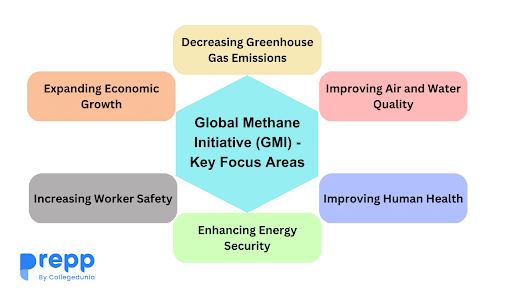
- GMI projects produce a variety of significant environmental and economic co-benefits, including:
- Stimulating local economic growth
- Developing new sources of economical alternative energy
- Improving local air and water quality, with accompanying public health advantages
- Increasing industrial worker safety
- Immediate reductions in GHG emissions
- Special attention is placed on bringing together all project participants, including governments, financial institutions, project developers, technology suppliers, and others.
Global Methane Initiative (GMI) and India
- Since the forum's creation in 2004, India has served as Vice-Chairman of the Steering Leadership for the first time, with the United States.
- India and Canada co-chairs the Virtual Global Methane Initiative Steering Leadership Meeting.
- India notified its members at the Global Methane Initiative (GMI) Steering Leadership Meeting about its efforts to reduce methane emissions.
Conclusion
Methane emissions are a major problem since they are a greenhouse gas that is 25-28 times more destructive than carbon dioxide. According to the UN, methane is responsible for 25% of the current global warming. The Global Methane Initiative (GMI) encourages cost-effective, near-term methane recovery through collaborations between industrialised and developing nations, with business sector, development banks, and nonprofit organisations participating.
FAQs
Question: What is the Global Methane Initiative?
Answer: The Global Methane Initiative (GMI) is a voluntary international partnership that aims to reduce global methane emissions from various sectors such as agriculture, energy, and waste, through the implementation of best practices and policies.
Question: Why is methane considered a potent greenhouse gas?
Answer: Methane is a potent greenhouse gas because it has a global warming potential that is significantly higher than carbon dioxide over a 20-year period, trapping heat in the atmosphere and contributing to climate change.
Question: What sectors contribute to methane emissions?
Answer: Key sectors contributing to methane emissions include agriculture (livestock and rice cultivation), energy (oil and gas extraction, coal mining), and waste (landfills and wastewater treatment).
Question: How does the Global Methane Initiative support methane emission reduction?
Answer: The GMI supports methane emission reduction by fostering collaboration among governments, the private sector, and non-governmental organizations to share knowledge, implement technologies, and create policies to reduce methane emissions.
Question: What are the expected benefits of reducing methane emissions globally?
Answer: Reducing methane emissions can provide significant environmental benefits by mitigating climate change, improving air quality, and supporting sustainable development in various sectors, while also reducing economic losses from methane waste.
MCQs
1. Which of the following gases has a higher global warming potential than carbon dioxide?
A) Methane
B) Nitrous oxide
C) Carbon monoxide
D) Ozone
Answer: (A) See the Explanation
Explanation: Methane is a potent greenhouse gas with a global warming potential much higher than that of carbon dioxide, making it a significant contributor to climate change over short periods.
2. What is the primary objective of the Global Methane Initiative?
A) To increase methane production
B) To reduce global methane emissions
C) To promote the use of methane as a fuel
D) To reduce carbon dioxide emissions
Answer: (B) See the Explanation
Explanation: The main objective of the Global Methane Initiative is to reduce global methane emissions across sectors such as agriculture, energy, and waste, by promoting best practices and supporting methane mitigation projects.
3. Which of the following sectors is the major contributor to methane emissions?
A) Agriculture
B) Transportation
C) Industrial processes
D) Forestry
Answer: (A) See the Explanation
Explanation: Agriculture, particularly livestock farming and rice cultivation, is the largest sector contributing to methane emissions, followed by waste management and energy production.
4. Which global organization leads the Global Methane Initiative?
A) United Nations Environment Programme (UNEP)
B) World Bank
C) World Health Organization (WHO)
D) International Energy Agency (IEA)
Answer: (B) See the Explanation
Explanation: The Global Methane Initiative is primarily supported by the World Bank, which helps facilitate international collaboration and provides technical expertise in methane emission reduction.
5. What is a key benefit of reducing methane emissions globally?
A) Reduced air pollution
B) Lower energy costs
C) Improved waste management
D) All of the above
Answer: (D) See the Explanation
Explanation: Reducing methane emissions leads to various benefits, including reduced air pollution, better waste management practices, and energy efficiency, all contributing to overall environmental and public health improvements.
GS Mains Questions and Model Answers
Q1: Discuss the role of the Global Methane Initiative in addressing global climate change.
Answer: The Global Methane Initiative (GMI) plays a critical role in addressing climate change by targeting methane emissions, which have a higher global warming potential than carbon dioxide. By fostering international cooperation, the GMI aims to reduce methane emissions from key sectors like agriculture, energy, and waste management. This initiative supports the implementation of cost-effective technologies and policies for methane mitigation, thereby contributing to global climate goals. The reduction of methane emissions can help mitigate the adverse impacts of climate change, improve air quality, and support the sustainable development of sectors involved.
Q2: Explain the importance of reducing methane emissions from the agricultural sector.
Answer: The agricultural sector is a significant source of methane emissions, particularly through livestock digestion (enteric fermentation) and rice paddies. Methane from these sources contributes to global warming and negatively impacts air quality. Reducing methane emissions in agriculture through practices such as improved livestock management, manure management, and wetland rice cultivation can provide substantial environmental benefits. By adopting low-methane technologies, agricultural sustainability can be improved, alongside reducing greenhouse gas emissions, and improving the overall resilience of the agricultural sector to climate change.
Q3: How can international cooperation through initiatives like the Global Methane Initiative accelerate the reduction of methane emissions?
Answer: International cooperation through initiatives like the Global Methane Initiative (GMI) helps align global efforts and share knowledge, resources, and technologies to reduce methane emissions. The GMI fosters partnerships between governments, industries, and research organizations to develop and implement best practices for methane mitigation across multiple sectors. Collaborative efforts ensure that countries with varying resources and capacities can adopt cost-effective solutions tailored to their specific contexts. This collective approach accelerates the transition to low-emission economies and enhances global efforts to combat climate change.
Previous Year Questions on Methane Emissions and Climate Change
1. UPSC CSE Mains 2020 (GS Paper 3):
Question: "What are the key sources of methane emissions in India, and how can they be mitigated through effective policies?"
Answer: Major sources of methane emissions in India include agriculture (livestock and rice paddies), waste management (landfills), and the energy sector (oil and gas extraction). Mitigation strategies include promoting sustainable agricultural practices, enhancing waste-to-energy technologies, and transitioning to cleaner energy sources. Policy frameworks supporting these initiatives, like incentivizing methane capture from landfills and promoting low-methane farming techniques, can significantly reduce methane emissions.
2. UPSC CSE Mains 2019 (GS Paper 2):
Question: "Discuss the role of international cooperation in addressing the challenge of global methane emissions. Highlight the contributions of initiatives like the Global Methane Initiative (GMI)."
Answer: International cooperation plays a crucial role in tackling methane emissions by enabling knowledge sharing, technical support, and the establishment of global frameworks. Initiatives like the Global Methane Initiative (GMI) facilitate collaboration between governments, businesses, and research organizations to implement methane mitigation practices in key sectors. The GMI supports countries in developing policies, deploying technologies, and fostering public-private partnerships, accelerating global efforts to reduce methane emissions and combat climate change.
Download the PREPP App and attempt FREE IAS Exam Mock Tests and get complete study material!
UPSC IAS : CSAT - Mini Live Test

Live Test : UPSC CSE Prelims CSAT (Paper-II) (Oct 20 - 23)
Full Test - 04: UPSC CSE Prelims CSAT (Paper-II)
Full Test - 03: UPSC CSE Prelims CSAT (Paper-II)
UPSC CSE Prelims 2026 GS Paper 1 Question Paper (24-May-2026)
UPSC CSE Prelims 2026 CSAT Paper 2 Question Paper (24-May-2026)

17 February 2025 | The Hindu Must Read Articles | Current Affairs

16 February 2026 | The Hindu Must Read Articles | Current Affairs

13 February 2026 | The Hindu Must Read Articles | Current Affairs









Comments