Shale Gas - Environment Notes
Shale gas is a kind of natural gas that is trapped inside shale strata. It is confined inside low-permeability shale formations, which are fine-grained sedimentary rock that serves as both a source and a reservoir. They are deeper than normal crude oil, which is discovered at 1,500 metres. Extraction of shale oil and gas necessitates deep vertical drilling followed by horizontal drilling. Indian geologists have found three shale gas basins: the Cambay Basin in Gujarat, the Assam-Arakan basin in northeast India, and the Gondwana Basin. This article explains about Shale Gas which is important for UPSC IAS exam preparation.
Table of Contents
Shale Gas - Definition
- Shale gas is natural gas that is trapped inside shale layers.
- Shale gas is one of several unconventional natural gas sources, including coalbed methane, tight sandstones, and methane hydrates.
- It is a type of unconventional oil created via pyrolysis, hydrogenation, or thermal breakdown of oil shale rock fragments.
- These processes transform the organic materials contained inside the rock into synthetic oil and gas. Indian geologists have found three shale gas basins: the Cambay Basin in Gujarat, the Assam-Arakan basin in northeast India, and the Gondwana Basin.
- According to the US Energy Information Administration, shale gas will contribute more than 45% of US natural gas production by 2035. China is thought to hold the world's greatest shale gas reserves.
- Most shales are not viable sources of natural gas because they have inadequate permeability to enable considerable fluid flow to a wellbore.
- The primary distinction between shale oil and conventional crude is that the former, sometimes known as 'tight oil,' is discovered in smaller quantities and at greater depths than conventional crude deposits.
- Its extraction necessitates the formation of fissures in oil and gas-rich shale in order to liberate hydrocarbons via a technique known as hydraulic fracturing.
Production of Shale Gas
- Shale gas is extracted via a technique known as hydraulic fracturing, sometimes known as fracking.
- Shale gas deposits are often dispersed horizontally rather than vertically.
- Deep holes or vertical wells are dug down into the desired shale rock formations first, followed by horizontal drilling, which allows for better access to the gas trapped deep within the shale rock formations.
- Following that, high-pressure fracking fluids are injected into the drilled holes. Fracking fluids are composed of water, sand, and chemicals.
- This fracturing liquid opens up fissures in the rocks, allowing trapped gas to flow through the fractures and into collecting wells.
Shale gas exploration in India
- In India, there is currently no large-scale commercial production of shale oil and gas.
- Limited success: The state-owned ONGC began exploring in 2013 and has evaluated shale oil and gas potential in 25 nomination blocks by the end of FY21, but has cut spending in recent years due to little success in shale exploration operations.
- Basins: While ONGC's assessment discovered shale oil prospects in Gujarat's Cambay basin and Andhra Pradesh's Krishna Godavari basin, the company concluded that the quantity of oil flow observed in these basins did not indicate "commerciality," and that the general characteristics of Indian shales differ significantly from those of North American shales.
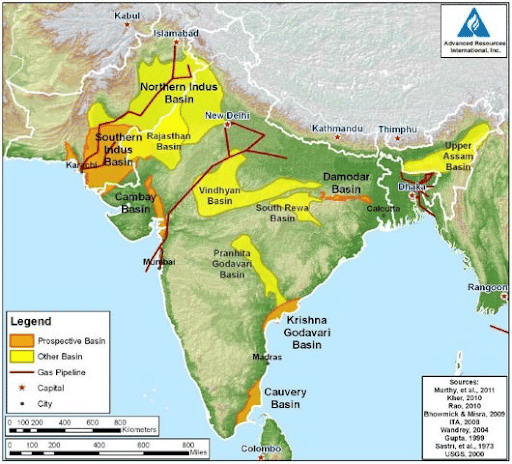
- Government of India Policy Guidelines: ONGC has selected 50 nomination PML (Petroleum Mining Lease) blocks under Phase-I of the policy guidelines announced by the Government of India (GoI) for the exploration and development of shale gas and oil in India by National Oil Companies (NOCs).
- So far, exploration operations have resulted in the finding of 65 small-to-medium-sized hydrocarbon fields with around 356 million tonnes (oil and oil equivalent gas) of initial on-land reserves.
- The present oil and gas production rates are 750-800 tonnes per day and 2.5-3 million cubic metres of gas, respectively.
- Legal Status of Shale Gas in India: The subject of Hydrocarbons falls under the legislative domain of the central government.
- Hydrocarbon Exploration and Licensing Policy (HELP) was implemented by the central government, which allowed exploration of all kinds of hydrocarbons in the block.
- The Ministry of Petroleum and Natural Gas released a “Draft Policy for the Exploration of Shale Oil and Gas in India” in 2012.
Shale Gas - Challenges
- Massive water demand for fracking
- Contamination of groundwater is a possibility.
- Another obstacle of the fracking process is the recycling and leakage difficulties related with the flowback water, which is frequently methane-contaminated.
- Excessive methane emissions
- Inadequate handling of drill cuttings
- Inadequate waste water disposal procedures
- In comparison to traditional sources, shale oil often creates more pollution during extraction, albeit the extent depends on whether or not the operators prevent wasteful and needless emissions.
Wayforward
- The optimal technique of water management should be recycling and reusing fracking water.
- Enforcing clear and realistic legislation on environmental and water concerns.
- India's soil contains 293 billion tonnes of coal. Environmental concerns make extraction difficult.
- However, 'underground coal gasification' can generate 6,900 trillion cubic feet of gas, which is far more than shale reserves.
- India's shale resources are estimated to be 65 trillion cubic feet. The potential for CBM in India is estimated to be 450 tcf.
- As a result, the emphasis must be on CBM exploration rather than the hazardous shale industry.
- Coal bed methane (CBM), which is produced from coal beds, is also an unconventional gas that occurs significantly closer to the land surface than shale gas.
Conclusion
Shale gas is natural gas trapped inside shale strata. Among the unconventional natural gas sources are coalbed methane, tight sandstones, and methane hydrates. It is a form of unconventional oil that is produced by the pyrolysis, hydrogenation, or thermal breakdown of oil shale rock pieces. Hydraulic fracturing, sometimes known as fracking, is a technology used to recover shale gas. There is presently no large-scale commercial production of shale oil and gas in India.
FAQs
Question. What is shale gas?
Shale gas is a type of natural gas that is found in shale rock formations deep underground. It is extracted using a process known as hydraulic fracturing, or "fracking," which involves injecting high-pressure fluid into the rock to release the gas. Shale gas has become an important source of energy in many countries.
Question. How is shale gas extracted?
Shale gas is extracted through a method called hydraulic fracturing (fracking). This involves drilling into shale rock formations and injecting a mixture of water, sand, and chemicals at high pressure to fracture the rock and release the gas trapped inside. Horizontal drilling is often used to access large shale deposits.
Question. What are the environmental concerns associated with shale gas extraction?
Shale gas extraction raises several environmental concerns, particularly related to water usage, contamination of groundwater, and air pollution. The fracking process can lead to the release of methane, a potent greenhouse gas, and the chemicals used in fracking fluids can potentially contaminate local water supplies.
Question. Is shale gas a clean energy source?
While shale gas is considered a cleaner alternative to coal and oil due to its lower carbon emissions when burned, it is not entirely free from environmental concerns. The fracking process can lead to groundwater contamination, habitat disruption, and air pollution, and the release of methane gas during extraction is a significant environmental issue.
Question. How does shale gas affect local communities?
Local communities can be impacted by shale gas extraction in various ways. The heavy use of water, the risk of water contamination, and the noise and traffic from drilling operations can disrupt local life. Additionally, the potential for seismic activity and the displacement of local wildlife are environmental concerns for nearby communities.
MCQs
- What is the primary method used to extract shale gas?
A) Surface mining
B) Hydraulic fracturing (fracking)
C) Underground mining
D) Open-pit mining
Answer: (B) See the Explanation
Shale gas is primarily extracted using hydraulic fracturing, or fracking, where high-pressure fluid is injected into shale rock to release the gas trapped inside.
- Which of the following is a major environmental concern associated with shale gas extraction?
A) Loss of biodiversity
B) Groundwater contamination
C) Ocean acidification
D) Deforestation
Answer: (B) See the Explanation
One of the major environmental concerns with shale gas extraction is the potential for groundwater contamination due to the chemicals used in the hydraulic fracturing process.
- Shale gas is considered a cleaner alternative to which fossil fuel?
A) Oil
B) Coal
C) Natural gas
D) None of the above
Answer: (B) See the Explanation
Shale gas is considered a cleaner alternative to coal because it produces lower carbon emissions when burned, making it a relatively cleaner source of energy compared to coal.
- What is one of the most significant risks associated with the hydraulic fracturing process?
A) Increased carbon dioxide emissions
B) Groundwater contamination
C) Deforestation
D) Ocean acidification
Answer: (B) See the Explanation
The risk of groundwater contamination is one of the significant environmental concerns associated with hydraulic fracturing, as chemicals used in the process can leak into nearby water sources.
- Which greenhouse gas is commonly released during the extraction of shale gas?
A) Carbon dioxide
B) Methane
C) Nitrous oxide
D) Sulfur dioxide
Answer: (B) See the Explanation
Methane, a potent greenhouse gas, is often released during shale gas extraction, especially during the drilling and fracking process, contributing to climate change.
GS Mains Questions and Model Answers
Q1: Discuss the environmental concerns associated with the extraction of shale gas and its implications for sustainable energy development.
Answer: The extraction of shale gas through hydraulic fracturing (fracking) raises several environmental concerns that must be carefully managed to ensure sustainable energy development. One of the most significant issues is groundwater contamination. The fracking process involves injecting large volumes of water mixed with chemicals into shale formations to release gas, which can result in the contamination of local groundwater supplies if not properly contained. Additionally, fracking can cause surface water depletion, as the extraction process requires significant water resources, which can impact local ecosystems and water availability for communities. Another concern is the emission of methane, a potent greenhouse gas, during the extraction process. Methane leaks can occur during drilling and transportation, undermining the environmental benefits of natural gas as a cleaner alternative to coal. There is also the potential for habitat disruption, noise pollution, and the risk of induced seismic activity due to the high-pressure injection of fluids into the earth. While shale gas is often seen as a cleaner alternative to coal, its environmental footprint raises questions about its role in the transition to more sustainable energy systems. Addressing these concerns requires stricter regulation of the fracking process, improved technologies to capture methane leaks, and better management of water resources to minimize environmental impacts.
Q2: Evaluate the role of shale gas in the global energy transition and its environmental implications.
Answer: Shale gas plays a significant role in the global energy transition due to its lower carbon emissions compared to coal and oil. As a cleaner-burning fossil fuel, shale gas is seen as an important bridge fuel that can help reduce the carbon footprint of the energy sector during the transition to renewable energy sources. Many countries, particularly in North America, have embraced shale gas as a way to reduce dependence on coal and enhance energy security. However, the environmental implications of shale gas extraction are complex. While burning shale gas produces fewer carbon emissions than coal, the extraction process, known as hydraulic fracturing (fracking), can result in significant environmental risks. These include the potential contamination of water supplies, air pollution, and the release of methane, a powerful greenhouse gas. Methane leaks from shale gas wells can offset the environmental benefits of using natural gas instead of coal, contributing to global warming. In terms of energy transition, shale gas offers an opportunity to reduce emissions in the short to medium term, but it should not be seen as a long-term solution. The environmental challenges associated with its extraction highlight the need for more sustainable energy sources, such as wind, solar, and hydroelectric power, in the long run. Shale gas, while providing a temporary solution, should be part of a broader strategy aimed at reducing overall fossil fuel consumption and investing in cleaner, renewable energy technologies.
Q3: Analyze the socio-economic impact of shale gas extraction on local communities and the economy.
Answer: Shale gas extraction can have both positive and negative socio-economic impacts on local communities and economies. On the positive side, shale gas production can generate significant economic benefits, including job creation and increased revenue for local governments. The construction of drilling sites, transportation infrastructure, and facilities for processing shale gas can create jobs in both the short and long term. Additionally, the increased production of shale gas can lead to lower energy prices, benefiting consumers and industries that rely on energy. However, the socio-economic impact is not entirely positive. Local communities can experience disruptions due to the environmental risks associated with shale gas extraction, such as water contamination and air pollution. These risks can have adverse health effects on residents and disrupt agricultural activities, which depend on clean water sources. The influx of workers into rural areas can also lead to increased pressure on local infrastructure, housing, and public services, straining resources and potentially leading to social tensions. Moreover, the long-term economic benefits of shale gas extraction may be limited if environmental degradation reduces the quality of life for local communities. While short-term economic gains are evident, the long-term sustainability of shale gas extraction depends on balancing economic growth with environmental protection and ensuring that local communities are adequately compensated for any adverse impacts.
Previous Year Questions on Shale Gas
1. UPSC CSE 2022
Question: What are the major environmental and socio-economic concerns related to the extraction of shale gas?
Answer: The extraction of shale gas raises significant environmental concerns, including groundwater contamination, air pollution, and the release of methane, which contributes to global warming. Socio-economic impacts include disruption to local communities due to water contamination, health risks, and increased pressure on local infrastructure. While it offers economic benefits such as job creation, the long-term sustainability is questionable due to these adverse effects.
2. UPSC CSE 2021
Question: Evaluate the role of shale gas in addressing global energy needs and the environmental risks associated with its extraction.
Answer: Shale gas can play an important role in reducing reliance on coal and oil, offering a cleaner alternative for energy generation. However, its extraction, particularly through fracking, poses environmental risks such as groundwater contamination, methane emissions, and potential seismic activity. These risks must be carefully managed to ensure shale gas contributes positively to energy transition without exacerbating environmental degradation.
Download the PREPP App and attempt FREE IAS Exam Mock Tests and get complete study material!
UPSC IAS : CSAT - Mini Live Test

Live Test : UPSC CSE Prelims CSAT (Paper-II) (Oct 20 - 23)
Full Test - 04: UPSC CSE Prelims CSAT (Paper-II)
Full Test - 03: UPSC CSE Prelims CSAT (Paper-II)
UPSC CSE Prelims 2026 GS Paper 1 Question Paper (24-May-2026)
UPSC CSE Prelims 2026 CSAT Paper 2 Question Paper (24-May-2026)

17 February 2025 | The Hindu Must Read Articles | Current Affairs

16 February 2026 | The Hindu Must Read Articles | Current Affairs

13 February 2026 | The Hindu Must Read Articles | Current Affairs









Comments