Strip Intercropping - Agriculture Notes
Strip Intercropping is the practice of raising two or more crops simultaneously in distinct strips spaced far enough apart to allow for independent cultivation. Planting strips of soybean and alfalfa in a field is an example of strip cropping. The practice of growing cultivated plants like cotton and sod-forming plants like alfalfa in alternating strips that follow the contour of the soil to reduce erosion. This article will explain to you about Strip Intercropping which will be helpful in preparing the Agriculture Syllabus for the UPSC Civil Service examination.
|
Table of Contents |
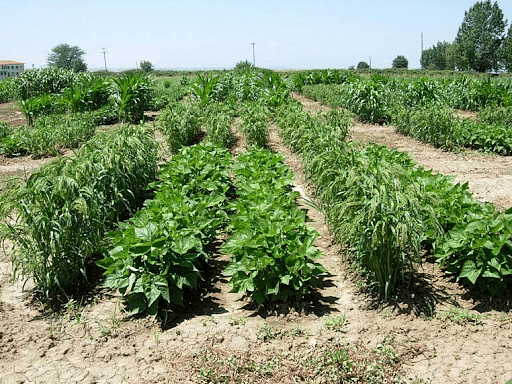
Strip Intercropping
What is Intercropping?
- Intercropping is a method of increasing agricultural productivity by planting two or more crops simultaneously on a specific plot of land in a specific row pattern.
- Small farmers who depend on rain for higher production are more likely to use it.
- This procedure has a specific row pattern, such as 1:1 or 1:2, which means that the primary crop is in the first row and the other crops are in the second or third row.
- These crops are blended in this technique despite having different nutrient needs. It guarantees the best possible use of the nutrients given.
- Additionally, it stops pests and diseases from spreading to every plant involved in a particular crop.
|
|
|
|---|---|
| Types of intercropping | Alley cropping |
| Parallel cropping | Synergistic cropping |
| Multi storey cropping | Relay intercropping |
What is Strip Intercropping?
- The term "strip cropping" refers to the practice of cropping different cultures in strips.
- To prevent soil erosion, it is a common practice on sloped terrain.
- Strip cropping in agriculture also applies to even terrains.
- The strips are sufficiently narrow to generate agronomic interactions between neighboring crops.
- Strip width is therefore essential to the design and operation of this cropping pattern. The strips are frequently changed from year to year.
- Basically, strip cropping agriculture is utilized to either enhance the growth of primary species or improve soil health.
- Although secondary species are the least expensive conservation tillage method, they rarely provide farmers with additional cash.
Strip Intercropping - Features
- The strips are uniformly placed throughout a field as closely as possible to the contour.
- Strips are typically equal in width and are sized to allow several or full-wide passes with tilling, sowing, harvesting, or other equipment.
- The average wind speed at a given location and the characteristics of the slope, notably the grade, affect the widths of strips in different ways.
- Both erosion-prone annual crops, like maize for silage, and erosive perennial crops, such as legumes and hay, can be used.
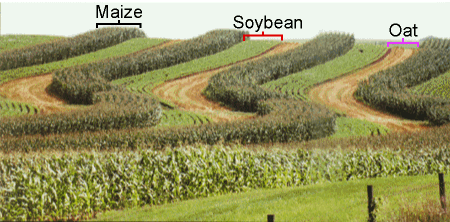
Strip Intercropping of Maize, Soybean & Oats
Strip Intercropping - Purpose
- To combat water and wind erosion
- To enhance water infiltration
- To keep the soil moist
- To lessen physical yield damage from airborne particles
- To reduce sedimentation
- To enhance the water quality
- To increase soil fertility
- To take part in nitrogen fixation
- To draw pollinators
- To manage pests
Strip Intercropping - Advantages
- By promoting infiltration and consequently raising soil moisture, strip cropping can increase crop yields.
- One of the least expensive methods accessible to farmers for reducing sheet and rill erosion is strip cropping.
- Strip intercropping results in improved soil fertility, health, enhanced water quality, and moisture retention in the soil.
- As more than one crop is planted it results in greater biodiversity, increased crop production, decreased dust emissions, increased water infiltration, etc.
How is Strip Intercropping Beneficial for India?
- Small farmers make up a significant portion of the population of India, with many holding less than 2 hectares of land.
- In its rural areas, agriculture still provides the primary source of income for almost 70% of households, with 82% of farmers being small and marginal.
- Only 30% of farmers take out official loans. More than 50% find it difficult to borrow money from lenders.
- Thus, larger farms, such as those controlled by businesses and the government, could engage in strip intercropping.
Conclusion
Strip cropping makes farmlands available for use in the future by lowering soil erosion, protecting field fertility, and removing environmental pollution. As a result, the strategy is not only good for the soil and crop yields, but it also fits into the category of sustainable farming methods because it achieves the main objectives of conserving the soil and using natural resources wisely.
FAQs
Question: What is strip intercropping?
Answer: Strip intercropping is an agricultural practice where two or more crops are grown in separate strips within the same field. This method maximizes land use, reduces soil erosion, and enhances biodiversity. Complementary crops are typically chosen to optimize resource use and improve overall yields.
Question: What are the benefits of strip intercropping?
Answer:
- Increased biodiversity, reducing the risk of pest infestations.
- Improved soil health through complementary nutrient use.
- Reduction in soil erosion as varied root systems stabilize the soil.
- Efficient land utilization by growing multiple crops in the same area.
Question: How does strip intercropping improve crop yields?
Answer: Strip intercropping improves crop yields by:
- Utilizing resources like water, sunlight, and nutrients more efficiently.
- Reducing crop failure risks, as the success of one crop compensates for the failure of another.
- Enhancing soil structure through diverse root systems, maintaining fertility and porosity.
Question: What are the challenges of strip intercropping?
Answer:
- Complex management due to multiple crops with different needs.
- Higher labor costs for planting, maintenance, and harvesting.
- Potential competition between crops for resources like nutrients and sunlight.
Question: How is strip intercropping different from traditional intercropping?
Answer: Traditional intercropping involves alternating rows of crops in close proximity, while strip intercropping involves planting crops in larger, separate strips within the same field. This allows crops to grow more independently while still benefiting from complementary interactions.
MCQs
- What is a major advantage of strip intercropping?
A) It reduces the number of crops grown in a field
B) It improves soil erosion control and biodiversity
C) It requires only one type of crop
D) It reduces crop rotation cycles
Answer: (B) See the Explanation
Strip intercropping helps control soil erosion and increases biodiversity by growing complementary crops together.
- Which of the following is a disadvantage of strip intercropping?
A) Reduced biodiversity
B) Complex crop management
C) Increased monoculture
D) Reduced soil health
Answer: (B) See the Explanation
Strip intercropping requires careful planning for planting, pest control, and harvesting, making it complex to manage.
- How does strip intercropping affect soil fertility?
A) It leads to soil degradation
B) It can improve soil fertility by growing complementary crops
C) It depletes soil nutrients
D) It requires frequent fertilization
Answer: (B) See the Explanation
Growing complementary crops helps maintain soil fertility by balancing nutrient requirements and improving soil structure.
- What type of crops are most suitable for strip intercropping?
A) Crops with similar growth patterns
B) Crops that are tolerant of high water stress
C) Crops with complementary growth habits
D) Crops requiring the same nutrients
Answer: (C) See the Explanation
Crops with complementary growth habits, such as different heights or nutrient needs, are best suited for strip intercropping.
- Which of the following is NOT a typical benefit of strip intercropping?
A) Increased pest resistance
B) Better land use efficiency
C) Increased reliance on chemical pesticides
D) Improved water retention in the soil
Answer: (C) See the Explanation
Strip intercropping reduces the need for chemical pesticides due to higher biodiversity and better pest management.
GS Mains Questions and Model Answer
Q1: Discuss the advantages and challenges of strip intercropping in improving agricultural sustainability.
Answer: Strip intercropping enhances agricultural sustainability through improved soil fertility, biodiversity, and efficient resource use. However, challenges include complex crop management and increased labor costs. Despite these, it remains a key technique for sustainable farming.
Q2: Explain the role of strip intercropping in enhancing food security and improving livelihoods in smallholder farming systems.
Answer: By diversifying crops and increasing productivity, strip intercropping enhances food security. Smallholder farmers benefit from better income opportunities and reduced risks of crop failure, leading to improved livelihoods.
Q3: Analyze the potential impact of strip intercropping on soil conservation and climate change mitigation in agriculture.
Answer: Strip intercropping prevents soil erosion, improves soil fertility, and aids carbon sequestration, reducing the agricultural carbon footprint. Its resilience-building capacity makes it valuable for mitigating climate change impacts.
Previous Year Questions on Strip intercropping
1. UPSC CSE 2021
Question: Discuss the role of intercropping in sustainable agriculture and its contribution to soil conservation.
Answer: Intercropping enhances sustainability through biodiversity, soil conservation, and nutrient cycling. Strip intercropping, specifically, helps reduce soil erosion and improve resource efficiency, contributing to long-term agricultural viability.
2. UPSC CSE 2020
Question: Evaluate the benefits and challenges of strip intercropping in improving farm productivity and soil health.
Answer: This question explores how strip intercropping increases productivity and soil health through efficient resource use and biodiversity. It also examines the challenges of crop management and labor intensity.
Download the PREPP App and attempt FREE IAS Exam Mock Tests and get complete study material!

Full Test - 04: UPSC CSE Prelims CSAT (Paper-II)
Full Test - 03: UPSC CSE Prelims CSAT (Paper-II)
UPSC CSE Prelims 2026 GS Paper 1 Question Paper (24-May-2026)
UPSC CSE Prelims 2026 CSAT Paper 2 Question Paper (24-May-2026)

17 February 2025 | The Hindu Must Read Articles | Current Affairs

16 February 2026 | The Hindu Must Read Articles | Current Affairs

13 February 2026 | The Hindu Must Read Articles | Current Affairs









Comments