Ratoon Cropping - Agriculture Notes
Ratooning is a farming technique that allows for two harvests in a single cropping season by growing a second crop from the first stubble, which could be more resource-efficient and profitable than direct-sown crops. This practice is also known as "stubble cropping." This article will explain to you about Ratoon Cropping which will be helpful in preparing the Agriculture Syllabus for the UPSC Civil Service exam.
|
Table of Contents |
What is Ratoon Cropping?
- Ratoon cropping is a type of cultivation in which a second crop is allowed to grow from the remains of a previously harvested crop.
- It is also known as stubble cropping because the new plants grow from the harvested crop's stubble.
- This method is used in crops such as sugarcane, pineapple, and banana.
- Ratooning cannot be used indefinitely because the yield and quality decrease with each cycle.
- In sugarcane, for example, two or three ratooning crops are possible before new planting is required.
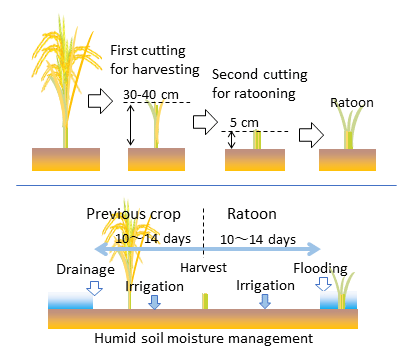
Process of Ratoon Cropping
|
|
|
|---|---|
| Sequential cropping | Cropping intensity |
| Intercropping | Cropping system |
| Difference between intercropping and mixed cropping | Mixed cropping |
Ratoon Cropping - Suitable Crops
- Ratooning is a commercial activity in numerous other crops in addition to sugarcane.
- Cotton, mint, pearl millet, pigeon peas, ramie, rice, and sorghum are a few examples.
- The practise of ratooning is widely employed on plants that will be utilised to make essential oils, fibre, and pharmaceuticals.
- The most popular crops for ratooning are those that typically produce a consistent yield for three years.
- For instance, the woody desert shrub guayule, a substitute for natural rubber, is harvested for the first time at the age of two and then ratooned every spring until a final crop of tops and roots is produced.
- As a monocarpic annual plant, rice is grown. In contrast, it can grow as a perennial in tropical regions, where it can produce a ratoon crop and last up to 30 years.
Ratoon Cropping - Management
- The ICAR-Indian Institute of Sugarcane Research, Lucknow, has identified specific technologies for managing ratoons, such as:
- selection of suitable varieties;
- cleaning of the field and removal of dead canes, trash, and other debris;
- shaving stubble;
- off-barring at the beginning of a ratoon;
- filling gaps when there is a gap of more than 45 cm between clumps;
- integrated nutrient management;
- weed management;
- maximize plant population;
- mulching trash in alternate rows.
- In order to manage the ratoon crop (0.35–0.4 ha/h) and increase its productivity, they have also designed and developed a tractor-operated two-row Ratoon Management Device (RMD) to carry out field operations for ratoon cultivation such as stubble shaving, deep tilling, off-barring, application of manure, fertilisers, bio-agents, etc., and finally earthing-up in a single pass.
Ratoon Cropping - Advantages
- The crop matures sooner in the season (by about one and a half months) and costs associated with field preparation, preliminary irrigation, and seed cane used for planting are reduced as a result of ratooning.
- Early maturation could lengthen the sugar mill's actual crushing time, increasing sugar yield.
- In some areas, sugarcane has also been ratooned (for short-term ratoon crops) to produce high-quality fodder for cattle.
- With adequate management, including plant protection, multiple ratooning of sugarcane may be used to preserve the purity of new, improved types and genetically modified plants for a longer length of time.
- Sugarcane is a suitable plant for its use in the bio-industry for the synthesis of value-added products (molecular farming) due to its high rates of CO2 fixation, vast capacity for storing soluble compounds, metabolic transformation systems, and containment of its genes, ensured by its vegetative proliferation.
- The latter has been achieved for the synthesis of sorbitol, isomaltulose, and p-hydroxy benzoic acid using biotechnological tools.
- The large-scale ratooning potential could be more beneficial in this endeavor by keeping desirable genes in such genetically modified plants for long enough to function more consistently.
Ratoon Cropping - Disadvantages
- The need for nitrogenous fertilizer is greater.
- Cane yields are typically lower than plant crop yields; hence ratoon crops go uncared for.
- Almost everywhere, the ratoon crops are often neglected which increases the susceptibility of ratoon crops to pests and diseases.
- Flowering occurs in some situations in certain varieties, resulting in an unusual delay in harvest and specific conditions that may result in an increase in fibre content, which may ultimately affect sugar recovery.
Conclusion
Due to the frequent low temperatures in subtropical India, crops that are harvested from November to mid-January typically sprout poorly, resulting in an unfavorable ratoon crop the following year. Buds on the stubble are dormant and only begin to sprout in February when the conditions are right. This could be controlled by either applying growth regulators to the plant's leaves before harvest or by treating the crop's recently harvested stubble.
FAQs
Question: What is ratoon cropping, and how does it work?
Answer: Ratoon cropping is an agricultural practice that involves harvesting the main crop and allowing the stubble or leftover shoots to regrow for a subsequent harvest without replanting. This method is commonly used in crops like sugarcane, rice, and some legumes. The practice capitalizes on the root system of the original plant, which remains intact in the soil, facilitating quicker regrowth. Ratoon crops typically yield lower quantities than the primary harvest but require significantly less labor and resources, making them a cost-effective option for farmers. This method can enhance productivity and provide an additional income source in a shorter time frame.
Question: What are the advantages of ratoon cropping?
Answer: Ratoon cropping offers several advantages, including:
- Cost Efficiency: Since the main crop's root system is retained, farmers save on seed costs and reduce the need for extensive tillage.
- Reduced Labor: Ratoon cropping requires less labor than planting a new crop, as the field is already prepared from the previous harvest.
- Soil Health Improvement: The practice promotes soil structure maintenance and prevents erosion, as the root systems stabilize the soil.
- Shorter Growth Cycle: Ratoon crops can be harvested sooner than newly planted crops, providing farmers with quicker returns on investment.
Question: What challenges are associated with ratoon cropping?
Answer: While ratoon cropping has many benefits, it also presents several challenges:
- Yield Variation: Ratoon crops often produce lower yields compared to the original crop, leading to less overall productivity.
- Pest and Disease Management: Continuous cropping can lead to increased susceptibility to pests and diseases, requiring effective management strategies.
- Nutrient Depletion: Over time, the soil may become depleted of essential nutrients if not properly managed, necessitating fertilizer application.
- Water Requirements: Ratoon crops may require consistent moisture levels, which can be challenging in arid regions.
Question: In which crops is ratoon cropping most commonly practiced?
Answer: Ratoon cropping is most commonly practiced in crops such as:
- Sugarcane: This is one of the most popular crops for ratooning, where the stubble regrows after the first harvest, allowing for multiple cycles.
- Rice: In areas with suitable climatic conditions, rice can be ratooned, providing an additional harvest after the main crop.
- Legumes: Certain leguminous plants also lend themselves well to ratoon cropping, benefiting from the established root systems.
Question: How does ratoon cropping impact sustainable agriculture?
Answer: Ratoon cropping can positively impact sustainable agriculture by promoting practices that enhance soil health and reduce resource use. By minimizing tillage, it helps maintain soil structure and reduces erosion. Additionally, the reduced need for seeds and fertilizers lowers the environmental footprint of farming operations. Ratoon cropping can lead to more efficient water usage, as established root systems can better access moisture. However, it's crucial for farmers to implement integrated pest management and nutrient replenishment strategies to ensure long-term sustainability while maximizing the benefits of this practice.
MCQs
1. What is the primary benefit of ratoon cropping?
A) Higher initial yields
B) Reduced labor and costs
C) Complete soil tillage
D) Longer growth cycles
Answer: (B) See the Explanation
Explanation: The primary benefit of ratoon cropping is reduced labor and costs, as it utilizes the existing root system of the previous crop, minimizing the need for replanting.
2. Which crop is most commonly associated with ratoon cropping?
A) Wheat
B) Sugarcane
C) Barley
D) Maize
Answer: (B) See the Explanation
Explanation: Sugarcane is most commonly associated with ratoon cropping, as it can regenerate after the initial harvest, allowing for additional yields without replanting.
3. What is a major challenge of ratoon cropping?
A) Increased seed costs
B) Lower pest resistance
C) Longer growth period
D) Soil erosion
Answer: (B) See the Explanation
Explanation: A major challenge of ratoon cropping is lower pest resistance, as continuous cropping can lead to increased susceptibility to pests and diseases, requiring careful management.
4. How does ratoon cropping benefit sustainable agriculture?
A) By promoting heavy tillage
B) By increasing water consumption
C) By reducing resource use and improving soil health
D) By eliminating pest management
Answer: (C) See the Explanation
Explanation: Ratoon cropping benefits sustainable agriculture by reducing resource use and improving soil health, as it minimizes tillage and maintains soil structure while maximizing resource efficiency.
5. In what way can ratoon cropping be economically advantageous?
A) It requires more fertilizers
B) It shortens the growth cycle for quicker returns
C) It increases the need for irrigation
D) It requires more labor input
Answer: (B) See the Explanation
Explanation: Ratoon cropping can be economically advantageous because it shortens the growth cycle, allowing farmers to harvest sooner and receive quicker returns on their investment.
GS Mains Questions and Model Answers
Q1: Discuss the advantages and disadvantages of ratoon cropping in modern agriculture.
Answer: Ratoon cropping presents several advantages in modern agriculture, primarily in terms of cost efficiency and resource management. One significant advantage is the reduction in seed costs, as the existing root system enables new shoots to grow without replanting. This practice also requires less labor compared to traditional cropping methods, leading to savings on labor costs. Additionally, ratoon cropping can enhance soil health by maintaining soil structure and preventing erosion through established root systems. However, there are disadvantages, including potential yield reductions in subsequent harvests and increased vulnerability to pests and diseases due to the lack of crop rotation. Nutrient depletion in the soil can also occur if proper management practices are not implemented. Thus, while ratoon cropping can be a sustainable and efficient practice, it requires careful planning and management to mitigate its disadvantages.
Q2: Analyze the role of ratoon cropping in enhancing agricultural productivity in developing countries.
Answer: Ratoon cropping plays a crucial role in enhancing agricultural productivity in developing countries by providing an efficient means of maximizing yields from existing crops. In regions where resources such as land, labor, and water are limited, ratoon cropping allows farmers to optimize their outputs without the need for significant investments in new seeds or extensive tillage. This method is particularly beneficial for smallholder farmers, as it provides an additional income source within a shorter time frame. Furthermore, by encouraging sustainable practices, such as maintaining soil health and reducing erosion, ratoon cropping contributes to long-term agricultural viability. The practice also helps adapt to changing climatic conditions by providing a resilient cropping option. Overall, ratoon cropping represents an important strategy for improving food security and economic stability in developing agricultural economies.
Q3: Evaluate the environmental implications of ratoon cropping and its contribution to sustainable farming practices.
Answer: Ratoon cropping offers several environmental benefits that contribute to sustainable farming practices. By reducing the need for replanting, it minimizes soil disturbance, which helps maintain soil structure and fertility. The established root systems of ratoon crops also enhance soil stability, reducing erosion and promoting better water retention in the soil. This practice can lead to improved water quality, as less soil erosion results in fewer sediments and pollutants entering waterways. However, the environmental implications of ratoon cropping can be mixed if not managed properly. Continuous cropping without crop rotation can lead to nutrient depletion and increased pest pressures, which can affect ecosystem balance. To mitigate these risks, farmers must adopt integrated pest management and regular soil health assessments, ensuring that ratoon cropping remains a beneficial practice within sustainable agriculture frameworks.
Previous Year Questions on Ratoon Cropping
1. UPSC CSE Prelims 2021:
Question: What is the main agricultural practice involved in ratoon cropping?
A) Replanting of seeds
B) Harvesting existing crops and allowing regrowth
C) Intensive tillage
D) Use of chemical fertilizers
Answer: (B)
Explanation: Ratoon cropping primarily involves harvesting existing crops and allowing regrowth from the stubble or root system without replanting seeds, making it a resource-efficient practice.
2. UPSC CSE Mains 2019 (GS Paper 1):
Question: "Discuss the significance of ratoon cropping in improving agricultural sustainability." Provide examples from relevant agricultural practices.
Answer: Ratoon cropping significantly improves agricultural sustainability by optimizing resource use and enhancing productivity without necessitating extensive replanting. This practice is particularly evident in sugarcane farming, where the stubble is allowed to regrow, yielding additional harvests. By minimizing soil disturbance, ratoon cropping helps maintain soil health and reduces erosion, contributing to a more resilient agricultural system. Furthermore, it decreases the reliance on chemical inputs, as fewer fertilizers are needed due to the established root system’s ability to access nutrients. The environmental benefits of ratoon cropping exemplify how traditional practices can be integrated into modern farming to achieve sustainable agricultural outcomes, ensuring food security while preserving ecological integrity.
Download the PREPP App and attempt FREE IAS Exam Mock Tests and get complete study material!

Full Test - 04: UPSC CSE Prelims CSAT (Paper-II)
Full Test - 03: UPSC CSE Prelims CSAT (Paper-II)
UPSC CSE Prelims 2026 GS Paper 1 Question Paper (24-May-2026)
UPSC CSE Prelims 2026 CSAT Paper 2 Question Paper (24-May-2026)

17 February 2025 | The Hindu Must Read Articles | Current Affairs

16 February 2026 | The Hindu Must Read Articles | Current Affairs

13 February 2026 | The Hindu Must Read Articles | Current Affairs









Comments