Sequential Cropping - Agriculture Notes
Sequential cropping is growing two or more crops in succession on the same field each year. After the previous crop has been harvested, the subsequent crop is planted. In some areas, the rainy season is long enough to grow two crops: either two main crops or one main crop followed by a cover crop. Growing two crops may also be possible if there are two rainy seasons or if there is enough moisture left in the soil to grow a second crop. For instance, planting maize during the prolonged rains and beans during the shorter rainy season. This article will explain to you about Sequential Cropping which will be helpful in preparing the Agriculture Syllabus for the UPSC Civil Service exam.
|
Table of Contents |
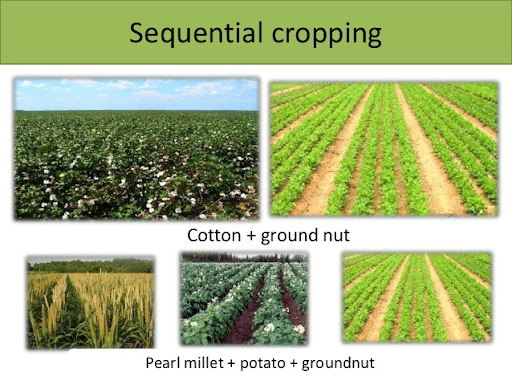
Sequential Cropping
What is Sequential Cropping?
- Sequential cropping systems are a type of crop rotation where a farmer grows two or more crops in a sequence where a crop replaces the next soon after harvest.
- After the main crop cultivated in the field or growing area has been harvested, this method often entails planting an additional crop.
- Sequential systems are more typical where the growing season is long while intercropping systems are more commonplace where labor is easily accessible and reasonably priced.
- Corn is a common crop that is grown in numerous locations in sequential cropping, particularly in tropical regions.
- Oats, wheat, barley, soybean, sorghum, alfalfa, and many clovers and grasses are some of the more popular crops produced in succession with corn.
- As there is no overlap between two or more crops, sequential cropping is also known as non-overlapping cropping.
|
|
|
|---|---|
| Relay cropping | Cropping system |
| Intercropping | Ratoon cropping |
| Cropping intensity | Mixed cropping |
Sequential Cropping - Advantages
- There is no struggle for nutrition, water, or light.
- Since only one crop is planted each time, competition for the soil factor is not an issue when using sequence cropping.
- The impact of one crop on another, however, changes how water and nutrients are managed.
- The application of conservation tillage helps lessen erosion. Tillage has advantages in terms of its ability to loosen the soil, prepare the seedbed, and suppress weeds.
Sequential Cropping - Disadvantages
- Absence of improved varieties.
- Insufficient extension services.
- Low market prices.
- The prevalence of pests and illnesses.
Conclusion
A simple form of multi-cropping is sequential cropping, which involves growing a second crop after harvesting the first crop. It is one of the oldest forms of agriculture. Throughout history, sequential cropping has been critical in adapting to changing climatic conditions. Although sequential cropping has traditionally been used on small farms and low-input production systems, it teaches lessons in structure and function that can be applied to the design of larger-scale farming systems.
FAQs
Question: What is sequential cropping?
Answer: Sequential cropping is an agricultural practice where two or more different crops are planted in the same field in a single growing season, one after the other. This method maximizes land utilization and enhances overall productivity by making efficient use of available resources such as soil nutrients and water. Sequential cropping allows farmers to increase their yields without expanding their cultivated area, thus contributing to food security and sustainable agriculture.
Question: What are the benefits of sequential cropping?
Answer: The benefits of sequential cropping include:
- Increased Yield: It enables farmers to harvest multiple crops in a year, boosting overall agricultural output.
- Soil Fertility Improvement: Different crops contribute varied nutrients to the soil, enhancing its fertility and structure.
- Pest and Disease Management: Rotating different crops can help reduce pest infestations and disease prevalence, lowering the need for chemical inputs.
- Efficient Resource Use: Sequential cropping optimizes the use of water and nutrients, leading to more sustainable farming practices.
- Economic Benefits: Farmers can achieve higher profits from multiple harvests, improving their livelihoods.
Question: How does sequential cropping differ from intercropping?
Answer: Sequential cropping and intercropping are both agricultural practices aimed at maximizing land use, but they differ in their execution:
- Sequential Cropping: Involves planting different crops in the same field one after the other within a single growing season. The crops do not grow simultaneously.
- Intercropping: Involves planting two or more crops simultaneously in the same field during a growing season. This practice aims to enhance biodiversity and utilize space more efficiently.
Question: What are some common crops used in sequential cropping?
Answer: Common crops used in sequential cropping vary based on regional climates and growing conditions but often include:
- Rice followed by wheat: A popular sequence in many Asian countries.
- Corn followed by soybeans: A common practice in North America.
- Millets followed by pulses: Beneficial in semi-arid regions for improving soil health.
- Barley followed by oilseeds: This sequence helps in optimizing soil nutrients.
Question: What challenges are associated with sequential cropping?
Answer: Challenges associated with sequential cropping include:
- Soil Degradation: Continuous cropping without proper management can lead to nutrient depletion and soil erosion.
- Pest Resistance: Repeated planting of certain crops may lead to pest resistance, necessitating integrated pest management strategies.
- Water Management Issues: Different crops have varying water requirements, complicating irrigation practices.
- Market Risks: Fluctuating market prices for different crops can affect farmers’ profitability.
- Labor Intensive: Sequential cropping may require additional labor for planting, managing, and harvesting multiple crops.
MCQs
1. What is the main goal of sequential cropping?
A) To plant crops in multiple fields
B) To grow multiple crops in one field during one season
C) To maintain soil health
D) To reduce water usage
Answer: (B) See the Explanation
Explanation: The main goal of sequential cropping is to grow multiple crops in the same field within one growing season, maximizing land productivity.
2. Which of the following is NOT a benefit of sequential cropping?
A) Increased yield
B) Soil fertility improvement
C) Pest resistance
D) Efficient resource use
Answer: (C) See the Explanation
Explanation: While sequential cropping can help manage pests, it does not inherently provide pest resistance; that is a different agricultural management practice.
3. What distinguishes sequential cropping from intercropping?
A) Planting different crops in the same field
B) Growing crops simultaneously
C) Planting the same crop repeatedly
D) Different seasons for each crop
Answer: (D) See the Explanation
Explanation: Sequential cropping involves planting different crops in the same field at different times, often in the same season, while intercropping involves simultaneous growth.
4. Which of the following is a common sequential cropping practice?
A) Rice followed by sugarcane
B) Corn followed by soybeans
C) Wheat followed by barley
D) All of the above
Answer: (B) See the Explanation
Explanation: Corn followed by soybeans is a well-known sequential cropping practice, particularly in North America, maximizing productivity.
5. Which challenge is commonly associated with sequential cropping?
A) Increased biodiversity
B) Soil degradation
C) Reduced labor requirements
D) Enhanced pest control
Answer: (B) See the Explanation
Explanation: Soil degradation can occur if crops are planted sequentially without proper soil management practices.
GS Mains Questions and Model Answers
Q1: Discuss the advantages of sequential cropping in enhancing agricultural productivity.
Answer: Sequential cropping enhances agricultural productivity by allowing farmers to harvest multiple crops within a single growing season. This practice optimizes the use of land, water, and nutrients, leading to increased overall yields. By alternating crops, farmers can improve soil health through varied nutrient contributions and reduce pest populations through crop rotation. Sequential cropping also aligns with market demands, enabling farmers to respond to price fluctuations by selecting high-value crops throughout the year. This adaptability fosters sustainable farming practices, contributing to food security and economic stability for farming communities.
Q2: Analyze the environmental implications of sequential cropping and how they can be managed sustainably.
Answer: While sequential cropping offers numerous benefits, it can also pose environmental challenges, including soil degradation, water resource depletion, and increased pesticide use. To manage these implications sustainably, farmers can implement practices such as crop rotation to maintain soil fertility and structure, use cover crops to prevent erosion, and adopt integrated pest management strategies to minimize chemical inputs. Additionally, employing precision agriculture techniques can enhance resource efficiency and reduce waste. By balancing productivity with environmental stewardship, farmers can sustain sequential cropping systems while preserving ecosystem health.
Q3: Evaluate the socio-economic impacts of sequential cropping on rural communities.
Answer: Sequential cropping has significant socio-economic impacts on rural communities by enhancing income opportunities through increased agricultural production. The ability to grow multiple crops in a year can lead to improved livelihoods for farmers, enabling them to invest in education, health, and infrastructure. Additionally, sequential cropping can reduce dependency on single crops, mitigating risks associated with market fluctuations. However, challenges such as labor demands and resource management must be addressed to maximize benefits. Overall, sequential cropping can contribute to rural development by fostering resilience and economic diversification among farming households.
Previous Year Questions on Sequential Cropping
1. UPSC CSE Prelims 2021:
Question: What is the main purpose of sequential cropping?
A) To improve soil fertility
B) To increase agricultural productivity
C) To reduce water usage
D) To control pests
Answer: (B)
Explanation: The main purpose of sequential cropping is to increase agricultural productivity by allowing farmers to harvest multiple crops in a single growing season.
2. UPSC CSE Mains 2019 (GS Paper 1):
Question: "Examine the role of sequential cropping in sustainable agriculture." Discuss its benefits and challenges.
Answer: Sequential cropping plays a vital role in sustainable agriculture by enhancing land use efficiency and increasing productivity. The practice allows for diverse cropping systems, which improve soil health and reduce pest pressure. However, challenges such as soil nutrient depletion and increased labor requirements need to be managed. Sustainable practices, including crop rotation and integrated pest management, can help address these challenges while maximizing the benefits of sequential cropping, contributing to food security and resilience in agricultural systems.
Download the PREPP App and attempt FREE IAS Exam Mock Tests and get complete study material!

Full Test - 04: UPSC CSE Prelims CSAT (Paper-II)
Full Test - 03: UPSC CSE Prelims CSAT (Paper-II)
UPSC CSE Prelims 2026 GS Paper 1 Question Paper (24-May-2026)
UPSC CSE Prelims 2026 CSAT Paper 2 Question Paper (24-May-2026)

17 February 2025 | The Hindu Must Read Articles | Current Affairs

16 February 2026 | The Hindu Must Read Articles | Current Affairs

13 February 2026 | The Hindu Must Read Articles | Current Affairs









Comments