Relay Cropping - Agriculture Notes
Relay cropping is a method of multiple cropping in which one crop is seeded into a standing second crop well before the second crop is harvested. Relay cropping has the potential to resolve a number of conflicts, including inefficient use of available resources, disagreements over sowing time, fertilizer application, and soil degradation. Relay cropping is a complex set of resource-efficient technologies capable of improving soil quality, increasing net return, increasing land equivalent ratio, and controlling weed and pest infestation. Rice-cauliflower-onion-summer gourd is one type of relay crop grown in India. This article will explain to you about Relay Cropping which will be helpful in preparing the Agriculture Syllabus for the UPSC Civil Service exam.
|
Table of Contents |
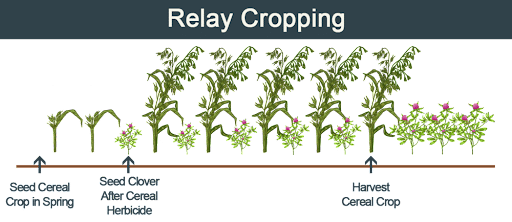
Relay Cropping
What is Cropping System?
- The term "cropping system" refers to the crops, crop rotations, and management strategies applied over a number of years to a specific agricultural land.
- Traditionally, cropping systems have been created to maximize output, but modern agriculture is increasingly focused on encouraging cropping systems that are environmentally sustainable.
- There are many cropping systems around the world including Multiple Cropping, Double Cropping, Triple Cropping, Relay Cropping, Ratoon Cropping, Intercropping, etc.
- The Cropping system can be defined as the type and sequence of crops cultivated over time on a specific area of soil.
- It could involve cultivating a single crop on the same land each year or rotating different crops in a regular pattern.
- Since it is location-specific, it alters as place and environment change. Any cropping system seeks to maximize return on investment by making effective use of all available resources, including solar energy, water, and land.
- The fundamental building blocks of any cropping system are management strategies, planting geometry, and seed genetics.
- The goals of any cropping system are as follows:
- Efficient use of all resources (land, water, and solar radiation).
- Keeping production stable while increasing net returns.
|
|
|
|---|---|
| Sequential cropping | Cropping system |
| Intercropping | Ratoon cropping |
| Cropping intensity | Mixed cropping |
What is Relay Cropping?
- Relay planting refers to the simultaneous planting of multiple crops in the same plot in the same season.
- Therefore, both crops share a portion of the growing season.
- Planting rice (or wheat), cauliflower, onion, and summer gourd (or potato onion, lady's fingers, and maize) in the same season is an example of relay cropping.
- It also means that labour is distributed more evenly, insects spread less, and legumes actually add nitrogen to the soil.
- Relay planting has less risk because it does not require relying just on one crop.
Relay Cropping - Advantages
- Higher Productivity: Relay cropping systems are thought to be a strategy to stabilize farm revenue and enhance land productivity in a small area by increasing the intensity of work and land use.
- Fodder Stock: Growing two crops guarantees sufficient fodder supplies for cattle.
- Food Security: With a relay cropping system, farmers may still harvest other crops to ensure food production all year long, even if one or two crops fail.
- Multiple Uses: Crops provide more than simply grains; they also produce wood for fuel and feed.
- Erosion Control: Improved ground cover results in better erosion management.
- Nitrogen Fixation: Any legumes involved may fix some nitrogen and add it to the soil.
Relay Cropping - Disadvantages
- Mechanization is challenging.
- The demands on management are greater.
- Due to less effective planting, weeding, and harvesting practices, overall production costs per unit of products may increase.
Conclusion
Climate change, soil degradation, and natural resource depletion are emerging as the most significant challenges to crop productivity and environmental sustainability in modern agriculture. In the conventional farming system, there are few options for dealing with these issues. Relay cropping has the potential to resolve a number of conflicts, including inefficient use of available resources, disagreements over sowing time, fertiliser application, and soil degradation. Despite a few drawbacks, relay cropping in India is seen as an approach where small farmers can generate revenue.
FAQs
Question: What is relay cropping?
Answer: Relay cropping is an agricultural practice that involves the planting of a second crop before the first crop has been harvested. This method allows for the efficient use of land, water, and other resources by overlapping the growth cycles of two crops. The primary objective of relay cropping is to maximize productivity and enhance the overall yield per unit area. This practice can improve soil health, reduce erosion, and provide better pest management by promoting biodiversity in the cropping system.
Question: What are the advantages of relay cropping?
Answer: Relay cropping offers several advantages:
- Increased Yield: By growing two crops simultaneously, farmers can increase total production per acre, optimizing land usage.
- Improved Soil Health: The presence of diverse crops can enhance soil structure and nutrient cycling, benefiting long-term fertility.
- Pest and Weed Control: The diversity created by relay cropping can reduce pest infestations and weed growth, decreasing the need for chemical inputs.
- Efficient Use of Resources: This method allows for better utilization of water and nutrients, as different crops may have varying requirements.
- Economic Stability: Growing multiple crops can provide farmers with a more stable income by diversifying their agricultural outputs.
Question: What are some common combinations used in relay cropping?
Answer: Common relay cropping combinations include:
- Rice and Soybean: Planting soybeans while the rice crop is still maturing.
- Wheat and Chickpeas: Sowing chickpeas into standing wheat crops before harvesting.
- Corn and Beans: Growing beans alongside corn to utilize space effectively.
- Barley and Vetch: Planting vetch as a cover crop with barley to enhance soil nitrogen.
- Potatoes and Mustard: Sowing mustard in potato fields after the potato plants have established.
Question: What challenges are associated with relay cropping?
Answer: Despite its benefits, relay cropping faces several challenges:
- Management Complexity: Coordinating the growth cycles and management practices for two crops can be complicated.
- Increased Labor Requirements: Relay cropping may require more labor for planting, managing, and harvesting multiple crops.
- Market Access: Farmers may face difficulties in marketing multiple crops simultaneously, affecting profitability.
- Pest and Disease Risks: The close proximity of different crops can sometimes increase the risk of pest and disease transmission.
- Climate Variability: Changes in weather patterns can impact the success of both crops, potentially leading to lower yields.
Question: How does relay cropping contribute to sustainable agriculture?
Answer: Relay cropping contributes to sustainable agriculture by promoting biodiversity, improving soil health, and optimizing resource use. The diversity of crops planted together can create a more resilient agricultural ecosystem, reducing reliance on chemical fertilizers and pesticides. This practice enhances the soil structure and fertility over time, supporting the long-term viability of farming systems. Additionally, by increasing overall productivity on the same land area, relay cropping can help reduce the pressure to convert additional land for agriculture, aiding in the conservation of natural ecosystems.
MCQs
1. What is the main goal of relay cropping?
A) Maximize water use
B) Increase land productivity
C) Minimize pest presence
D) Reduce labor costs
Answer: (B) See the Explanation
Explanation: The main goal of relay cropping is to increase land productivity by growing two crops simultaneously.
2. Which of the following is a benefit of relay cropping?
A) Decreased soil fertility
B) Reduced crop yield
C) Improved pest control
D) Higher labor costs
Answer: (C) See the Explanation
Explanation: Improved pest control is a benefit of relay cropping, as the diversity of crops can reduce pest populations.
3. Which of the following combinations is commonly used in relay cropping?
A) Wheat and Rice
B) Corn and Beans
C) Cotton and Barley
D) Soybean and Sorghum
Answer: (B) See the Explanation
Explanation: Corn and beans are a common combination used in relay cropping, utilizing space effectively.
4. What is a significant challenge of implementing relay cropping?
A) Reduced biodiversity
B) Labor management complexity
C) Fixed crop cycles
D) Increased pesticide use
Answer: (B) See the Explanation
Explanation: Labor management complexity is a significant challenge of implementing relay cropping due to coordinating the needs of two crops.
5. How does relay cropping promote sustainable agriculture?
A) By reducing crop variety
B) By enhancing resource utilization
C) By increasing dependency on chemicals
D) By limiting crop diversity
Answer: (B) See the Explanation
Explanation: Relay cropping promotes sustainable agriculture by enhancing resource utilization and improving soil health through biodiversity.
GS Mains Questions and Model Answers
Q1: Analyze the impact of relay cropping on agricultural productivity and sustainability.
Answer: Relay cropping has a significant positive impact on agricultural productivity and sustainability. By allowing two crops to grow in the same field during overlapping periods, farmers can maximize the use of land and resources. This practice increases overall yields per acre, enabling farmers to produce more food without expanding their agricultural footprint. Additionally, relay cropping enhances sustainability by improving soil health and biodiversity. The diversity of crops can improve soil structure, reduce erosion, and enhance nutrient cycling. Furthermore, by minimizing pest populations through increased crop diversity, farmers can reduce their reliance on chemical pesticides. Overall, relay cropping fosters a more resilient agricultural system capable of withstanding climate variability and market fluctuations.
Q2: Discuss the economic benefits of relay cropping for farmers.
Answer: Relay cropping offers numerous economic benefits for farmers, primarily by increasing their overall productivity and profitability. By growing two crops simultaneously, farmers can harvest more produce within the same growing season, thereby enhancing their income. This method allows for better cash flow management, as farmers can market different crops at various times, reducing financial risks. Additionally, the reduced need for chemical fertilizers and pesticides, owing to the natural pest control provided by crop diversity, can lower input costs. Furthermore, by optimizing resource use, such as water and labor, farmers can achieve greater efficiencies in their farming practices, leading to higher profit margins. Relay cropping thus serves as a valuable strategy for improving the economic viability of farming operations.
Q3: Evaluate the challenges and opportunities associated with implementing relay cropping in diverse agro-climatic zones of India.
Answer: Implementing relay cropping in diverse agro-climatic zones of India presents both challenges and opportunities. One significant challenge is the variation in climatic conditions that may affect crop compatibility and growth cycles. Farmers must adapt relay cropping practices to local conditions, which may require additional research and extension services. Moreover, the complexity of managing multiple crops can increase labor requirements and necessitate skilled labor, which may not always be available. However, the opportunities are substantial. Relay cropping can be tailored to suit different regions, allowing for the cultivation of climate-resilient crop varieties. Additionally, this practice can enhance soil fertility and water conservation, addressing some of the pressing issues faced by farmers in arid and semi-arid regions. By leveraging local knowledge and engaging with agricultural research institutions, farmers can effectively implement relay cropping, contributing to improved productivity and sustainability across India.
Previous Year Questions on Relay Cropping
1. UPSC CSE Prelims 2021:
Question: What is the primary benefit of relay cropping?
A) Higher risk of pests
B) Increased land productivity
C) Longer growing seasons
D) Dependency on a single crop
Answer: (B)
Explanation: The primary benefit of relay cropping is increased land productivity by growing two crops simultaneously.
2. UPSC CSE Mains 2019 (GS Paper 1):
Question: Assess the role of relay cropping in enhancing food security in India.
Answer: Relay cropping plays a vital role in enhancing food security in India by optimizing land use and increasing agricultural output. By allowing farmers to grow two crops in one growing season, relay cropping helps maximize production and minimizes the risk of crop failure. This practice can contribute to more stable food supplies, particularly in regions vulnerable to climate variability. Additionally, it supports farmers' livelihoods by diversifying income sources and reducing dependency on single-crop farming. Overall, relay cropping is an effective strategy to bolster food security while promoting sustainable agricultural practices.
Download the PREPP App and attempt FREE IAS Exam Mock Tests and get complete study material!

Full Test - 04: UPSC CSE Prelims CSAT (Paper-II)
Full Test - 03: UPSC CSE Prelims CSAT (Paper-II)
UPSC CSE Prelims 2026 GS Paper 1 Question Paper (24-May-2026)
UPSC CSE Prelims 2026 CSAT Paper 2 Question Paper (24-May-2026)

17 February 2025 | The Hindu Must Read Articles | Current Affairs

16 February 2026 | The Hindu Must Read Articles | Current Affairs

13 February 2026 | The Hindu Must Read Articles | Current Affairs









Comments