Secularism - Indian Polity Notes
Secularism is defined as the separation of religion from the political, economic, social, and cultural components of life, with religion considered as a completely personal affair. Secularism is most frequently characterised as the separation of religion from civic affairs and the state, but it can also refer to a similar attitude that seeks to eliminate or diminish religion's presence in any public realm. 42nd Constitution Amendment Act of 1976 added the term 'Secular' in the preamble. In this article, we will be discussing Secularism which is important for UPSC Exams.
| To Read update on this topic: |
|
Table of Contents |
Secularism In The History Of India
- Secularism in the Indian context is rooted in the country's long history of religious diversity and tolerance.
- The emergence of four Vedas, as well as varied interpretations of the Upanishads and Puranas, clearly demonstrate Hinduism's religious diversity.
- As early as the third century B.C Ruler Ashoka was the first great emperor to declare that the state would not prosecute any religious sect.
- Ashoka made an appeal in his 12th Rock Edict not only for the tolerance of all faith factions but also for the development of a spirit of great respect for all.
- The struggle for religious tolerance and cohabitation of many religions continued even after the arrival of Jainism, Buddhism, and eventually Islam and Christianity on Indian land.
- Mughal Emperor Akbar implemented a policy of "Sulh-e-Kul" or "universal peace," which promoted religious tolerance and inclusion. He abolished the jizya tax on non-Muslims and included Hindus, Christians, and others in his administration.
- The Sufi and Bhakti groups in medieval India used love and peace to bring individuals from different communities together.
- Even though the British pursued a policy of divide and rule, the Indian Independence movement deepened and expanded the ethos of secularism.
| Other Relevant Links | |
|---|---|
| Democratic Socialism | Republic |
| Justice | Liberty |
| Equality | Fraternity |
| Secular State | Socialism |
| Sovereignty | Western Secularism and Indian Secularism |
|
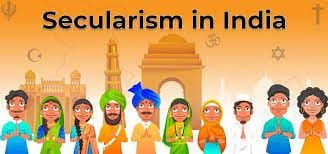
"Indian secularism is not merely a separation of religion and state, but a profound commitment to the harmonious coexistence of diverse faiths, ensuring that all individuals, regardless of their beliefs, enjoy equal respect and opportunities." |
Philosophy Of Indian Secularism
- The term secularism' is related to the Vedic notion of 'Dharma nirapekshata,' which refers to the state's neutrality toward religion.
- Western societies have chosen this secularism model, in which the government is completely divorced from religion (i.e. separation of church and state).
- The Indian ideology of secularism is linked to "Sarva Dharma Sambhava," which implies "equal regard for all religions" (literally, "the endpoint of all religions' pathways is the same, but the paths themselves may be different).
- 'Positive secularism,' as embraced and championed by figures such as Swami Vivekananda and Mahatma Gandhi, embodies the dominant ethos of Indian culture.
- There is no official state religion in India. Different personal laws - such as marriage, divorce, inheritance, and alimony - vary depending on a person's faith.
- Indian secularism is a means to handle religious pluralism and ensure peaceful coexistence of different religions, rather than an aim in itself.
Secularism And The Indian Constitution
All of the main ideas of secularism are clearly included into several clauses of the constitution.
- The forty-second Constitution Amendment Act of 1976 inserted the phrase "secular" to the preamble (India is a sovereign, socialist, secular, democratic, republic).
- The Supreme Court in the S. R. Bommai v. Union of India case 1994 established that the 42nd Amendment made it explicit what was implicit in the Constitution.
- It emphasises that India is a constitutionally secular country with no official religion. And that the state must respect and embrace all religions, rather than favouring or patronising any one.
- While Article 14 guarantees everyone equality before the law and equal protection under the law, Article 15 broadens the definition of secularism by forbidding discrimination on the basis of religion, race, caste, sex, or place of birth.
- Article 16 (1) ensures that all citizens have equal access to public job opportunities and reiterates that no discrimination will be made on the basis of religion, race, caste, sex, descent, place of birth, or domicile.
- Article 25 guarantees 'Freedom of Conscience,' which means that everyone has the right to freedom of conscience and to freely profess, practise, and promote religion.
- According to Article 26, every religious group or individual has the right to organize and maintain religious and philanthropic institutions, as well as to administer its own religious affairs.
- According to Article 27, no citizen shall be compelled to pay taxes for the promotion or maintenance of any religion or any institution.
- Article 28 allows religious instruction to be taught at educational institutions run by various religious groups.
- Minorities have cultural and educational rights under Article 29 and Article 30.
- Article 51A, or Fundamental Duties, requires all citizens to foster unity and the sense of fraternal brotherhood, as well as to cherish and conserve our composite culture's rich heritage.
Indian Vs. Western Model Of Secularism
India has created its own distinct idea of secularism over time, which differs significantly from the equivalent western concept in the following ways:
- According to the western concept of secularism, the "State" and "Religion" each have their own areas of influence, and neither the state nor the religion may intervene in the affairs of the other.
- As a result, the western concept of secularism necessitates the complete separation of religion and government.
- In India, however, there is no 'wall of separation' between religion and the state, either in law or in practise.
- Both the state and religion can, and frequently do, engage and intervene in each other's affairs in India, within the legally regulated and judicially established limitations.
- To put it another way, Indian secularism does not necessitate the complete exclusion of religion from state operations.
- According to the Western paradigm, the state cannot provide financial support to religiously run educational institutions.
- The Indian model, on the other hand, has adopted a constructive approach to involvement.
- In India, all religious minorities have the right to build and operate their own educational institutions, which may be assisted by the government.
- In the Western approach, the state does not meddle in religious matters until religion is operating within the bounds of the law.
Threats To Secularism
- While the Indian Constitution declares the state to be religiously neutral, our society is deeply rooted in religion.
- The mingling of religion and politics, or the mobilization of votes based on primal identities such as religion, caste, and ethnicity, has posed a threat to Indian secularism.
- Communal politics is characterized by the communalization of social space, the propagation of myths and stereotypes against minorities, the attack on rational ideals, and the use of divisive ideological propaganda and politics.
- The politicization of one religious organization leads to the politicization of other religious groups in a competitive manner, culminating in inter-religious conflict.
- Communal riots are one of the forms of communalism. In the recent past, communalism has proven to be a serious challenge to India's secular fabric.
- Islamic fundamentalism or revivalism advocates for the establishment of an Islamic state based on sharia law, which is in direct opposition to secular and democratic state concepts.
Recent News
Hijab Ban & Indian Concept Of Positive Secularism
- It is the responsibility of the state to ensure that a person can profess and practise her faith without jeopardising her other rights.
- The right to religion in terms of practises has been called into question on several occasions; this time, the dispute centred on preventing students from enrolling in college in Karnataka.
- Since the state declares that no one may express their religious identity in public and the prohibition on hijab in public places has been supported by the constitutional courts there, it was contested before the Karnataka High Court.
To Delete "Socialism" & "Secularism" From Preamble To Constitution
- The Supreme Court considered a writ suit brought by Rajya Sabha MP Dr.Subramanian Swamy seeking to remove the phrases "Socialism" and "Secularism" from the Preamble to the Constitution.
- The petitioners contend that the founders of the Constitution never meant to include socialist or secular notions in democratic administration.
- According to reports, Dr. B R Ambedkar resisted the inclusion of these lines because the Constitution cannot impose political ideology on persons by taking away their right to choose.
Ayodhya Ruling
- SC has always upheld and strengthened secularism, but it's Ayodhya ruling is problematic on that score.
- The Supreme Court ruling conveys the notion that even if the majority group takes the law into its own hands and ruins or damages a house of worship of any minority community, it may be rewarded, and the state can wither away.
- This is the most terrifying. In such circumstances, the disadvantaged minority population being disheartened and unhappy might have serious implications for the future.
Conclusion
The history of civilizations and the terrible experiences we've had as a result of communal issues have taught us that secularism is required to overcome religious oddities. Secularism is essential for limiting the majority religion's authority and limiting the use of political power based on religious grounds. It's also to protect people's rights to privacy (i.e., to exit from their religion, embrace another religion or have the freedom to interpret religious teachings). It is vital to ensure intra-religious and inter-religious equality and freedom, as well as to acknowledge religion's universality and plurality. If we achieve an absolute harmonious state, terms like "Unity in Diversity" and "melting pot" of multiculturalism will be used to praise India.
FAQs
Question: What is secularism in the Indian context?
Answer: In India, secularism implies that the state does not favor any religion and ensures equal treatment and respect for all religions. It signifies a commitment to religious neutrality, allowing individuals the freedom to practice any faith or none at all.
Question: How is Indian secularism different from Western secularism?
Answer: Indian secularism is distinct as it allows the state to intervene in religious matters for reform and to ensure equality, unlike Western secularism, which promotes a strict separation of church and state. Indian secularism seeks to balance respect for religion with social justice.
Question: Why was secularism included in the Indian Constitution?
Answer: Secularism was included to promote unity and harmony in India’s diverse society, preventing religious discrimination and safeguarding the rights of religious minorities, thereby fostering a peaceful coexistence.
Question: How does the Indian Constitution protect secularism?
Answer: The Constitution upholds secularism through several articles, including Article 25-28, which guarantee religious freedom, prohibit religious instruction in state-funded institutions, and ensure equality of all religions before the state.
Question: What role does the judiciary play in upholding secularism in India?
Answer: The judiciary plays a critical role in interpreting and enforcing secular principles, ensuring that state actions align with secular values and protecting individuals' rights to religious freedom.
MCQs
1. Which article of the Indian Constitution guarantees freedom of religion?
A) Article 21
B) Article 14
C) Article 25
D) Article 32
Answer: (C) See the Explanation
Explanation: Article 25 of the Indian Constitution guarantees freedom of religion, allowing individuals to practice, profess, and propagate their religion.
2. Which principle does Indian secularism emphasize?
A) Complete separation of religion and state
B) Religious majority control
C) Equal respect for all religions
D) State-sponsored religion
Answer: (C) See the Explanation
Explanation: Indian secularism emphasizes equal respect for all religions rather than complete separation, ensuring no religion is given preferential treatment.
3. What role does the judiciary have in upholding secularism in India?
A) Making religious laws
B) Interpreting secular principles
C) Enforcing religious practices
D) Favoring majority religions
Answer: (B) See the Explanation
Explanation: The judiciary in India interprets secular principles, ensuring that government policies respect all religions equally without favoring any.
4. Secularism was explicitly added to the Indian Constitution in which year?
A) 1947
B) 1950
C) 1976
D) 1985
Answer: (C) See the Explanation
Explanation: The term "secular" was explicitly added to the Preamble of the Indian Constitution by the 42nd Amendment Act in 1976.
5. Which article prohibits religious instruction in state-funded institutions in India?
A) Article 30
B) Article 25
C) Article 28
D) Article 32
Answer: (C) See the Explanation
Explanation: Article 28 of the Indian Constitution prohibits religious instruction in state-funded institutions, supporting the secular nature of the Indian state.
GS Mains Questions and Model Answers
Q1: Discuss the significance of secularism in a diverse country like India.
Answer: Secularism is vital in India, a country with vast religious diversity. It ensures equal respect for all religions, preventing dominance by any single religious group and fostering social harmony. By ensuring that the state does not align with any religion, secularism protects minority rights, promotes religious freedom, and contributes to a unified yet diverse social fabric. This principle is crucial for maintaining peace and preventing religious conflicts, supporting India’s democratic ethos and pluralistic society.
Q2: How does the Indian model of secularism address religious diversity?
Answer: The Indian model of secularism uniquely respects all religions without enforcing a strict separation of religion and state. It allows the state to intervene in religious matters when necessary, promoting reforms for social justice, such as banning untouchability and advocating gender equality in religious practices. This inclusive approach balances religious freedoms with social equity, accommodating diversity while preventing religious discrimination and supporting a cohesive society.
Q3: Evaluate the role of the Indian judiciary in upholding the principle of secularism.
Answer: The judiciary plays a pivotal role in enforcing secular principles by interpreting the Constitution to protect religious freedom and equality. Through landmark judgments, it has reinforced the secular nature of the state, ensuring that laws and policies respect all religions without favoritism. By addressing issues like temple entry, religious conversion, and minority rights, the judiciary ensures that secularism aligns with constitutional values, thus safeguarding India’s diverse social landscape.
Previous Year Questions on Secularism
1. UPSC CSE Prelims 2020:
Question: Which of the following articles of the Indian Constitution deal with the right to freedom of religion?
A) Articles 19-21
B) Articles 23-25
C) Articles 25-28
D) Articles 32-35
Answer: (C)
Explanation: Articles 25 to 28 of the Indian Constitution address the right to freedom of religion, ensuring individuals have the freedom to practice and propagate their religion.
2. UPSC CSE Mains 2019 (GS Paper 1):
Question: "Examine the challenges to secularism in contemporary India and suggest measures to address these challenges."
Answer: Secularism in India faces challenges like religious polarization, political manipulation of religious sentiments, and communal violence. To counter these issues, promoting education that emphasizes tolerance, enforcing strict legal actions against hate speech, and encouraging dialogue between communities are essential. Strengthening laws on discrimination and enhancing judicial intervention to prevent misuse of religion for political gain are also critical. These measures can reinforce secular values, ensuring a balanced and harmonious society.
*email: contactus@prepp.in
Download the PREPP App and attempt FREE IAS Exam Mock Tests and get complete study material!

Full Test - 04: UPSC CSE Prelims CSAT (Paper-II)
Full Test - 03: UPSC CSE Prelims CSAT (Paper-II)
UPSC CSE Prelims 2026 GS Paper 1 Question Paper (24-May-2026)
UPSC CSE Prelims 2026 CSAT Paper 2 Question Paper (24-May-2026)

17 February 2025 | The Hindu Must Read Articles | Current Affairs

16 February 2026 | The Hindu Must Read Articles | Current Affairs

13 February 2026 | The Hindu Must Read Articles | Current Affairs









Comments