Significance of the Preamble - Indian Polity Notes
The preamble is the soul and backbone of the Indian Constitution. It wouldn't make sense to read the Constitution without first reading the preamble. It is the preamble that provides a quick overview of why the Constitution was drafted.
This article gives a brief idea of the significance of the Preamble of the Indian Constitution. It also highlights the important Supreme Court judgements related to the Preamble of the Indian Constitution.
|
Table of Contents |

Content of the Preamble
The preamble's words are carefully chosen, and the arrangement of the terms and their sequence clearly describe their importance and role in the creation of the constitution.
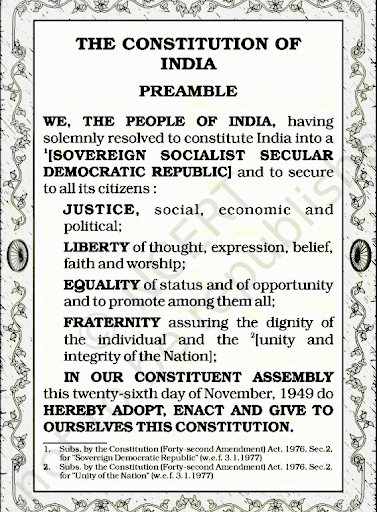
Preamble of the Indian Constitution
The main terms in the Preamble are:
- We, the People of India
- Sovereignty
- Socialism
- Secularism
- Democratic
- Republic
- Justice
- Liberty
- Equality
- Fraternity
*click on the links above to know more about the main terms.
| Other Relevant Links | |
|---|---|
| Text of the Preamble | Preamble Decoded |
| Keywords in the Preamble | Preamble As Part Of The Constitution |
|
B. R. Ambedkar said about the preamble: It was, indeed, a way of life, which recognises liberty, equality, and fraternity as the principles of life and which cannot be divorced from each other. "The Preamble to our Constitution is a beautifully worded declaration of the basic philosophy of the Indian Republic." Nani Palkhivala |
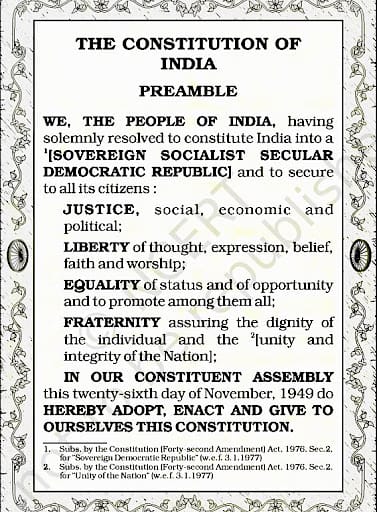
Significance Of The Preamble
- Outlines the Constitution’s Ideals And Philosophy: The Preamble of the Constitution outlines the Constitution's underlying ideals and philosophy, as well as the policy goals and objectives that the founding authors of the Constitution aimed for.
- The Preamble serves as an interpretative tool for the judiciary. Courts often refer to it to understand the intentions of the Constitution's framers and to resolve ambiguities in the constitutional text.
- Justice, Liberty, Equality& Fraternity as Goals: It states that the constitution's goal is to provide justice, liberty, equality, and fraternity to its citizens.
- Aids in Decoding Policies & Legislations: It's a kind of primer on the statute, and it's often quite helpful in decoding the policy and legislative meaning. It expresses "what we'd been thinking or dreaming about for a long time."
- Holds the Principles & Goals Required during the British Rule: It encapsulates all of the principles and goals for which the country fought during the British Regime in a solemn manner.
- People As the Source of the Constitution: It identifies the people of India as the source of the constitution.
- Has an Enacting Clause: It contains the enacting clause, which puts the constitution into effect.
- Has the Fundamental Liberties: It defines the fundamental liberties that the Indian people sought to safeguard for all citizens, as well as the basic style of government and politics that was to be built.
-
An Aid to the Supreme Court: It aids the Supreme Court in determining whether a particular provision or piece of legislation is consistent with the spirit of the Constitution.
Supreme Court Judgements Regarding The Preamble
Union of India v. Madangopal (1953)
The court referred to the word ‘We the people of India' and observed that “the brief of our constitution i.e. preamble derives the authority i.e. citizens of India.
D.S. Nakara v. Union of India (1982)
The court observed that the basic reason to include the term Socialist was to brief the makers so that they can make provisions of the constitution that provide a decent life to the citizen and especially security from cradle to grave.
Air India Statutory Corporation v. United Labour Union (1992)
- The court stated that the main purpose of the concept of socialism is to establish social order through the rule of law.
- The court observed that justice aims to secure the political, social, economic interests of the citizen and provide the opportunity and a standard of life and allow them to live with dignity.
St. Xavier’s College v. the State of Gujarat (1974)
The Supreme Court, in this case, explained the concept of secularism. It does not mean anti-religion but it means that the state will respect every religion and should not interfere in their practices but not follow any religion.
Mohan Lal v. District Magistrate, Rai Bareilly (1992)
The court was of the opinion that democracy as the political concept in which the people directly or through their representatives give their involved in the administration.
Union of India v. Association for Democratic Reforms (2002)
The court was of the opinion that democracy is important and essential for a welfare state, the people should get a chance to elect their leader who can act for the people.
Berubari Union Case (1960)
- The Preamble provides insight into the ideas of the Constitution's framers. If a term in any article of the Constitution is obscure or has more than one interpretation, the Supreme Court recognised that the Preamble could be employed as a guiding principle.
- Despite this acknowledgement of the Preamble's importance, the Supreme Court decided that the Preamble might take the place of the law's express requirements.
- Because the Preamble is not part of the Constitution, the Supreme Court determined in the Berubari case that it can never be recognised as a source of considerable power.
Kesavananda Bharati Case (1973)
- The Supreme Court rejected earlier opinions in the Kesavananda Bharati case (1973), ruling that the Preamble is a part of the Constitution that can be amended under Article 368 of the Constitution.
- The 42nd Amendment subsequently amended the Preamble by adding the terms Socialist, Secular, and Integrity in the Preamble.
- It stated that the Preamble is extremely important and that the Constitution should be read and interpreted in light of the Preamble's big and noble vision.
Union Government v. LIC Of India Case (1995)
- The Supreme Court ruled in the LIC of India case that the Preamble is an integral part of the Constitution.
- Thus, the core ideas, purposes, and philosophical postulates that the Constitution of India stands for are contained in the Preamble to the Constitution of Free India.
Despite the above Supreme Court rulings, two things need to be noted -
- The Preamble is neither a source of power for the legislature nor a limitation on its authority.
- Its provisions are not enforceable in courts of law since it is non-justiciable.
Conclusion
The preamble serves as an introduction to the statutes, or the constitution. A preamble is a declaration issued by the legislature with the goal of passing a statute, and it is useful in the interpretation of any statute. The preamble has a crucial role in determining the country's destiny.
FAQs
Question: What is the significance of the Preamble in the Indian Constitution?
Answer: The Preamble serves as an introduction to the Indian Constitution, outlining the fundamental values such as justice, liberty, equality, and fraternity, which the Constitution aims to uphold.
Question: What does the term 'Sovereign' imply in the Preamble?
Answer: The term 'Sovereign' means that India is free to make its own decisions without being controlled by any external authority or power.
Question: Why is India referred to as a 'Secular' state in the Preamble?
Answer: India is termed as 'Secular' because it does not have an official state religion, and it treats all religions equally, ensuring freedom of religion for all citizens.
Question: How does the Preamble reflect India's commitment to democracy?
Answer: The Preamble reflects India's commitment to democracy by stating that the government derives its authority from the people through free and fair elections.
Question: What is the significance of 'Justice' as mentioned in the Preamble?
Answer: The term 'Justice' in the Preamble refers to social, economic, and political justice for all citizens, ensuring equality and fairness in all aspects of life.
MCQs
1. Which of the following is not mentioned in the Preamble of the Indian Constitution?
A) Liberty
B) Justice
C) Sovereignty
D) Fundamental Rights
Answer: (D) See the Explanation
Fundamental Rights are part of the Constitution but are not explicitly mentioned in the Preamble. The Preamble highlights liberty, justice, and sovereignty as key principles.
2. What does the term 'Republic' signify in the Indian Preamble?
A) India has a monarch as the head of state
B) The head of state is elected
C) Political power is inherited
D) There is no provision for a President
Answer: (B) See the Explanation
The term 'Republic' in the Preamble means that the head of state, the President of India, is elected rather than inheriting the position by birth.
3. What is meant by 'Fraternity' in the Preamble of India?
A) The rule of law
B) A sense of brotherhood and unity among citizens
C) Protection of minority rights
D) Economic equality
Answer: (B) See the Explanation
'Fraternity' refers to promoting a sense of brotherhood and unity among all citizens, ensuring the dignity of the individual and the unity of the nation.
4. Which of the following terms was added to the Preamble by the 42nd Amendment Act of 1976?
A) Sovereign
B) Socialist
C) Democratic
D) Justice
Answer: (B) See the Explanation
The terms 'Socialist' and 'Secular' were added to the Preamble by the 42nd Amendment Act in 1976 to reflect India's commitment to economic and social justice.
5. Which part of the Constitution is often referred to as its 'soul'?
A) Fundamental Rights
B) Directive Principles of State Policy
C) Preamble
D) Schedules
Answer: (C) See the Explanation
The Preamble is often referred to as the 'soul' of the Constitution as it encapsulates the core values and guiding principles that the Constitution upholds.
GS Mains Questions and Model Answers
Q1: Discuss the role of the Preamble in shaping the Indian Constitution.
Answer: The Preamble plays a crucial role in shaping the Indian Constitution by laying down the basic principles and philosophy that guide the Constitution. It emphasizes the ideas of justice, liberty, equality, and fraternity, which are fundamental to the functioning of Indian democracy. The Preamble serves as a moral compass, directing the interpretation of the Constitution and providing a vision of the kind of society the framers intended to create.
Q2: Analyze the significance of the terms 'Socialist' and 'Secular' in the Indian Preamble.
Answer: The inclusion of the terms 'Socialist' and 'Secular' in the Preamble reflects India's commitment to social justice and religious freedom. 'Socialist' signifies the state's responsibility to reduce economic inequality and ensure equitable distribution of resources. 'Secular' emphasizes that India does not recognize any religion as the state religion and promotes equal respect for all religions. Together, these terms reinforce the idea of a socially inclusive and religiously neutral nation.
Q3: How does the Preamble of the Indian Constitution reflect the aspirations of the people of India?
Answer: The Preamble reflects the aspirations of the people of India by outlining the core values of justice, liberty, equality, and fraternity. These ideals represent the collective desire for a just, free, and inclusive society where every individual has the opportunity to live with dignity. The Preamble serves as a guiding light for the nation, embodying the vision of the framers to create a society based on democratic principles and social harmony.
Previous Year Questions on Preamble
1. UPSC CSE Mains 2020 (GS Paper 2)
Question: Discuss the relevance of the Preamble to the Constitution of India in contemporary times.
Answer: The Preamble remains highly relevant in contemporary times as it serves as a reminder of the core values that guide the nation’s democratic functioning. In a time of social and political challenges, the Preamble's emphasis on justice, liberty, equality, and fraternity continues to provide a framework for addressing issues of inequality, religious tolerance, and governance. It reinforces the idea of a sovereign, socialist, secular, and democratic republic that is inclusive and respects the dignity of individuals.
2. UPSC CSE Prelims 2019
Question: Which of the following principles is not mentioned in the Preamble of the Indian Constitution?
A) Liberty
B) Equality
C) Sovereignty
D) Federalism
Answer: D
Explanation: While the Preamble mentions liberty, equality, and sovereignty, the concept of federalism is not explicitly mentioned in the Preamble. Federalism is a structural feature of the Constitution found in other parts.
*email: contactus@prepp.in
Download the PREPP App and attempt FREE IAS Exam Mock Tests and get complete study material!

Live Test : UPSC CSE Prelims CSAT (Paper-II) (Oct 20 - 23)
Full Test - 04: UPSC CSE Prelims CSAT (Paper-II)
Full Test - 03: UPSC CSE Prelims CSAT (Paper-II)
UPSC CSE Prelims 2026 GS Paper 1 Question Paper (24-May-2026)
UPSC CSE Prelims 2026 CSAT Paper 2 Question Paper (24-May-2026)

17 February 2025 | The Hindu Must Read Articles | Current Affairs

16 February 2026 | The Hindu Must Read Articles | Current Affairs

13 February 2026 | The Hindu Must Read Articles | Current Affairs









Comments