Preamble of the Indian Constitution - Indian Polity Notes
Preamble is an introductory and declarative statement that outlines the document's goal and underlying philosophy. The Question of whether the “Preamble is a part of the Constitution or Not?” was decided by two important Supreme Court judgments popularly known as, the Berubari Union Case (1960) and the Kesavananda Bharati case (1973). This article will give insights regarding a few Supreme Court judgments which emphasized the status of the preamble and its amendability.
|
Table of Contents |
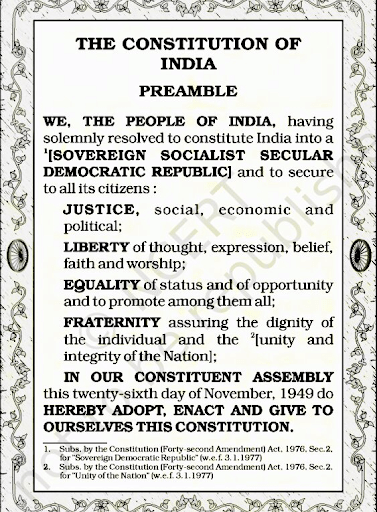
TEXT OF THE PREAMBLE
WE, THE PEOPLE OF INDIA,
having solemnly resolved to constitute India into a
SOVEREIGN, SOCIALIST, SECULAR,DEMOCRATIC, REPUBLIC
and to secure to all of its citizens;
JUSTICE social, economic and political;
LIBERTY of thought, expression, belief, faith and worship;
EQUALITY of status and of opportunity;and to promote among them all;
FRATERNITY assuring the dignity of the individual and the unity and
integrity of the nation;
IN OUR CONSTITUENT ASSEMBLY,
this 26th day of November, 1949, do
HEREBY ADOPT, ENACT AND GIVE TO
OURSELVES THIS CONSTITUTION.
|
"The Preamble of the Constitution is the keynote to the Constitution. It is a key to open the mind of the makers of the Constitution." B.R. Ambedkar. |

Supreme Court Judgements
Berubari Union Case (1960)
- The Preamble provides insight into the ideas of the Constitution's framers. If a term in any article of the Constitution is obscure or has more than one interpretation, the Supreme Court recognized that the Preamble could be employed as a guiding principle.
- Despite this acknowledgement of the Preamble's importance, the Supreme Court held that the preamble can not be considered as part of the Constitution and therefore it is not enforceable in a court of law.
- The Preamble is not the supreme power or source of any restriction or prohibition but it plays an important role in the interpretation of statutes and provisions of the Constitution.
- Because the Preamble is not part of the Constitution, the Supreme Court determined in the Berubari case that it can never be recognized as a source of considerable power.
|
|
|
|---|---|
| Text of the Preamble | Preamble Decoded |
| Keywords in the preamble | Significance of the Preamble |
Kesavananda Bharati Case (1973)
- The Supreme Court rejected earlier opinions in the Kesavananda Bharati case (1973), ruling that the Preamble is a part of the Constitution that can be amended under Article 368 of the Constitution.
- The 42nd Amendment subsequently amended the Preamble by adding the terms Socialist, Secular, and Integrity in the Preamble.
- It stated that the Preamble is extremely important and that the Constitution should be read and interpreted in light of the Preamble's big and noble vision.
Union Government v. LIC of India Case (1995)
- The Preamble is an intrinsic part of the Constitution, according to the Supreme Court in the LIC of India case.
- Thus, the Preamble to the Constitution of Free India contains the essential principles, aims, and philosophical postulates that the Constitution of India stands for.
Despite the above Supreme Court rulings, two things need to be noted -
- The Preamble is neither a source of power for the legislature nor a limitation on its authority.
- Its provisions are not enforceable in courts of law since it is non-justiciable.
Conclusion
A Preamble provides significant help in the interpretation of the Constitution when words actually are ambiguous. The Preamble's intentions are merely a part of the Constitution's essential structure, and nothing more. Finally, it was revealed that courts in India are unable to force the government to carry out the Preamble's principles. The preamble can be amended, and the 42nd Constitutional Amendment Act of 1976 was the only time it was altered.
FAQs
Question. What is the Preamble to the Indian Constitution?
Answer: The Preamble is an introductory statement in the Constitution that outlines the Constitution's goals, philosophy, and the objectives for which the various provisions were framed. It declares India as a Sovereign, Socialist, Secular, Democratic, and Republic state, ensuring justice, liberty, equality, and fraternity to all citizens.
Question. Is the Preamble a part of the Indian Constitution?
Answer: Yes, the Preamble is part of the Indian Constitution. However, it is not justiciable, meaning it cannot be directly enforced in a court of law. It provides insight into the Constitution’s vision, but it does not have legal enforceability.
Question. What does the Preamble say about the governance of India?
Answer: The Preamble defines the form of government as a sovereign, socialist, secular, democratic, republic. It emphasizes the goals of establishing justice, securing liberty, ensuring equality, and promoting fraternity among citizens.
Question. What legal significance does the Preamble have?
Answer: While the Preamble is not enforceable in court, it serves as a guide for interpreting the Constitution. It helps in understanding the intent of the framers, especially when terms in the Constitution are ambiguous.
Question. How did the Supreme Court interpret the Preamble?
Answer: The Supreme Court has ruled that the Preamble is a part of the Constitution, but it is not enforceable. In cases like Kesavananda Bharati (1973), the Court held that the Preamble outlines the Constitution’s philosophical and fundamental principles, but cannot be used to impose or limit powers.
MCQs
- What is the legal status of the Preamble in the Indian Constitution?
A) A part of the Constitution but has no legal effect
B) Not a part of the Constitution and has no legal effect either
C) A part of the Constitution and has the same legal effect as any other part
D) Part of the Constitution but has no legal effect independently of other parts
Answer: (A) See the Explanation
The Preamble is part of the Constitution but is not justiciable, meaning it has no legal effect on its own but guides the interpretation of the Constitution.
- Which of the following words were added to the Preamble by the 42nd Amendment Act, 1976?
A) Secular and Socialist
B) Democratic and Sovereign
C) Justice and Equality
D) Fraternity and Liberty
Answer: (A) See the Explanation
The terms Socialist and Secular were added to the Preamble in 1976 through the 42nd Amendment.
- According to the Supreme Court, the Preamble is:
A) Not a part of the Constitution
B) A guiding principle for interpreting the Constitution
C) Justiciable
D) Part of the Fundamental Rights
Answer: (B) See the Explanation
The Preamble is not justiciable but serves as a guide for interpreting the Constitution’s provisions.
- Which case ruled that the Preamble is part of the Constitution?
A) Berubari Union Case
B) Kesavananda Bharati Case
C) Golaknath Case
D) Union of India v. LIC of India
Answer: (B) See the Explanation
The Kesavananda Bharati case (1973) established that the Preamble is part of the Constitution.
- Which of the following best describes the Preamble of the Indian Constitution?
A) It is the soul of the Constitution
B) It is a reflection of the Constitution’s philosophy
C) It is enforceable by law
D) It is a part of Fundamental Rights
Answer: (B) See the Explanation
The Preamble reflects the philosophical foundation of the Constitution but is not enforceable by law.
GS Mains Questions and Model Answer
Q1: Discuss the significance of the Preamble in the Indian Constitution.
Answer: The Preamble serves as an introductory statement and sets the tone for the Constitution. It outlines the philosophy and vision of the framers, establishing India as a Sovereign, Socialist, Secular, Democratic Republic. The terms like justice, liberty, equality, and fraternity in the Preamble shape the objectives of the Indian state and influence the interpretation of other constitutional provisions. The Preamble also plays a key role in resolving ambiguities in the Constitution's articles and helps in interpreting the law within the framework of the Constitution’s broader principles. Although non-justiciable, the Preamble serves as an essential tool for understanding the Constitution's intent.
Q2: How does the Preamble influence the interpretation of the Constitution?
Answer: The Preamble provides the basic values and goals on which the Constitution is founded. It acts as a guiding principle for interpreting ambiguous provisions. When the language of specific articles is unclear or has multiple interpretations, the Preamble helps in understanding the intent of the framers and provides a framework for judicial interpretation. In cases like Kesavananda Bharati (1973), the Supreme Court emphasized that the Preamble is vital for understanding the philosophical and fundamental principles of the Constitution. It is not enforceable directly but serves as a reference point for interpreting the Constitution.
Q3: Explain the impact of the 42nd Amendment Act, 1976 on the Preamble of the Indian Constitution.
Answer: The 42nd Amendment Act of 1976 made significant changes to the Preamble by adding the terms Socialist and Secular to describe the nature of the Indian Republic. This amendment aimed to reflect the social and political changes that were occurring in the country during that time, aligning the Preamble with the progressive ideals of the government. The addition of these terms helped reaffirm India's commitment to social justice and religious neutrality, reinforcing the values of equality and non-discrimination. The amendment also emphasized the unity and integrity of India, which had been a priority for the government.
Previous Year Questions on Preamble as Part of the Constitution
1. UPSC CSE 2021
Question: Discuss the significance of the Preamble in the Indian Constitution and its impact on the interpretation of fundamental rights.
Answer: This question asks for an analysis of the Preamble’s role in shaping fundamental rights in the Constitution. The answer should focus on how the Preamble guides the interpretation of rights and the overall philosophy behind the right to justice, liberty, equality, and fraternity.
2. UPSC CSE 2020
Question: Explain the legal status of the Preamble of the Indian Constitution and its role in the judicial interpretation of constitutional provisions.
Answer: This question requires an explanation of the legal status of the Preamble in the context of the Constitution. The answer should cover the judicial view that the Preamble is part of the Constitution but is not enforceable, and discuss its significance in interpreting other provisions. The Kesavananda Bharati case and other relevant cases should be mentioned.
*email: contactus@prepp.in
Download the PREPP App and attempt FREE IAS Exam Mock Tests and get complete study material!

Full Test - 04: UPSC CSE Prelims CSAT (Paper-II)
Full Test - 03: UPSC CSE Prelims CSAT (Paper-II)
UPSC CSE Prelims 2026 GS Paper 1 Question Paper (24-May-2026)
UPSC CSE Prelims 2026 CSAT Paper 2 Question Paper (24-May-2026)

17 February 2025 | The Hindu Must Read Articles | Current Affairs

16 February 2026 | The Hindu Must Read Articles | Current Affairs

13 February 2026 | The Hindu Must Read Articles | Current Affairs









Comments