Text of the Preamble - Indian Polity Notes
Preamble defines the aim and objectives of the Constitution.It defines Indian state as Sovereign, Socialist, Secular,Democratic and Republic. Preamble is an introductory and declarative statement that outlines the document's underlying philosophy.The concept of the Preamble was first included in the Constitution of the United States. This was followed by several countries, including India.The Preamble of the Indian Constitution is included in the UPSC Indian Polity and Governance Syllabus. The text of the Preamble is discussed in this article.
|
Table of Contents |
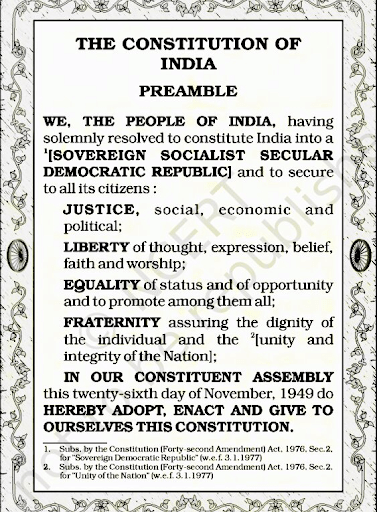
TEXT OF THE PREAMBLE
WE, THE PEOPLE OF INDIA,
having solemnly resolved to constitute India into a
SOVEREIGN, SOCIALIST, SECULAR,DEMOCRATIC, REPUBLIC
and to secure to all of its citizens;
JUSTICE social, economic and political;
LIBERTY of thought, expression, belief, faith and worship;
EQUALITY of status and of opportunity;and to promote among them all;
FRATERNITY assuring the dignity of the individual and the unity and
integrity of the nation;
IN OUR CONSTITUENT ASSEMBLY,
this 26th day of November, 1949, do
HEREBY ADOPT, ENACT AND GIVE TO
OURSELVES THIS CONSTITUTION.
Four Important Aspects
- Constitution’s Power: The Constitution's power is derived from the people of India.
- Nature of the Indian State: It declares India to be a sovereign, socialist, democratic, secular, and republican polity.
- The Constitution's Goals: The Constitution's goals are justice, liberty, equality, and fraternity.
- Date of Adoption: November 26th, 1949
| Other Relevant Links | |
|---|---|
| Preamble Decoded | Keywords in the preamble |
| Significance of the preamble | Preamble as part of the constitution |
Key Terms In The Preamble
Sovereign
Sovereignty means having complete control over one's own affairs without interference from other entities or sources. No foreign force has the authority to impose its will on India's government. It means that India is an independent state, not a dependency or a dominion of any other nation.
Socialist
A socialist is someone who believes that society, rather than private companies, should own or control various goods and services. Thus, socialism is an economic system based on the societal perspective rather than on the individual perspective.
Secular
The term secular means the separation of a state from religion and its affairs. Being secular also describes items, activities, or attitudes that have nothing to do with religion. Secularism in India means the equal treatment of all religions by the state and it is different from western secularism. The Preamble to the Constitution of India proclaimed that India is a secular republic with the passage of the 42nd Amendment in 1976.
Democratic
A democratic government practices democracy as a fundamental form of governance. In such a political system people rule the government either directly or via representatives elected by them. India's citizens elect their governments using a universal adult franchise system known as "one person, one vote." Every Indian citizen above the age of 18 who is not otherwise excluded by law has the right to vote. The term "democratic" encompasses not only political but also social and economic democracy.
Republic
A 'Republic' is a state in which the people and their elected representatives hold supreme power. Rather than a monarch, it has an elected head of state. The term "republic" in our Preamble denotes that India has a president who is elected by the people. The Indian state's goals are as follows: The most sought-after concepts expressed here are justice, equality, liberty, and brotherhood.
Justice
In a society, justice refers to the rule of law, the lack of arbitrariness, and a system of equal rights, freedoms, and opportunities for all. To promote equality for its population, India strives for social, economic, and political justice.
Liberty
Liberty is defined as the freedom that Indian citizens have in their daily lives. This shows that Indian individuals are not subjected to unjustified constraints in terms of what they think, how they express themselves, or how they seek to put their beliefs into action. However, liberty does not imply the ability to do anything one wants, and it must be utilized within the confines of the law.
Equality
The term 'equality' refers to the absence of special privileges for any group in society, as well as the availability of equal opportunities to all people without prejudice.
Fraternity
- Fraternity means a sense of brotherhood and sisterhood among its citizens, as well as a sense of belonging to the country.
- But, Fraternity is the principle which gives unity and solidarity to social life according to Dr. B. R. Ambedkar.
- Fraternity, according to the Preamble, must ensure two things: human dignity and national unity and integrity. The 42nd Constitutional Amendment adds the word 'integrity' to the Preamble (1976).
Conclusion
It serves as a timeless guide, reflecting shared ideals and commitments. Through its concise language, the preamble becomes a foundational statement that resonates with the collective spirit of a community or nation. It stands as a beacon, directing the interpretation and implementation of the Constitution's subsequent articles.
FAQs
Question: What is the Preamble of the Indian Constitution?
Answer: The Preamble of the Indian Constitution is an introductory statement that outlines the objectives and guiding principles of the Constitution. It reflects the values of justice, liberty, equality, and fraternity that the Constitution aims to establish for the people of India. The Preamble sets the tone for the entire Constitution and serves as a guiding framework for its interpretation. It declares India to be a Sovereign, Socialist, Secular, Democratic Republic and highlights the commitment to securing justice and equality for all citizens.
Question: What are the key words mentioned in the Preamble of the Indian Constitution?
Answer: The key words mentioned in the Preamble of the Indian Constitution are:
- Sovereign: India is an independent and self-governing nation, free from external control.
- Socialist: The state aims to promote social and economic equality among all citizens.
- Secular: India does not favor any religion and treats all religions equally.
- Democratic: India is governed by the people, with elections held to choose representatives.
- Republic: The head of the state (the President) is elected, not hereditary.
- Justice: The Preamble emphasizes social, economic, and political justice.
- Liberty: It guarantees liberty of thought, expression, belief, faith, and worship.
- Equality: The state aims to provide equal opportunities and protect against discrimination.
- Fraternity: The Preamble advocates for unity and the dignity of the individual.
Question: What is the significance of the Preamble of the Indian Constitution?
Answer: The Preamble is significant because it lays down the fundamental principles and ideals upon which the Constitution is based. It serves as an introductory declaration of the Constitution’s philosophy, and helps interpret the laws and provisions within the Constitution. It also outlines the vision of the framers of the Constitution regarding justice, equality, and liberty, guiding the judiciary in the interpretation of laws. Though not legally enforceable, the Preamble has a strong persuasive value and is often cited by the courts to clarify constitutional provisions.
Question: Has the Preamble of the Indian Constitution been amended?
Answer: Yes, the Preamble of the Indian Constitution has been amended once. In 1976, the 42nd Amendment Act added the words "Socialist" and "Secular" to the Preamble, further strengthening the ideals of justice and equality. Originally, the Preamble described India as a "Sovereign Democratic Republic," but after the amendment, it became a "Sovereign Socialist Secular Democratic Republic." This change reflected the political and social developments of the time.
Question: What is the relationship between the Preamble and the Constitution of India?
Answer: The Preamble serves as the preface to the Constitution of India, outlining its core values and guiding principles. While it is not legally enforceable by itself, the Preamble plays a crucial role in interpreting the Constitution. The courts often refer to the Preamble to determine the intentions of the framers when interpreting constitutional provisions. The Preamble serves as a beacon for all constitutional amendments and legal provisions, ensuring that they align with the principles of justice, liberty, equality, and fraternity outlined in it.
MCQs
1. Which of the following terms was added to the Preamble of the Indian Constitution by the 42nd Amendment Act, 1976?
A) Sovereign
B) Democratic
C) Secular
D) Republic
Answer: (C) See the Explanation
Explanation: The 42nd Amendment Act, 1976, added the words "Secular" and "Socialist" to the Preamble, thus altering its description of India as a "Sovereign Democratic Republic" to a "Sovereign Socialist Secular Democratic Republic."
2. What does the term 'Republic' in the Preamble of the Indian Constitution imply?
A) The head of the state is a hereditary monarch
B) The head of the state is elected
C) The state does not have a head
D) The state is governed by a dictator
Answer: (B) See the Explanation
Explanation: The term 'Republic' implies that the head of the state (the President of India) is elected, not a hereditary monarch, emphasizing the democratic nature of the Indian state.
3. What is the primary purpose of the Preamble of the Indian Constitution?
A) To set the tone for the entire Constitution
B) To define the fundamental rights of citizens
C) To outline the duties of the state
D) To define the legislative structure of the country
Answer: (A) See the Explanation
Explanation: The primary purpose of the Preamble is to set the tone for the Constitution, outlining the guiding principles such as justice, liberty, equality, and fraternity, which form the foundation of the Indian state.
4. Which of the following words is NOT part of the Preamble of the Indian Constitution?
A) Socialist
B) Secular
C) Federal
D) Republic
Answer: (C) See the Explanation
Explanation: The Preamble of the Indian Constitution includes the terms "Socialist," "Secular," and "Republic," but does not include the term "Federal," as India is a Union of States, not a federation in the strict sense.
5. Which of the following is the guiding principle of the Indian Constitution as stated in the Preamble?
A) Equality
B) Socialism
C) Justice
D) All of the above
Answer: (D) See the Explanation
Explanation: The Preamble of the Indian Constitution mentions guiding principles such as equality, justice, and socialism, reflecting the ideals upon which the Constitution is built.
GS Mains Questions and Model Answers
Q1: Analyze the significance of the Preamble in shaping the constitutional framework of India. How does it guide the interpretation of the Constitution?
Answer: The Preamble plays a significant role in shaping the constitutional framework of India as it reflects the ideals and aspirations of the Constitution's framers. It lays down the foundational principles of justice, liberty, equality, and fraternity, which guide the interpretation of constitutional provisions. The Preamble is not just an introduction but also acts as a guiding framework for the Constitution, influencing the interpretation of laws by the judiciary. Courts have often used the Preamble to interpret ambiguous constitutional provisions in a manner consistent with the values it upholds. For instance, the Preamble’s reference to ‘justice’ has influenced judgments on fundamental rights and social justice, ensuring that the laws align with the ideals of equality and fairness.
Q2: Discuss the impact of the 42nd Amendment on the Preamble. How did it alter the nature of the Indian state?
Answer: The 42nd Amendment, enacted in 1976, introduced the terms ‘Socialist’ and ‘Secular’ into the Preamble of the Indian Constitution, thereby altering the nature of the Indian state. Before the amendment, the Preamble referred to India as a "Sovereign Democratic Republic." After the amendment, India was described as a "Sovereign Socialist Secular Democratic Republic." This change reflected the growing emphasis on economic equality and secularism in the post-independence era. The inclusion of "Socialist" aligned the Constitution with socialist ideals, focusing on reducing inequalities and ensuring equitable distribution of wealth. The term "Secular" reinforced the Constitution's commitment to treating all religions equally and maintaining the separation of religion from the affairs of the state.
Q3: Evaluate the role of the Preamble in ensuring the protection of fundamental rights and freedoms in India.
Answer: The Preamble plays a crucial role in ensuring the protection of fundamental rights and freedoms in India by establishing the guiding principles that underpin the Constitution’s provisions. It declares India to be a democratic republic, committed to ensuring justice, liberty, and equality for all its citizens. These values are reflected in the Fundamental Rights enshrined in Part III of the Constitution. The judiciary has often referred to the Preamble to interpret the scope of these rights, ensuring that the laws protect individual freedoms and promote social justice. For example, the Preamble’s commitment to "fraternity" has been interpreted to mean the protection of human dignity and the fostering of a sense of brotherhood among all citizens, which is reflected in the enforcement of fundamental rights.
Previous Year Questions on the Preamble
1. UPSC CSE Prelims 2021:
Question: The words "Socialist" and "Secular" were added to the Preamble of the Indian Constitution by which amendment?
A) 44th Amendment
B) 42nd Amendment
C) 52nd Amendment
D) 61st Amendment
Answer: (B)
Explanation: The 42nd Amendment of 1976 added the words "Socialist" and "Secular" to the Preamble of the Indian Constitution.
2. UPSC CSE Mains 2020 (GS Paper 2):
Question: "Discuss the role of the Preamble in guiding the interpretation of the Constitution of India."
Answer: The Preamble plays an essential role in guiding the interpretation of the Indian Constitution by providing the core values of justice, liberty, equality, and fraternity. It helps the judiciary interpret constitutional provisions, particularly when the language of certain provisions is vague or ambiguous. For instance, the Preamble’s reference to justice has shaped numerous landmark judgments on fundamental rights and equality, helping to clarify their application in diverse contexts.
Question: The language and ideals of the Preamble of the Constitution of India are influenced/borrowed from which of the following constitution?
- USA
- France
- British
Select the correct option from the codes given below:
(a) 1 and 2 only
(b) 2 and 3 only
(c) 1 and 3 only
(d) All of the above
Answer: (a) See the Explanation
- The language and ideals of the Preamble of the Constitution of India are influenced /borrowed from the US Constitution.
- Ideals of Republic, Liberty, and Fraternity is borrowed from French Constitution
Question: What was the exact constitutional status of India on 26th January, 1950?(UPSC 2021)
(a) A Democratic Republic
(b) A Sovereign Democratic Republic
(c) A Sovereign Secular Democratic Republic
(d) A Sovereign Socialist Secular Democratic Republic
Answer: (b) See the Explanation
The constitutional status of India on 26th January, 1950 was a Sovereign Democratic Republic.The original Preamble, adopted by the Constituent Assembly on 26th November, 1949 and came into force on 26th January, 1950, declared India as a Sovereign Democratic Republic.By the 42nd Amendment of 1976 “Socialist” and“Secular'' words were added. Present status of India is SOVEREIGN SOCIALIST SECULAR DEMOCRATIC REPUBLIC.
Therefore (b) is the correct answer.
Question: The Preamble to the Constitution of India is (UPSC 2020)
(a) A part of the Constitution but has no legal effect
(b) Not a part of the Constitution and has no legal effect either
(c) A part of the Constitution and has the same legal effect as any other part
(d) A part of the Constitution but has no legal effect independently of other part
Answer: (d) See the Explanation
The Preamble to the Constitution of India is a part of the Constitution but has no legal effect independently of other part. In Kesavanand Bharti case (1973), the Supreme Court held that the Preamble is a part of the Constitution and can also be amended under Article 368 of the Constitution. The preamble, therefore, is a part of the Constitution.
Therefore (d) is the correct answer.
*email: contactus@prepp.in
Download the PREPP App and attempt FREE IAS Exam Mock Tests and get complete study material!

Full Test - 04: UPSC CSE Prelims CSAT (Paper-II)
Full Test - 03: UPSC CSE Prelims CSAT (Paper-II)
UPSC CSE Prelims 2026 GS Paper 1 Question Paper (24-May-2026)
UPSC CSE Prelims 2026 CSAT Paper 2 Question Paper (24-May-2026)

17 February 2025 | The Hindu Must Read Articles | Current Affairs

16 February 2026 | The Hindu Must Read Articles | Current Affairs

13 February 2026 | The Hindu Must Read Articles | Current Affairs









Comments