Democratic Socialism - Indian Polity Notes
Democratic socialism is a political philosophy that advocates for a democratic political system alongside a socialist economic system. It also means faith in mixed economy where both the public and private sector co-exist side by side. It aims to end poverty, ignorance and inequality. It is a blend of Marxism and Gandhism. In this article, we will be discussing Democratic Socialism which is important for UPSC Exams.
|
Table of Contents |
Constitutional Provisions Pertaining to Democratic Socialism in India
- The preamble is also known as the essence of the Indian Constitution was amended by the 42nd Constitutional Amendment Act to add three words- socialist, secular, and integrity.
- Socialist principles are also reflected in directive principles of state policy, that aim at providing social and economic justice, leading to a welfare state.
These include:
- Article 38: state to secure a social order for the welfare of people
- Article 39: certain principles of policy to be followed by the state
- Article 39A: equal justice and free legal aid
- Article 41: the right to work, to education, and to public assistance in certain areas
- Article 42: just and humane conditions of work and maternity relief
- Article 43: living wages, etc for workers
- Article 43A: participation of workers in the management of industries
- Article 47: duty of the state to raise the level of nutrition, the standard of living
|
Democratic socialism is a political and economic ideology that advocates for a democratic political system alongside a socialist economic system. |
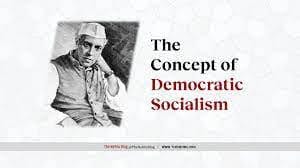
Main Principles of Democratic Socialism
- It advocates slow and reformative change since it believes in evolution.
- It advocates for periodic elections, planning, and a progressive parliamentary assembly..
- It views the state as a good concept. The state, according to democratic socialism, is an important tool for achieving social justice in society.
- It opposes class struggle. According to democratic socialists, divergent interests can be reconciled, allowing for class harmony.
- It rejects economic determinism, recognizing that while economic power is vital, it is not the primary source of power.
- It promotes nationalism and thus national growth.
- It encourages an individual's religious freedom to accept God in any form.
| Other Relevant Links | |
|---|---|
| Western Secularism and Indian Secularism | Republic |
| Justice | Liberty |
| Equality | Fraternity |
| Secular | Sovereignty |
| Socialism | Secularism |
Methods of Democratic Socialism
Non Violent approaches
- As democratic socialism avoids using violent struggle or revolution in any manner possible. There are a variety of nonviolent approaches that can be used to "achieve socialism's goals"
Gradualism
- According to Democratic Socialism, it is vital to proceed step by step. This is sometimes referred to as gradualism.
- Gradualism is inextricably linked to reformism (in the strict sense). Both obviate the need for a drastic adjustment.
- Gradualism has the effect of assisting people in realizing the importance of socialism.
- The democratic socialists believe that socialism cannot be forced upon the people; instead, they must be physically and intellectually equipped to embrace it.
- The former implies that there will be a physical environment conducive to the acceptance of socialism. Mentally, people must also be ready.
Economic Planning
- Economic planning is an important approach of democratic socialism that was created to streamline production and distribution in a planned manner.
- Production and distribution of manufactured goods are managed through planning. Planning is extremely important in a democratic socialist state.
- The management of the economy proceeds in a definite and scientific manner as a result of planning, which ensures the achievement of promised goals, particularly the proper distribution of wealth, and therefore the reduction of inequalities.
- One of the main curses of capitalism, according to democratic socialists, is the huge inequality in income and wealth, which is the result of an uncontrolled economy.
- Democratic socialism strives to save society from this scourge, which is why it strongly argues for the implementation of planning. By planning, we mean making a scientific conclusion and then acting decisively on it.
- The technique of planning was first developed by the former Soviet Union in the 1930s, and it was then adopted by other countries, particularly those pursuing socialism as their objective. In several cases, the Labour Party government in the United Kingdom introduced planning after the Second world war.
People's Participation
- Individuals’ participation in planning activities at all levels is ensured so that people from all walks of life can gain first-hand knowledge of the economy's performance.
- Along with planning, democratic socialism takes a highly practical step, which is the formulation of schemes and projects, as well as the selection of the proper method and time for implementing the plans and projects.
- Planning and this method are inextricably linked. Planning entails taking measured action to ensure that unforeseen events do not impair the economy's operation.
Criticism of Democratic Socialism
- Both Marxists and liberals have challenged democratic socialism. Democratic socialism, according to Marxists, is a sort of regionalism in which Marxism has been modified, and thus the revolutionary DNA of Marxism has been sacrificed. It is unable to recognize capitalism's fundamental character. It is impossible to reform capitalism; it can only be replaced.
- According to liberals, democratic socialism, such as Marxism, places a higher value on collectivity than individual liberty, limiting individual liberty. It places a lot of emphasis on the state as a tool for social change, but expanding the state's power also entails expanding administrative powers.
- It places a lot of emphasis on planning, yet planning has flaws of its own. It suffocates self-initiative.
Judicial Pronouncements Pertaining to Democratic Socialism
- Over the years the judiciary has further strengthened this concept by its various judgments, some of which are listed below:
Samantha vs. State of Andhra Pradesh
- Supreme Court while defining socialism stated that the establishment of egalitarian social order through rule of law is the basic structure of the constitution
S.R. Chaudhari vs. the State of Punjab
- It stated that constitutional provisions should be looked through an object-oriented approach and it should be understood based on its democratic spirit
Conclusion
Democratic socialism presents a vision of a society where political and economic systems are aligned to promote equality, social justice, and democratic participation. While it faces challenges related to efficiency, bureaucracy, and balance, successful examples in various countries demonstrate its potential to provide high standards of living and social welfare within a democratic framework.
FAQs
Question: What is Democratic Socialism?
Answer: Democratic Socialism is a political ideology that combines socialism and democracy, aiming for social and economic equality through government intervention and welfare programs while maintaining democratic freedoms.
Question: How is Democratic Socialism different from traditional socialism?
Answer: Traditional socialism often advocates for the complete abolition of capitalism, while democratic socialism seeks to reform capitalism through regulation, public sector control, and social welfare programs without eliminating private enterprise.
Question: What role does government play in a democratic socialist system?
Answer: In a democratic socialist system, the government plays a key role in regulating the economy, providing social welfare programs, and controlling key industries. Its goal is to reduce inequality and ensure that everyone has access to basic needs like healthcare and education.
Question: How does the Indian Constitution reflect the ideals of Democratic Socialism?
Answer: The Indian Constitution embodies democratic socialist ideals by promoting social justice, economic equality, and welfare measures for its citizens. Provisions for welfare state, Directive Principles of State Policy, and land reforms reflect these values.
Question: What are some examples of welfare measures under Democratic Socialism in India?
Answer: Some examples include universal healthcare, free education, public distribution system (PDS), employment guarantee schemes like Mahatma Gandhi National Rural Employment Guarantee Act (MGNREGA), and pension schemes for the elderly.
MCQs
1. Which of the following best defines Democratic Socialism?A. A system advocating complete state control of all industries
B. A political ideology combining democracy and capitalism
C. A political ideology that seeks social and economic justice within a democratic framework
D. A system that rejects all forms of private enterprise
Answer: (C) See the Explanation
Democratic Socialism seeks to achieve social and economic justice through government intervention and welfare programs within a democratic political system, without completely abolishing private enterprise.
A. Democratic Socialism supports totalitarianism
B. Communism allows private ownership, while Democratic Socialism does not
C. Democratic Socialism works within a democratic system, while communism advocates for a one-party rule
D. Communism emphasizes a mixed economy, while Democratic Socialism focuses on capitalism
Answer: (C) See the Explanation
Communism advocates for a one-party rule with total state control over resources, while Democratic Socialism operates within a democratic framework that upholds political rights and freedoms.
A. Abolition of private property
B. Privatization of public sector enterprises
C. Progressive taxation and public sector control over key industries
D. Deregulation of markets
Answer: (C) See the Explanation
Progressive taxation, public sector control over key industries like railways and defense, and welfare schemes are examples of democratic socialist policies that aim for economic equality.
A. The private sector is completely eliminated
B. The private sector coexists with public sector enterprises under government regulation
C. The private sector is given total control of the economy
D. The private sector operates without any regulations
Answer: (B) See the Explanation
In a democratic socialist economy, the private sector coexists with public sector enterprises, but operates under government regulation to ensure social and economic equity.
A. Fundamental Rights
B. Directive Principles of State Policy
C. Emergency Provisions
D. Federalism
Answer: (B) See the Explanation
The Directive Principles of State Policy in the Indian Constitution promote social justice and economic welfare, aligning with the principles of Democratic Socialism.
GS Mains Questions and Model Answers
1. Discuss the relevance of Democratic Socialism in modern India’s economic and political framework.Answer: Democratic Socialism remains relevant in modern India’s economic and political framework as it aims to balance economic growth with social welfare. While India has embraced a more liberalized economy since the 1990s, the state continues to play a significant role in sectors like education, healthcare, and social security. Policies such as Mahatma Gandhi National Rural Employment Guarantee Act (MGNREGA) and the Public Distribution System (PDS) reflect the country’s commitment to social welfare. However, challenges remain in ensuring equitable distribution of resources, and the need for reforms in public services continues. Democratic Socialism offers a framework for inclusive growth by addressing the needs of the underprivileged while maintaining democratic freedoms.
2. Analyze the role of the Directive Principles of State Policy in promoting Democratic Socialism in India.Answer: The Directive Principles of State Policy (DPSP), enshrined in Part IV of the Indian Constitution, play a crucial role in promoting Democratic Socialism. These principles aim to create a welfare state by ensuring social justice, economic equality, and the upliftment of marginalized communities. Key provisions like promoting the right to work, education, and public assistance for those in need reflect the influence of democratic socialist ideals. While the DPSP is non-justiciable, they guide governments in formulating policies that aim to reduce inequality and provide welfare to all citizens. However, the challenge lies in effectively implementing these policies in a manner that balances economic growth with social justice.
3. Evaluate the effectiveness of welfare schemes in India in achieving the objectives of Democratic Socialism.Answer: Welfare schemes in India, such as MGNREGA, Pradhan Mantri Awas Yojana, and Ayushman Bharat, aim to achieve the objectives of Democratic Socialism by providing essential services and support to the economically weaker sections of society. These schemes have helped reduce poverty, improved healthcare access, and provided employment opportunities, contributing to social and economic equality. However, challenges like bureaucratic inefficiencies, corruption, and resource allocation have limited the effectiveness of these programs. To fully achieve the goals of Democratic Socialism, the government must focus on better implementation, transparency, and ensuring that welfare schemes reach the intended beneficiaries.
Previous Year Questions on Democratic Socialism
1. UPSC CSE Prelims 2018
Question: Which part of the Indian Constitution reflects the principles of Democratic Socialism?
A. Preamble
B. Directive Principles of State Policy
C. Fundamental Rights
D. Schedules
Answer: B. The Directive Principles of State Policy reflect the principles of Democratic Socialism, emphasizing social justice, economic equality, and welfare.
2. UPSC CSE Mains 2017 (GS Paper 2)
Question: "The Indian Constitution embodies the ideals of Democratic Socialism. Discuss the role of Directive Principles of State Policy in achieving these objectives."
Answer: The Indian Constitution embraces the ideals of Democratic Socialism, with the Directive Principles of State Policy (DPSP) playing a key role in guiding the state towards achieving social justice and economic equality. The DPSP provides a framework for the state to create a welfare state through policies that promote education, healthcare, employment, and public assistance. While non-justiciable, these principles influence government policies aimed at reducing inequality and ensuring equitable distribution of resources. Over the years, various welfare programs have been introduced in line with the DPSP to uplift the marginalized sections of society. However, effective implementation and reform are essential to fully realize the objectives of Democratic Socialism.
*email: contactus@prepp.in
Download the PREPP App and attempt FREE IAS Exam Mock Tests and get complete study material!

Full Test - 04: UPSC CSE Prelims CSAT (Paper-II)
Full Test - 03: UPSC CSE Prelims CSAT (Paper-II)
UPSC CSE Prelims 2026 GS Paper 1 Question Paper (24-May-2026)
UPSC CSE Prelims 2026 CSAT Paper 2 Question Paper (24-May-2026)

17 February 2025 | The Hindu Must Read Articles | Current Affairs

16 February 2026 | The Hindu Must Read Articles | Current Affairs

13 February 2026 | The Hindu Must Read Articles | Current Affairs









Comments