President's Rule (Article 356) - Emergency Provisions - Indian Polity Notes
President's Rule is the suspension of state government and imposition of direct union government’s rule in a state. President’s Rule is explained under Article 356 of the Indian Constitution. Under this Article, the President may issue a proclamation to impose emergency in a state if he is satisfied on receipt of a report from the Governor of the State, or otherwise, that a situation has arisen under which the Government of the State cannot be carried on smoothly. It is also known as ‘State Emergency’ or ‘Constitutional Emergency’.
There have been questions on the topic of the President’s Rule in the UPSC exams earlier. This article explains about the President's Rule, Grounds of Declaration, Approval, and Comparison which is useful for UPSC Prelims 2024 as well as Mains 2024.
| To Read update on this topic: |

|
President's Rule is the suspension of state government and imposition of direct union government’s rule in a state
|
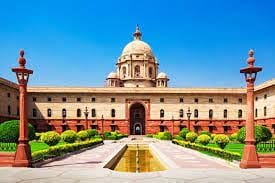
President Rule - Grounds of Declaration
- According to Article 355, the Center has a responsibility to make sure that each state's government is operating in line with the Constitution's rules.
- In the event that the state's constitutional machinery malfunctions, the Center assumes this role and, pursuant to Article 356, assumes control of the state's administration.
- The President’s Rule can be proclaimed under Article 356 on two grounds–one mentioned in Article 356 itself and another in Article 365:
- If the President determines that a situation has developed that prevents a state's administration from continuing in conformity with the Constitution, he or she may issue a proclamation pursuant to Article 356. Notably, the president may decide whether to act based on the state governor's report or not (i.e., even without the governor's report).
- According to Article 365, whenever a state refuses to follow or implement a directive from the centre, it is legal for the president to declare that a situation has developed in which the state's administration can no longer be carried out in accordance with the terms of the constitution.
|
|
|
|---|---|
| Effects of National Emergency | Financial Emergency |
| National Emergency | Criticism of Emergency Provisions |
Parliamentary Approval and Duration of President Rule
- Like National Emergency, such a proclamation must also be placed before both the Houses of Parliament for its approval.
- In this case approval must be given within two months; otherwise, the proclamation ceases to operate.
- Lok Sabha dissolved: If during these two months, the Lok Sabha is dissolved and the Rajya Sabha has approved it, then, the proclamation shall cease to operate on expiration of thirty days from the date on which the Lok Sabha first sits after its reconstitution, unless it is approved by the Lok Sabha before the expiration of this period.
- Period: A proclamation so approved, unless revoked, ceases to operate on the expiration of a period of six months from the date of issue of the proclamation.
- Extension: Unless revoked, its life can be extended by six months each, several times, but in no case beyond three years. Thereafter, the President’s Rule must come to an end, and the normal constitutional machinery must be restored in the State.
- The 44th Amendment introduced a new provision to put restraint on the power of Parliament to extend a proclamation issued under Article 356 beyond one year.
Revocation of President Rule
- Any such Proclamation may be revoked or varied by a subsequent Proclamation.
- It can be revoked by the President at any time without parliamentary approval.
- A proclamation issued under Article 356(1) expires in any of the following modes:
- After two months of its making, it is not presented for approval before both Houses of the Parliament [Article 356(3)].
- Even before two months, if the proclamation on presentation to the Houses of Parliament fails to get approval from any House [Article 356(3)].
- After 6 months from the date of the proclamation, in case no further resolution is passed by the House of Parliament after the passage of the initial resolution approving the said proclamation [Article 356(4)].
- After the expiry of 6 months from the passage of the last resolutions of approval passed by the House of Parliament subject to an overall maximum limit of 3 years from the date of the proclamation. Continuance of the proclamation beyond one year is subject to the fulfilment of the conditions laid down in Article 356(5):
- A National Emergency is already in operation; or if
- The Election Commission certifies that the election to the State Assembly cannot be held.
- These safeguards were added by 44th Constitutional Amendment Act of 1978.
- The date on which the President issues a proclamation of revocation [Article 356(2)].
President’s Rule - Subject to Judicial Review
- The President's approval for imposing President’s Rule under Article 356 became final and conclusive by the 38th Amendment Act of 1975, and it could not be contested in court on any grounds.
- However, the 44th Amendment Act of 1978 later repealed this clause, meaning that the President's satisfaction is subject to judicial review.
Effects of President Rule
- The declaration of emergency due to the breakdown of Constitutional machinery in a State has the following effects:
- The President can assume to himself all or any of the functions of the State Government or he may vest all or any of those functions with the Governor or any other executive authority.
- The President may dissolve the State Legislative Assembly or put it under suspension. He may authorise the Parliament to make laws on behalf of the State Legislature.
- The president dismisses the state Council of Ministers headed by the Chief Minister.
- The President can make any other incidental or consequential provision necessary to give effect to the object of proclamation.
- The President is not, however, authorised to assume the powers of the High Court, or to suspend any constitutional provision pertaining to it.
- It has no effect on Fundamental Rights of the citizens.
Use and Misuse of Article 356
- Dr. B.R. Ambedkar had hoped that Article 356 would be a dead letter. However, experience has shown that Article 356 has become a deadly weapon.
- First used in 1951 (Punjab) it has been used 134 times since then.
- In 1992 President rule was imposed in Madhya Pradesh, Himachal Pradesh, and Rajasthan in the context of which the Supreme Court in 1994 issued guidelines in the judgment S.R Bommai vs Union of India (9 Judge Bench).
- Although the 38th Constitutional Amendment act had made presidential satisfaction immune to judicial review. The 44th Constitutional Amendment act made the same subject to judicial review.
Cases of Proper and Improper Use
In the light of the Sarkaria committee report, further guidelines of this judgment pertained to the proper or improper situation in which president’s rule is imposed. These are:
Cases of proper use
- If the result of the assembly election is a hung assembly.
- If the majority party declines to form a Government.
- No party is willing/able to form a Government.
- If there has been non-compliance by the State with the direction issued by the Union.
- Internal subversion- a Government deliberately acting against Law/Constitution.
- If there is a physical breakdown i.e., to say the government willfully refuse to discharge its function and provide for governance in the state.
Cases of improper use
- Without a floor test, purely based on the assessment of the Governor it is imposed.
- Government falls but the Governor does not explore alternative possibilities to form a government.
- Ruling party’s defeat in Lok Sabha elections.
- Nearly on the ground of maladministration/allegations of corruption/stringent financial exigencies.
- Without giving a prior warning for rectification to the state.
- For intra-party/extraneous purposes.
Criticism of President Rule
- The way President’s Rule was imposed on various occasions has raised many questions.
- At times the situation really demanded it. But at other times, President’s Rule was imposed purely on political grounds to topple the ministry formed by a party different from the one at the Centre, even if that particular party enjoyed a majority in the Legislative Assembly.
- Suspending or dissolving assemblies and not giving a chance to the other political parties to form governments in states has been due to partisan consideration of the Union Government, for which Article 356 has been clearly misused.
Comparison between President’s Rule and National Emergency
| Details | President’s Rule | National emergency |
|---|---|---|
| Constitutional Provisions |
|
|
| Grounds |
|
|
| State legislature |
|
|
| Authority |
|
|
| Period |
|
|
| Centre-state relations |
|
|
| Effects on Fundamental rights |
|
|
| Revocation |
|
|
Conclusion
Even if Article 356 is changed while taking into account all of the Sarkaria Commission's recommendations, there is still a risk of abuse of power because the effectiveness of any law is determined by how well it is enforced. As a result, a rigorous reading of Article 356 can only be expected to retain the spirit of 'co-federation' while selecting for President rule, and the union administration should not exploit this power to further their own political goals.
|
|
|
|---|---|
| Indian Polity UPSC Notes | Emergency Provisions |
| Centre-State Relations | Inter-State Relations |
| Federal System | Parliamentary System |
FAQs
Q1: What is President's Rule in India?
Answer: President's Rule is a provision under Article 356 of the Indian Constitution that allows the central government to take control of a state’s governance in case of a failure of constitutional machinery.
Q2: Under what circumstances can President's Rule be imposed?
Answer: It can be imposed when the President believes that the governance in the state cannot be carried on per the Constitution, usually due to political instability or the breakdown of law and order.
Q3: How long can President's Rule last?
Answer: President's Rule can be imposed for a maximum of six months at a time, but it can be extended up to three years with parliamentary approval.
Q4: What are the implications of President's Rule for the state government?
Answer: The state assembly may be dissolved, and the central government assumes control of state functions, leading to the appointment of a central governor to oversee governance.
Q5: What are the provisions for a state emergency under Article 352?
Answer: Article 352 allows the President to declare a national emergency in case of war, external aggression, or armed rebellion, significantly increasing the powers of the government.
MCQs
- Under which article is President's Rule enacted?
a) Article 352
b) Article 356
c) Article 360
d) Article 370
Answer: (B) See the Explanation
- What is the maximum duration of President's Rule without parliamentary approval?
a) 3 months
b) 6 months
c) 1 year
d) Indefinite
Answer: (B) See the Explanation
- Which of the following is NOT a reason for imposing President's Rule?
a) Political instability
b) Natural disasters
c) Breakdown of constitutional machinery
d) Failure of law and order
Answer: (B) See the Explanation
- Who has the authority to dissolve the state assembly during President's Rule?
a) The Chief Minister
b) The Governor
c) The Prime Minister
d) The President
Answer: (D) See the Explanation
- Which article allows the imposition of a national emergency?
a) Article 352
b) Article 356
c) Article 360
d) Article 370
Answer: (A) See the Explanation
GS Mains Questions and Model Answers
Q1: Explain the significance of President's Rule in the context of Indian federalism.
Answer: President's Rule serves as a crucial mechanism within Indian federalism, allowing the central government to intervene in state affairs during constitutional crises. This provision ensures the maintenance of law and order and constitutional governance when a state government is unable to function effectively. However, its frequent application raises concerns about the centralization of power and undermines the autonomy of states. Balancing federal principles while ensuring accountability is essential for a healthy democratic framework, making the judicious use of President's Rule vital for preserving the federal structure.
Q2: Discuss the checks and balances associated with the imposition of President's Rule in a state.
Answer: The imposition of President's Rule includes several checks and balances to prevent arbitrary use of power. Firstly, the President must be satisfied that the government of the state cannot be carried on in accordance with the Constitution. Additionally, President's Rule is subject to parliamentary approval and must be re-evaluated every six months. Furthermore, state assemblies can question and debate the rationale for its imposition, ensuring accountability. These mechanisms are designed to protect the democratic rights of the states while allowing for necessary intervention during crises.
Q3: Analyze the impact of President's Rule on the political dynamics of a state.
Answer: The imposition of President's Rule can significantly alter the political dynamics of a state. It often leads to the dissolution of the existing government and assembly, paving the way for fresh elections, which may change the political landscape. The central government’s intervention can also influence political alignments, party strategies, and voter sentiments. However, it can be perceived as an infringement on state autonomy, leading to political unrest and opposition from regional parties. The long-term impact hinges on the effectiveness of governance during this period and the subsequent electoral outcomes.
Previous Year Questions on Presidents Rule
1. UPSC CSE 2019
Question: "Discuss the provisions related to President's Rule under the Indian Constitution."
Answer: The provisions for President's Rule are detailed in Article 356 of the Indian Constitution. It allows the President to take over the governance of a state if he/she believes that the state's constitutional machinery has broken down. The state assembly can be dissolved, and the President can appoint a governor to administer the state. Initially, President's Rule can last for six months but can be extended up to three years with parliamentary approval. This mechanism is crucial for maintaining constitutional order and can influence the political scenario significantly.
2. UPSC CSE 2020
Question: "Evaluate the impact of emergency provisions on the federal structure of India."
Answer: Emergency provisions, including President's Rule under Article 356 and the national emergency under Article 352, have profound implications for India's federal structure. They allow the central government to intervene in state matters, which can undermine state autonomy and disrupt the balance of power. While intended to restore order and governance, frequent use can lead to tensions between the central and state governments. These provisions must be applied judiciously to preserve the federal ethos and avoid the perception of authoritarianism. The overall impact is a delicate balance between ensuring stability and respecting federal principles, crucial for India's democratic integrity.
*email: contactus@prepp.in
Download the PREPP App and attempt FREE IAS Exam Mock Tests and get complete study material!

Full Test - 04: UPSC CSE Prelims CSAT (Paper-II)
Full Test - 03: UPSC CSE Prelims CSAT (Paper-II)
UPSC CSE Prelims 2026 GS Paper 1 Question Paper (24-May-2026)
UPSC CSE Prelims 2026 CSAT Paper 2 Question Paper (24-May-2026)

17 February 2025 | The Hindu Must Read Articles | Current Affairs

16 February 2026 | The Hindu Must Read Articles | Current Affairs

13 February 2026 | The Hindu Must Read Articles | Current Affairs









Comments