Effects of National Emergency – Indian Polity Notes
Part XVIII of the Constitution, from Articles 352 to 360, contains the Emergency provisions. These provisions enable the Central Government to effectively respond to any abnormal situation. The rationale for including these provisions in the Constitution is to protect the country's sovereignty, unity, integrity, and security, as well as the democratic political system and the Constitution. In this article we will discuss more about the provisions and effects of National Emergency.
|
Table of Contents |

About National Emergency
- A state of emergency caused by war, external aggression, or armed rebellion is commonly referred to as a 'National Emergency.' However, the term "proclamation of emergency" is used in the Constitution to describe such an emergency.
- The provisions of National Emergency are contained in Article 352.
- When a national emergency is declared due to 'war' or 'external aggression,' it is referred to as a 'External Emergency.'
- When it is declared on the basis of 'armed rebellion,' however, it is known as 'Internal Emergency.'
- This type of emergency has been declared three times previously: in 1962, 1971, and 1975.
- The first declaration of national emergency was issued in October 1962 in response to Chinese aggression in the NEFA (North-East Frontier Agency–now Arunachal Pradesh), and it lasted until January 1968.
- As a result, a new proclamation was not required during the war against Pakistan in 1965.
- In the aftermath of the Pakistan attack, the government declared a second state of emergency in December 1971.
- Even while this Emergency was in effect, a third National Emergency proclamation was issued in June 1975.
- In March 1977, both the second and third proclamations were revoked.
- The first two proclamations (1962 and 1971) were issued on the basis of 'external aggression,' while the third proclamation (1975) was issued on the basis of 'internal disturbance.
| Other Relevant Links | |
|---|---|
| National Emergency | Financial Emergency |
| President’s Rule | Suspension of Fundamental Rights During Emergency |
|
Article 352 empowers the President to declare an emergency if the security of India or any part thereof is threatened by war, external aggression, or armed rebellion. |
Constitutional Provisions
| Articles | Provisions |
|---|---|
| Article 352 |
|
| Article 353 |
Effect of the proclamation of emergency. |
| Article 354 |
Application of provisions relating to the distribution of revenues while a Proclamation of emergency is in operation. |
| Article 355 |
It shall be the duty of the Union to protect every State against external aggression and internal disturbance and to ensure that the government of every State is carried on in accordance with the provisions of this Constitution. |
| Article 357 |
Exercise of legislative powers under Proclamation issued under article 356. |
| Article 358 |
Suspension of provisions of Article 19 during emergencies. |
| Article 359 |
Suspension of the enforcement of the rights conferred by Part III during emergencies. |
Effects of National Emergency
A declaration of emergency has far-reaching consequences for the political system. These consequences can be classified into following types:
Effect on Centre-State Relations
Executive
- During a national emergency, the Centre's executive power extends to directing any state as to how its executive power should be exercised.
- Normally, the Centre can only issue executive directives to a state on a limited number of issues. During a national emergency, however, the Centre gains the authority to issue executive orders to a state on 'any' matter.
- The state governments are thus brought completely under the control of the Centre, though they are not suspended.
Legislative
- During a national emergency, the Parliament is given the authority to pass laws on any subject on the State List.
- Although a state legislature's legislative power is not suspended, it is subject to the Parliament's overriding power.
- As a result, the normal distribution of legislative powers between the Centre and the states is suspended, though state legislatures are not.
- The laws passed by Parliament on state subjects during a National Emergency are rendered ineffective six months after the emergency has ended.
- Notably, while a proclamation of national emergency is in effect, the President has the authority to issue ordinances on state subjects even if Parliament is not in session.
- Furthermore, the Parliament may delegate powers and impose duties on the Centre or its officers and authorities in matters not covered by the Union List in order to carry out laws enacted under its expanded jurisdiction as a result of the declaration of a National Emergency.
Financial
- While a state of national emergency is declared, the President has the authority to change the constitutional distribution of revenues between the centre and the states.
- This means that the president has the authority to either reduce or cancel the transfer of funds from the Centre to the states.
- This modification will continue until the end of the fiscal year in which the Emergency is terminated.
- Furthermore, the President's orders must be laid before both Houses of Parliament.
Effect on Lok Sabha and State Assembly
- While a proclamation of National Emergency is in effect, the Lok Sabha's term may be extended by a law of Parliament for one year at a time (for any length of time)beyond its normal term of five years.
- This extension, however, cannot last longer than six months after the emergency has ended.
- Similarly, during a national emergency, the Parliament may extend the normal tenure of a state legislative assembly (five years) by one year each time (for any length of time), subject to a maximum period of six months after the Emergency has ended.
Effect on Fundamental Rights
Articles 358 and 359 describe how a National Emergency affects Fundamental Rights. Article 358 addresses the suspension of the Fundamental Rights guaranteed by Article 19, whereas Article 359 addresses the suspension of other Fundamental Rights (except those guaranteed by Articles 20 and 21).
Suspension of Fundamental Rights under Article 19
- When a proclamation of national emergency is issued, the six Fundamental Rights enshrined in Article 19 are automatically suspended, according to Article 358.
- The state is exempt from the restrictions imposed by Article 19 while a proclamation of national emergency is in effect.
- In other words, the state has the authority to enact any law or take any executive action that restricts or eliminates the six Fundamental Rights guaranteed by Article 19.
- Any such law or executive action cannot be challenged on the basis that it violates the six Fundamental Rights guaranteed by Article 19.
- When the National Emergency ends, Article 19 automatically reactivates and enters into force.
- Any law enacted during the Emergency that is in conflict with Article 19 is null and void.
- However, no remedy exists for anything done during the Emergency, even after it has ended.
- This means that legislative and executive actions taken during the emergency cannot be challenged after the emergency has ended.
- The scope of Article 358 was limited in two ways by the 44th Amendment Act of 1978.
- To begin, the six Fundamental Rights enshrined in Article 19 can be suspended only when the National Emergency is declared due to war or external aggression, rather than armed rebellion.
- Second, only laws related to the Emergency are immune from challenge, not other laws. Furthermore, only executive action taken in accordance with such a law is protected.
Suspension of other Fundamental Rights
- During a National Emergency, Article 359 allows the president to suspend the right to petition any court for the enforcement of Fundamental Rights.
- The Fundamental Rights are not suspended in their entirety, but only their enforcement.
- The rights mentioned are theoretically alive, but the right to seek redress is suspended.
- The suspension of enforcement only applies to the Fundamental Rights specified in the Presidential Order.
- Furthermore, the suspension could be for the duration of the emergency or for a shorter period specified in the order, and the suspension order could apply to the entire country or to any part of it.
- It should be presented for approval to each House of Parliament.
- While a Presidential Order is in effect, the State may enact any law or take any executive action that restricts or eliminates the specified Fundamental Rights.
- Any such law or executive action cannot be challenged on the basis that it violates the specified Fundamental Rights.
- When the Order expires, any law enacted as a result loses its force to the extent that it is inconsistent with the specified Fundamental Rights.
- However, no remedy exists for anything done while the order is in effect, even if the order is no longer in effect.
- This means that legislative and executive actions taken while the Order is in effect cannot be challenged even after the Order has expired.
- The scope of Article 359 was limited in two ways by the 44th Amendment Act of 1978.
- The President cannot suspend the right to petition the Court for the enforcement of fundamental rights guaranteed by Articles 20–21.
- In other words, even during an emergency, the right to protection from criminal prosecution (Article 20) and the right to life and personal liberty (Article 21) remain enforceable.
- Only laws related to the emergency are protected from challenge, not other laws, and only executive action taken under such a law is protected.
- The President cannot suspend the right to petition the Court for the enforcement of fundamental rights guaranteed by Articles 20–21.
Related Challenges
- The 1975 Emergency (internal emergency) proved to be the most contentious. The misuse of Emergency powers drew widespread condemnation.
- The constitution's federal character will be lost, and the union will become all-powerful.
- Fundamental rights will lose their significance, and the democratic foundation will crumble.
- The state's powers, both in the Union and in the Units, will be concentrated totally in the hands of the union executive.
- The state's financial autonomy will be revoked.
- The president will rise to the position of tyrant.
SC Judgements
- In the Minerva Mills case (1980), the Supreme Court held that National Emergency can be challenged in the court on the ground of malafide or that the declaration was based on wholly extraneous and irrelevant facts.
- The Supreme Court discriminated between Articles 358 and 359 in the case of Makhan Singh v. State of Punjab.
- In the case of Bhut Nath v. State of West Bengal, the Supreme Court held that detention powers cannot be used to subvert, supplant or to substitute punitive law of Penal Code
- Also, to make the position clearer on this matter the 38th Amendment to the constitution added clause 5 to Article 352 saying that the ‘satisfaction of the president as used in Article 352(1) and (3) is to mean “final and conclusive” and “could not be challenged in any court of law”.
- The Supreme Court declares the 39th Constitutional Amendment Act, 1971, void because it violates the basic structure of the Indian Constitution and is unconstitutional.
Constitutional Amendments
38th Amendment Act of 1975
It added the provision that the President may also issue different proclamations on the grounds of war, external aggression, armed rebellion, or imminent danger of such, whether or not a proclamation has already been issued by him and is in effect.
42nd Amendment Act of 1976
It enabled the President to limit the operation of a National Emergency to a specified part of India.
44th Amendment Act of 1978
- Originally, the Constitution listed "internal disturbance" as the third ground for declaring a National Emergency, but the term was vague and had a broader connotation.
- This Amendment changed the words "armed rebellion" to "internal disturbance."
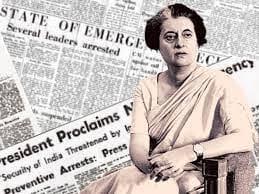
- As a result, it is no longer possible to declare a National Emergency on the basis of 'internal disturbance,' as the Congress government led by Indira Gandhi did in 1975.
- The President may declare a national emergency only after receiving a written recommendation from the cabinet.
- This means that an emergency can only be declared with the approval of the cabinet, rather than simply on the prime minister's advice.
- This amendment enacted this safeguard to eliminate the possibility of the prime minister acting alone in this matter.
Conclusion
The Emergency Provisions provide the President with sweeping powers to deal with abnormal and extraordinary situations. Any misuse of these powers can easily lead to the subversion of democracy. But the actual working of the Constitution for more than five decades has demonstrated that emergency powers were generally used in the interest of the country barring a few cases where emergency was imposed due to political considerations.
| Other Relevant Links | |
|---|---|
| Indian Polity UPSC Notes | |
| Centre-State Relations | Inter-State Relations |
| Federal System | Parliamentary System |
FAQs
Q1: What was the National Emergency in India?
Answer: The National Emergency refers to the period from June 26, 1975, to March 21, 1977, when the Indian government, led by Prime Minister Indira Gandhi, declared a state of emergency under Article 352 of the Constitution, citing internal disturbance.
Q2: What were the key reasons for the imposition of the National Emergency?
Answer: The main reasons included political unrest, widespread protests against the government, and the deteriorating law and order situation. The government claimed that the country faced threats to national security.
Q3: How did the National Emergency affect civil liberties?
Answer: During the Emergency, civil liberties were severely curtailed. Fundamental rights, including the right to free speech and assembly, were suspended, and many opposition leaders were arrested, leading to a climate of fear and repression.
Q4: What was the impact of the National Emergency on Indian politics?
Answer: The Emergency had significant political consequences, including the consolidation of power by the ruling party, widespread public discontent, and the eventual defeat of Indira Gandhi in the 1977 elections, leading to the first non-Congress government.
Q5: How did the National Emergency influence the Indian Constitution?
Answer: The Emergency period prompted discussions about the need for checks and balances in the Constitution. Post-Emergency, the 44th Amendment was enacted to restore and safeguard civil liberties and to ensure that such an overreach of power does not occur in the future.
MCQs
- When was the National Emergency declared in India?
A) January 26, 1950
B) March 21, 1977
C) June 26, 1975
D) December 31, 1980
Answer: (C) See the Explanation
- Which Article of the Indian Constitution allows for the declaration of a National Emergency?
A) Article 356
B) Article 352
C) Article 360
D) Article 370
Answer: (B) See the Explanation
- What was one of the major consequences of the National Emergency?
A) Increased civil liberties
B) Strengthening of the opposition parties
C) Suspension of fundamental rights
D) Formation of new political parties
Answer: (C) See the Explanation
- Which amendment to the Indian Constitution was enacted in response to the excesses during the Emergency?
A) 42nd Amendment
B) 44th Amendment
C) 61st Amendment
D) 73rd Amendment
Answer: (B) See the Explanation
- Who was the Prime Minister of India during the National Emergency?
A) Lal Bahadur Shastri
B) Indira Gandhi
C) Rajiv Gandhi
D) Atal Bihari Vajpayee
Answer: (B) See the Explanation
GS Mains Questions and Model Answers
Q1. Discuss the impact of the National Emergency on civil liberties in India.
Answer: The National Emergency declared in 1975 had a profound impact on civil liberties in India. During this period, fundamental rights guaranteed by the Constitution were suspended, leading to widespread violations of human rights. The government undertook mass arrests of political opponents, curtailing free speech, press, and assembly. Censorship of the media was implemented, and dissent was silenced through intimidation and repression.
This environment created a climate of fear, where citizens were hesitant to express their views or engage in political activities. The Emergency also set a precedent for the misuse of power, leading to long-lasting consequences for democratic institutions. Post-Emergency, the 44th Amendment sought to restore civil liberties and introduced safeguards against such abuses, emphasizing the importance of protecting individual rights within a democratic framework.
Q2. Analyze the political consequences of the National Emergency in India.
Answer: The National Emergency had significant political consequences, altering the landscape of Indian politics. Initially, the Emergency allowed Indira Gandhi to consolidate power, suppressing opposition and strengthening the ruling party's grip on governance. However, the widespread discontent that arose from the suppression of civil liberties led to a backlash against her government.
The Emergency galvanized opposition parties, leading to the formation of the Janata Party, which united various factions against the Congress Party. The political repression experienced during this period ultimately culminated in the 1977 general elections, where Indira Gandhi and the Congress Party faced a historic defeat. This marked the first time a non-Congress government was formed in India, signaling a shift in political dynamics and the importance of accountability and public sentiment in a democratic society.
Q3. Evaluate the constitutional implications of the National Emergency.
Answer: The National Emergency of 1975 brought significant constitutional implications for India. It highlighted the vulnerabilities in the constitutional framework, particularly concerning the balance of power between the executive and legislative branches. The excessive use of emergency powers led to a reevaluation of the provisions within the Constitution, prompting the enactment of the 44th Amendment in 1978.
This amendment aimed to restore civil liberties and impose stricter conditions on the declaration of emergencies, thereby ensuring greater accountability and oversight. It emphasized the need for judicial review of the government's actions during emergencies and sought to prevent the recurrence of such abuses of power. The Emergency period served as a critical lesson in safeguarding democracy and civil rights, reinforcing the necessity for checks and balances in governance.
Previous Year Questions on Effects of National Emergency
1. UPSC CSE 2018
Question. "Evaluate the effects of the National Emergency on Indian democracy."
Answer: The National Emergency declared in 1975 had profound effects on Indian democracy, as it led to the suspension of fundamental rights and a significant curtailment of civil liberties. During this period, political dissent was suppressed, and many opposition leaders were jailed, fostering an atmosphere of fear and repression. The media faced censorship, which restricted the flow of information and stifled public discourse.
However, the Emergency also acted as a catalyst for political awakening among the masses, as citizens united against the excesses of the government. The subsequent defeat of Indira Gandhi in the 1977 elections marked a pivotal moment in Indian politics, highlighting the resilience of democracy. The Emergency's impact underscored the necessity for constitutional safeguards to protect civil rights and maintain democratic governance.
2. UPSC CSE 2020
Question. "Discuss the constitutional safeguards against the misuse of emergency provisions in India."
Answer:The misuse of emergency provisions during the 1975 National Emergency prompted significant constitutional reforms to safeguard against similar occurrences in the future. The 44th Amendment Act of 1978 was enacted to restore civil liberties and establish checks on the executive's power. It reinstated the right to move courts for the enforcement of fundamental rights even during an emergency.
Additionally, the amendment stipulated that a proclamation of emergency must be approved by Parliament within a stipulated time frame and could only be extended for a limited duration. The amendment also clarified the grounds for declaring a national emergency, emphasizing the need for a genuine threat to the security of the nation. These safeguards are crucial for preserving the democratic fabric of the country and ensuring accountability in governance.
*email: contactus@prepp.in
Download the PREPP App and attempt FREE IAS Exam Mock Tests and get complete study material!
UPSC IAS : CSAT - Mini Live Test

Live Test : UPSC CSE Prelims CSAT (Paper-II) (Oct 20 - 23)
Full Test - 04: UPSC CSE Prelims CSAT (Paper-II)
Full Test - 03: UPSC CSE Prelims CSAT (Paper-II)
UPSC CSE Prelims 2026 GS Paper 1 Question Paper (24-May-2026)
UPSC CSE Prelims 2026 CSAT Paper 2 Question Paper (24-May-2026)

17 February 2025 | The Hindu Must Read Articles | Current Affairs

16 February 2026 | The Hindu Must Read Articles | Current Affairs

13 February 2026 | The Hindu Must Read Articles | Current Affairs









Comments