National Emergency (Article 352) - Emergency Provisions - Indian Polity Notes
Article 352 of the Indian Constitution is about the proclamation of emergency. It empowers the President to declare a state of emergency if the security of India or any part thereof is threatened by war, external aggression, or armed rebellion.
During the emergency, the central government gains special powers, and some of the fundamental rights can be suspended or restricted. It is a crucial provision aimed at addressing extraordinary situations that pose a threat to the nation's security and stability. Provisions in Part XVII of the Indian Constitution from Articles 352 to 360 deal with Emergency.
There have been questions on the National Emergency topic in the UPSC Prelims earlier, candidates need to be well acquainted with the facts such as under which article, which type of emergency is declared and on what grounds. This article is useful for Prelims 2024 preparation and UPSC Mains 2024 as well.
|
Table of Contents |

National Emergency - Grounds Of Declaration
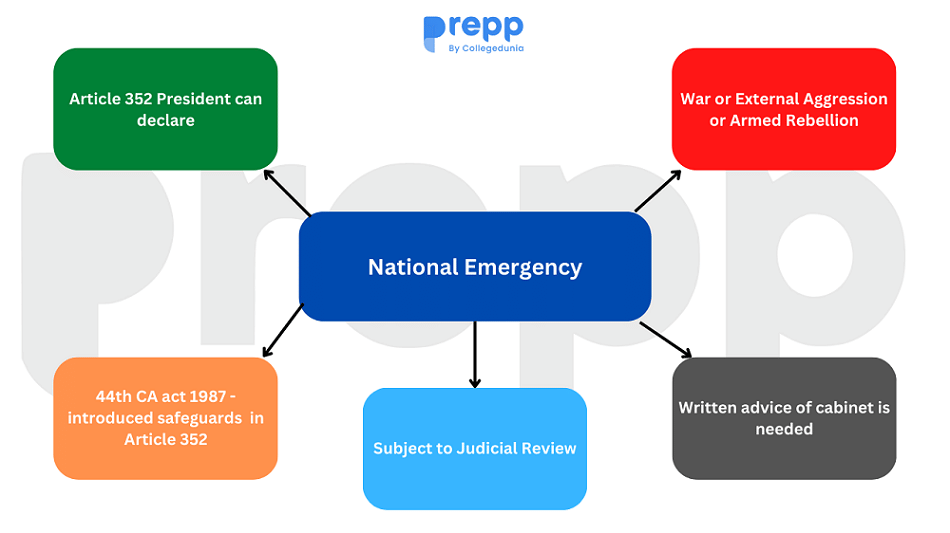
- Under Article 352, the President can declare a national emergency when the security of India or a part of it is threatened by war or external aggression or armed rebellion.
- The president may proclaim a national emergency if he considers there is an urgent danger of war, external aggression, or armed rebellion, even before any of these events actually occur.
- An "External Emergency" is a national emergency that is proclaimed due to "war" or "external aggression." On the other hand, it is referred to as an "internal emergency" when it is proclaimed due to "armed rebellion."
- The word "armed rebellion" was added by the 44th Amendment. It was previously called an internal disturbance.
- Emergency can be declared over the complete territory of India or any part thereof. The 42nd Amendment Act of 1976 enabled the president to limit the operation of a National Emergency to a specific part of India.
- The President can declare an emergency only on the written advice of the cabinet. This means that the emergency may only be proclaimed with the cabinet's approval and not only on the prime minister's recommendation.
- This safeguard was added by 44th Amendment Act of 1978.
Examples
- If war is declared against any neighboring country or any other country by India, in such situation President can declare an ‘External Emergency’
- If the army, police, or any other organization revolts against the government, and the revolt is expressly armed, the insurrection might be classified as "armed rebellion." 'Internal Emergency' is the term for such emergency.
|
Article 352 empowers the President to declare a state of emergency if the security of India or any part thereof is threatened by war, external aggression, or armed rebellion.
|

|
|
|
|---|---|
| Effects of National Emergency | Financial Emergency |
| President’s Rule | Criticism of Emergency Provisions |
Parliamentary Approval And Duration Of National Emergency
- Within a month after its declaration, the declaration of Emergency must be ratified by both Houses of Parliament.
- The 44th Amendment Act of 1978 shortened the two-month time originally given to the Parliament for approval.
- Approval: Every proclamation made under Article 352 (except a proclamation revoking the previous proclamation) should be laid before each house of parliament and must be approved by them with special majority, i.e., by a majority of the total membership of that house and by a majority of not less than 2/3rd of the members of that house present and voting.
- If parliament fails to approve such a proclamation, then it ceases to be in operation on the expiry of one month after the proclamation is made.
- If parliament approves such a proclamation, then it will be in force for 6 months from the date on which it was approved by the parliament, unless revoked earlier.
- It can be approved by parliament any number of times but not beyond 6 months at a time.
- Lok sabha not in session: However, if the proclamation of emergency is issued at a time when the Lok Sabha has been dissolved or the dissolution of the Lok Sabha takes place during the period of one month without approving the proclamation, then the proclamation survives until 30 days from the first sitting of the Lok Sabha after its reconstitution, provided the Rajya Sabha has in the meantime approved it.
- The proclamation of emergency made by the president under Article 352 is subject to the judicial review and its constitutionality can be questioned in a court of law on grounds of malafide intentions.
Revocation Of Proclamation Of National Emergency
- The Proclamation of Emergency may be revoked by the President by another Proclamation at any time during its continuance. Such a Proclamation need not be approved by the Parliament.
- President must revoke if Lok Sabha passes a disapproval resolution by a simple majority.
- This was introduced by the 44thAmendment Act.
- The 44th Amendment Act of 1978 provided that, when one-tenth of the total members of the Lok Sabha give written notice to the Speaker (or to the president if the House is not in session), a special sitting of the House should be held within 14 days for the purpose of considering a resolution disapproving the continuation of emergency.
Effects of National Emergency
The political system is drastically and broadly affected by a declaration of emergency:
Effects on centre-state relations
- When an emergency declaration is in effect, the regular framework of relations between the centre and the state is fundamentally altered.
- Three categories, namely executive, legislative, and financial
On Executive
- The President of India can issue directions to the states as to the manner in which the executive power of the states is to be exercised.
- State governments are not dismissed, they continue to operate, but are brought under the effective control of the centre, which assumes the power to give instructions to the state government, which shall abide by such directions (Article 353(A)).
On Legislature
- Under Article 353 (B) State legislatures continue to operate and legislate, but parliament assumes concurrent legislative power on state subjects and a law such enacted by parliament, shall cease to operate at the expiry of six months after the revocation of national emergency, to the extent of incompetency.
- Further the life of the Lok Sabha may be extended 1 year at a time by Parliament law (Article 83(2)). However, this extension can never be beyond 6 months from the date of revocation of emergency.
On Financial relations
- Under Article 268-279 pertaining to centre state financial relations may be modified by presidential order subject to parliamentary approval as soon as may be (Article 354).
- However, this modification may never go beyond the financial year in which the emergency is revoked.
- The President can suspend the distribution of financial resources between centre and states and centre can make use of any national resource to fight the cost on the basis of which, emergency is declared.
Effects of the Life of the Lok Sabha and State Assembly
- The life of Lok sabha may be extended by a law of Parliament for periods longer than its regular five-year period,one year at a time, up to an unlimited number of years, when a declaration of a national emergency is in effect.
- However, this extension is only valid for a total of six months after the emergency has ended.
- For example the Fifth Lok Sabha's tenure (1971–1977) was twice lengthened by an additional year each time.
- Similarly, the Parliament may extend the normal tenure of a state legislative assembly (five years) by one year each time (for any length of time) during a national emergency, subject to a maximum period of six months after the Emergency has ceased to operate.
Effect on Fundamental Rights
- Article 358 deals with the suspension of the Fundamental Rights guaranteed by Article 19, while Article 359 deals with the suspension of other Fundamental Rights (except those guaranteed by Articles 20 and 21).
- As per Article 358, when a proclamation of national emergency is in operation, the six fundamental rights under Article 19 are suspended only when National Emergency is declared on the ground of war or external aggression and not on the grounds of armed rebellion
- Article 359 authorises the president to suspend the right to move any court for the enforcement of fundamental rights during a National Emergency except for Article 20 and Article 21.
National Emergency declared so far in India
- It has been declared in our country three times so far. For the first time, an emergency was declared on 26 October 1962 after China attacked our borders in the North East. This National Emergency lasted till 10 January 1968, long after the hostilities ceased.
- For the second time, it was declared on 3 December 1971 in the wake of the second India- Pakistan War and was lifted on 21 March 1977 on the basis of external aggression.
- Third National Emergency (called internal emergency) was imposed on 25 June 1975. This emergency was declared on the grounds of ‘internal disturbances’.
Criticism of Emergency Provision
- The constitution's federal character will be lost, and the union will become all-powerful.
- Fundamental rights will lose their significance, and the democratic foundation will crumble.
- The state's powers will be concentrated totally in the hands of the union executive.
- The state's financial autonomy will be undermined.
- The president will rise to the position of tyrant.
Series of Amendments Relating National Emergency
38th Constitutional Amendment Act 1975
- It empowered the president to proclaim a national emergency on different grounds even though an emergency is already under operation. For example, President can issue a different proclamation on grounds of war, external aggression, armed rebellion, or imminent danger thereof, whether or not there is a proclamation already issued by him and such proclamation is in operation.
- It made the declaration of the National Emergency immune to judicial review. But this provision was subsequently deleted by the 44th Amendment Act of 1978.
39th Constitutional Amendment Act 1975
- It was adopted in response to a judgment by the Allahabad High Court, which declared Prime Minister Indira Gandhi's election to the Lok Sabha void on Raj Narain's petition.
- The president, vice president, prime minister, and Speaker of the House of Representatives are no longer subject to the judiciary's jurisdiction. They will be decided by whichever authority the Parliament deems appropriate.
42nd Constitutional Amendment Act 1976
- It empowered the president to modify or vary national emergency. Under the original constitution, only the imposition or revocations were possible.
- Under the original constitution, the president could have imposed a national emergency only over the complete territory of India. This amendment enabled him to rule over a part of the country.
44th Constitutional Amendment 1978
- It was enacted to prevent the misuse of emergency power by the executive.
- It has introduced a number of safeguards in Article 352.
- These are as follows:
- Prior to the 44th Amendment Act 1978, a proclamation of emergency could be issued on the grounds of war or external aggression or internal disturbance. The internal disturbance was a vague one, and could be misused by the executive. The Act therefore introduced the expression "armed rebellion" in place of internal disturbance.
- Initially approval was to be on the basis of simple majority, but at present it needs a special majority.
- There was no parliamentary control, once a proclamation of emergency was approved by it. But now a special sitting of Lok Sabha can be held for the purpose of considering disapproval.
Judicial Pronouncements Related To National Emergency
- In the Minerva Mills case (1980), the Supreme Court held that National Emergency can be challenged in the court on the ground of malafide or that the declaration was based on wholly extraneous and irrelevant facts.
- The Supreme Court discriminated between Articles 358 and 359 in the case of Makhan Singh v. the State of Punjab.
| Article 358 | Article 359 |
|---|---|
| It only acts in an emergency when the country's security is threatened by war or external aggression. | It operates in any emergency proclaimed under Article 352. |
| It deals with the suspension of the Fundamental Rights guaranteed by Article 19 | It deals with the suspension of other Fundamental Rights (except those guaranteed by Articles 20 and 21) |
- In the case of Bhut Nath v. State of West Bengal, the Supreme Court held that it is a political question and not a justiciable issue. Also to make the position more clear on this matter the 38th Amendment to the constitution added clause 5 to Article 352 saying that the ‘satisfaction of the president as used in Article 352(1) and (3) is to mean “final and conclusive” and “could not be challenged in any court of law”.
- Is the 39th Constitutional (Amendment) Act, of 1971 Constitutionally valid?
- For the first time, the Supreme Court stated that Clause 4 of Article 329A is violative and unconstitutional, citing the landmark case of Kesavananda Bharati v. the State of Kerala. It violates the separation of powers principle by delegating judicial functions to the legislature. The amendment was against the "Rule of Law."
- The Supreme Court declares the 39th Constitutional Amendment Act, 1971, void because it violates the basic structure of the Indian Constitution and is unconstitutional.
Other Provisions Related to National Emergency
| Articles | Provisions |
|---|---|
| Article 353 | Effect of the proclamation of emergency. |
| Article 354 | Application of provisions relating to the distribution of revenues while a Proclamation of emergency is in operation. |
| Article 355 | It shall be the duty of the Union to protect every State against external aggression and internal disturbance and to ensure that the government of every State is carried on in accordance with the provisions of this Constitution. |
| Article 357 | Exercise of legislative powers under Proclamation issued under article 356. |
| Article 358 | Suspension of provisions of Article 19 during emergencies. |
| Article 359 | Suspension of the enforcement of the rights conferred by Part III during emergencies. |
Conclusion
Emergency Provisions under Article 352-360 provide the President with powers to deal with abnormal and extraordinary situations. Any misuse of these powers can easily lead to the subversion of democracy. But the actual working of the Constitution for more than six decades has demonstrated that emergency powers were generally used in the interest of the country barring a few cases where an emergency was imposed due to political considerations. In spite of the misuse of emergency provisions in some States, there is a broad consensus that emergency provisions still have a role to play under the conditions prevailing in India.
|
|
|
|---|---|
| Indian Polity UPSC Notes | Emergency Provisions |
| Centre-State Relations | Inter-State Relations |
| Federal System | Parliamentary System |
FAQs
Question: What is a National Emergency in India?
Answer: A National Emergency can be declared by the President of India under Article 352 if there is a threat of war, external aggression, or armed rebellion. This emergency centralizes power, allowing the central government to override state governments, restricts certain rights, and impacts India's federal structure.
Question: What are the types of emergencies under the Indian Constitution?
Answer: The Indian Constitution provides for three types of emergencies: National Emergency (Article 352), State Emergency (Article 356), and Financial Emergency (Article 360). Each emergency addresses specific crises affecting India's sovereignty, states, or financial stability.
Question: What changes did the 44th Amendment make to Emergency Provisions?
Answer: The 44th Amendment (1978) replaced “internal disturbance” with “armed rebellion” as grounds for declaring a National Emergency. It also made parliamentary approval mandatory for continuing an emergency and protected certain fundamental rights from suspension.
Question: How does a National Emergency impact fundamental rights?
Answer: During a National Emergency, fundamental rights under Articles 19 and, in specific cases, Articles 20 and 21 may be suspended. This enables the government to limit freedoms like expression, assembly, and movement to maintain national security.
Question: How long can a National Emergency last in India?
Answer: Once declared, a National Emergency must be approved by Parliament within one month and can last for six months. It can be extended indefinitely with repeated six-month approvals from Parliament.
MCQs
1. Under which Article can the President declare a National Emergency?
A) Article 356
B) Article 352
C) Article 360
D) Article 365
Answer: (B) See the Explanation
Explanation: Article 352 empowers the President to declare a National Emergency if there is a threat of war, external aggression, or armed rebellion.
2. Which amendment restricted the grounds for National Emergency to "war, external aggression, and armed rebellion"?
A) 42nd Amendment
B) 44th Amendment
C) 52nd Amendment
D) 62nd Amendment
Answer: (B) See the Explanation
Explanation: The 44th Amendment replaced “internal disturbance” with “armed rebellion” as valid grounds for a National Emergency.
3. Which Article cannot be suspended even during a National Emergency?
A) Article 19
B) Article 20
C) Article 21
D) Both B and C
Answer: (D) See the Explanation
Explanation: The 44th Amendment protects Articles 20 and 21 (life and personal liberty) from suspension during emergencies.
4. How often must Parliament approve a National Emergency to extend it?
A) Every 6 months
B) Every 3 months
C) Every 1 year
D) Every month
Answer: (A) See the Explanation
Explanation: A National Emergency must be renewed by Parliament every six months for it to remain in effect.
5. Which rights are primarily affected during a National Emergency?
A) Right to equality
B) Right to freedom
C) Right to property
D) Right to education
Answer: (B) See the Explanation
Explanation: Fundamental rights under Article 19, related to freedom, may be restricted during a National Emergency.
GS Mains Questions and Model Answers
Q1: Explain the impact of the 44th Amendment on the emergency provisions in India. How did it change the grounds and implications of a National Emergency?
Answer: The 44th Amendment made significant changes to India’s emergency provisions, particularly for National Emergency under Article 352. It limited the grounds to "war, external aggression, and armed rebellion," replacing "internal disturbance," thus preventing misuse. It introduced mandatory parliamentary approval within a month and periodic renewals every six months. Fundamental rights under Articles 20 and 21 were made inviolable, even during an emergency, reinforcing individual rights against state overreach.
Q2: Discuss the implications of a National Emergency on the federal structure of India. How does it shift the balance of power?
Answer: A National Emergency centralizes power, allowing the Union to override state powers to maintain national security. State legislative powers may be constrained as the Parliament can legislate on state subjects. Additionally, the President can modify revenue distribution between the Union and states, impacting financial autonomy. This provision strengthens the Union government’s control but has been scrutinized for undermining India’s federal framework during emergencies.
Q3: Evaluate the constitutional safeguards in place to prevent the misuse of emergency provisions in India. Are they effective?
Answer: The 44th Amendment introduced safeguards to prevent emergency misuse, requiring Parliament’s approval within one month and six-monthly renewals. Fundamental rights like life and liberty are protected from suspension. Judicial review of the President’s decision to declare an emergency is also permitted. These checks aim to prevent arbitrary use of emergency powers, promoting a balanced approach between security needs and individual rights. However, critics argue that more checks are necessary for effective control.
Previous Year Questions on National Emergency
1. UPSC CSE Prelims 2020:
Question: Which Article was amended to replace "internal disturbance" with "armed rebellion" as grounds for a National Emergency?
A) Article 352
B) Article 356
C) Article 360
D) Article 368
Answer: (A)
Explanation: The 44th Amendment modified Article 352 to limit the grounds for declaring a National Emergency, enhancing its scope and specificity.
2. UPSC CSE Mains 2018 (GS Paper 2):
Question: "Discuss the constitutional provisions regarding the declaration of National Emergency in India. How do these provisions affect the rights and federal framework of the country?"
Answer: The Constitution empowers the President to declare a National Emergency (Article 352) in cases of war, aggression, or armed rebellion. During this period, rights under Article 19 may be suspended, and state powers are consolidated under the Union government. Parliamentary approval is required to maintain the emergency. This centralization can impact federalism, highlighting the tension between state autonomy and national security. The 44th Amendment introduced safeguards to limit misuse and ensure periodic legislative oversight.
*email: contactus@prepp.in
Download the PREPP App and attempt FREE IAS Exam Mock Tests and get complete study material!
UPSC IAS : CSAT - Mini Live Test

Live Test : UPSC CSE Prelims CSAT (Paper-II) (Oct 20 - 23)
Full Test - 04: UPSC CSE Prelims CSAT (Paper-II)
Full Test - 03: UPSC CSE Prelims CSAT (Paper-II)
UPSC CSE Prelims 2026 GS Paper 1 Question Paper (24-May-2026)
UPSC CSE Prelims 2026 CSAT Paper 2 Question Paper (24-May-2026)

17 February 2025 | The Hindu Must Read Articles | Current Affairs

16 February 2026 | The Hindu Must Read Articles | Current Affairs

13 February 2026 | The Hindu Must Read Articles | Current Affairs









Comments