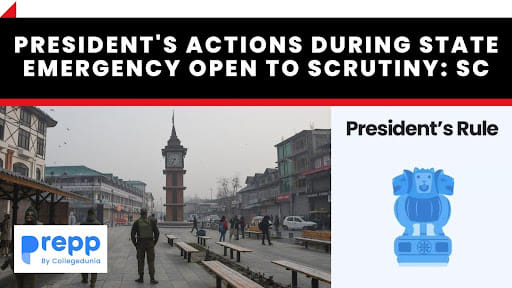
President's Actions During State Emergency Open To Scrutiny: SC
(Source: The Hindu, 12/12/2023)
Click here for Daily Current Affairs
Why in the news?
- Recently, the Supreme Court ruled that the declaration of State Emergency under Article 356 of the Constitution and the subsequent actions of the President must have a reasonable nexus.
- The ruling came in a case challenging the President's actions regarding the imposition of President's Rule in Jammu and Kashmir following the abrogation of Article 370.
Table of Contents
What has the Supreme Court ruled on the President’s powers during a State Emergency?
- The Supreme Court ruled that the imposition of President’s rule in a state and the subsequent actions of the President should have a reasonable nexus.
- The exercise of power by the President under Article 356 must have a reasonable nexus to the object of the Proclamation.
- The Supreme Court laid down ground rules to assess whether the actions or exercise of power by the Parliament or President during the emergency period were mala fide or not.
- The Court claimed that the onus was on the person challenging the actions of the President to prima facie establish if they were a mala fide or extraneous exercise of power.
- In case, a prima facie case was made out, the onus would then shift to the Union to justify that the exercise of power had a reasonable nexus with the object of the proclamation.
- The Chief Justice opined that the power of the Parliament extended beyond mere lawmaking to include executive action as well in a state that was under President’s rule.
- Neither the President nor the Parliament would be restricted by the absence of competence when assuming legislative powers of the State legislature following the declaration of Article 356.
- However, the actions of Parliament, which assumed the role of the state legislature were subject to judicial review, where the court could determine if the exercise of the constitutional power of the state by Parliament had a reasonable nexus with the objective of the proclamation.
- Further, the court claimed that the exercise of power by the President for the everyday administration of the State was not ordinarily subject to judicial review as it could lead to chaos and uncertainty.
How was it applied to the Kashmir issue?
- That court opined that petitioners could question whether the object of the President, while declaring State emergency on the ground of failure of constitutional machinery was to abrogate the special status of Jammu and Kashmir and bifurcate the state.
- The Court referenced the verdict of the Supreme Court in the SR Bommai vs Union of India case to validate the President’s actions in J&K i.e the abrogation of Article 370 while the state of Jammu and Kashmir was under President’s Rule.
- The five-judge bench unanimously upheld the power of the President to abrogate Article 370 of the Constitution and reaffirmed that the President could unilaterally issue a notification that Article 370 ceases to exist.
- The Chief Justice claimed that no material relief could be given even if the court had found that the Proclamation could not have been issued under Article 356 since President’s Rule was revoked in the state on October 31st 2019.
What is the President's Rule?
- President’s Rule or State Emergency or Constitutional Emergency is when the Union government assumes control of the administration of the state.
- Constitutional provisions:
- Article 355: The Centre is responsible for ensuring that the governance of the state is in line with the Constitution. If the state's constitutional machinery malfunctions, the Center assumes this role and assumes control of the state's administration by invoking Article 356.
- Article 356: The President may issue a proclamation to impose an emergency in a state if he is satisfied on receipt of a report from the Governor of the State, or otherwise, that a situation has arisen under which the Government of the State cannot be carried on smoothly.
- When can it be proclaimed: A State Emergency can be invoked on two grounds - one mentioned in Article 356 and one mentioned in Article 365.
- Article 356: If the President determines that a situation has developed that prevents a state's administration from continuing in conformity with the Constitution
- Article 365: The President may declare that a situation has developed in which the state’s administration cannot be carried out in accordance with the Constitution if a state refuses to follow or implement a directive from the Centre.
- Consequences of President's rule:
- The Governor carries out the administration of the state on behalf of the President.
- He/she is assisted by the state's Chief Secretary and other advisors they can appoint.
- The President may declare that the state legislature's powers would be exercised by Parliament or dissolve the State Legislative Assembly or place it under suspension.
- However, the President is not authorized to assume the powers of the High Court or suspend any constitutional provisions related to it.
- Duration of a state emergency: The imposition of President’s Rule in a state requires parliamentary approval.
- The proclamation of President's rule must be approved in both Houses of Parliament within two months through a simple majority.
- The proclamation ceases to exist after six months from the date of issue.
- However, its life can be extended by six months each, up to a maximum of three years following which the normal constitutional machinery must be restored.
- The 44th Amendment (1978) introduced a new provision restraining the power of Parliament to extend a proclamation under Article 356 beyond one year.
- Revocation:
- A Proclamation under Article 356 may be revoked or changed by a subsequent Proclamation.
- It can be revoked by the President only on his own.
- It also stands revoked if not approved by any House of Parliament (even before the two months) and after six months if not approved by Parliament.
- Is judicial review applicable?
- The 38th Amendment Act of 1975 had stated that the imposition of President’s Rule could not be contested in court on any grounds.
- However, the 44th Amendment Act repealed this clause, making it open to judicial review.
To learn more about State Emergency, click the link.
S R Bommai vs Union of IndiaBackground of the case
What was the Supreme Court’s verdict?
Impact of the Ruling
|
Conclusion
The Supreme Court’s recent ruling on the exercise of the President’s powers during a State Emergency has underlined the continuing influence of the SR Bommai judgment in determining the balance of power between the Centre and states and the autonomy of states.
(*Click this link to read prelims specific weekly current affairs articles)
FAQs
Question: What are the emergency powers mentioned in the Indian Constitution?
Answer:
A state of emergency refers to a period of governance that is proclaimed by the President of India during certain crises. The Constitution mentions three types of emergencies
- National Emergency: Under Article 352, the president can declare a national emergency when the security of India or a part of it is threatened by war, external aggression, or armed rebellion.
- State Emergency: Under Article 356, the Union government can take over the government of a state through a presidential order in case of failure of constitutional machinery in a state or if the state does not comply with a directive of the Centre. It is also known as ‘President’s Rule’.
- Financial Emergency: The president is empowered to proclaim a financial emergency if he is satisfied that a situation has arisen due to which the financial stability or credit of India or any part of its territory is threatened.
- It is mentioned in Article 360 of the constitution.
Question: What is judicial review?
Answer:
Judicial review refers to the power of the Indian Judiciary to determine whether a law or decision passed by the Legislative or Executive adheres to the constitutional principles. In case the law is proved to be unconstitutional, the Supreme Court or High Courts reserve the right to declare it null and void.
UPSC Mains Practice Question:
|
MCQs
Question: Which of the following is/are the exclusive power(s) of Lok Sabha?
- To ratify the declaration of Emergency
- To pass a motion of no-confidence against the Council of Ministers
- To impeach the President of India
Select the correct answer using the code given below: (UPSC CSE 2022)
(a) 1 and 2
(b) 2 only
(c) 1 and 3
(d) 3 only
Answer: (b) See the Explanation
- The proclamation of Emergency must be approved by both the Houses of Parliament within one month from the date of its issue.
- If approved by both the Houses of Parliament, the emergency continues for six months and can be extended to an indefinite period with an approval of the Parliament for every six months. Hence statement 1 is incorrect.
- According to Article 75 (3), the Council of Ministers shall be collectively responsible to the House of the People.
- Therefore, only the Lok Sabha can pass a no-confidence motion against the Council of Ministers. Hence statement 2 is correct.
- As per Article 61, when a President is to be impeached for violation of the Constitution, the charges can be initiated by either House of Parliament.
- The impeachment resolution must be passed by a majority of two-thirds of the total membership in each house. Hence statement 3 is incorrect.
Therefore, option (b) is the correct answer.
Question: Which of the following are the discretionary powers given to the Governor of a State?
- Sending a report to the President of India for imposing the President’s rule
- Appointing the Ministers
- Reserving certain bills passed by the State Legislature for consideration of the President of India
- Making the rules to conduct the business of the State Government
Select the correct answer using the code given below. (UPSC CSE 2014)
(a) 1 and 2 only
(b) 1 and 3 only
(c) 2, 3, and 4 only
(d) 1, 2, 3 and 4
Answer: (b) See the Explanation
- According to Article 163 of the Constitution, the Governor shall exercise his functions with the aid and advice of the Council of Ministers except for functions which require his discretion.
- Under Article 356 of the Indian Constitution, the Governor of a State can send a report to the President of India recommending the imposition of presidential rule in the State.
- This is a discretionary power conferred upon the Governor by the Constitution. Hence, statement 1 is correct.
- The Governor appoints the Chief Minister (CM) and other ministers who hold office during his pleasure.
- However, the appointment of ministers is not at the discretion of the Governor. Hence, statement 2 is incorrect.
- The Governor can reserve certain bills passed by the State legislature for the consideration of the President.
- This is a discretionary power of the Governor. Hence, statement 3 is correct.
- The Governor makes rules for the convenient transaction of business of a state government and the allocation of business among the ministers.
- However, this is not a discretionary power as it is done on the advice of the Council of Ministers. Hence, statement 4 is incorrect.
Therefore, option (b) is the correct answer
Download the PREPP App and attempt FREE IAS Exam Mock Tests and get complete study material!

Full Test - 04: UPSC CSE Prelims CSAT (Paper-II)
Full Test - 03: UPSC CSE Prelims CSAT (Paper-II)
UPSC CSE Prelims 2026 GS Paper 1 Question Paper (24-May-2026)
UPSC CSE Prelims 2026 CSAT Paper 2 Question Paper (24-May-2026)

17 February 2025 | The Hindu Must Read Articles | Current Affairs

16 February 2026 | The Hindu Must Read Articles | Current Affairs

13 February 2026 | The Hindu Must Read Articles | Current Affairs









Comments