Monocots or Monocotyledons - Agriculture Notes
Monocotyledons, also known as monocots, are grass and grass-like flowering plants (angiosperms) with only one embryonic leaf, or cotyledon, in their seeds. Monocots dominate vast areas of the planet and account for the vast majority of agricultural plants in terms of biomass production. There are approximately 60,000 monocotyledon species. With over 20,000 species, the orchids are the largest family in this group. This article will explain to you about the Monocots or monocotyledons which will be helpful in preparing the Agriculture Syllabus for the UPSC Civil Service exam.
|
Table of Contents |
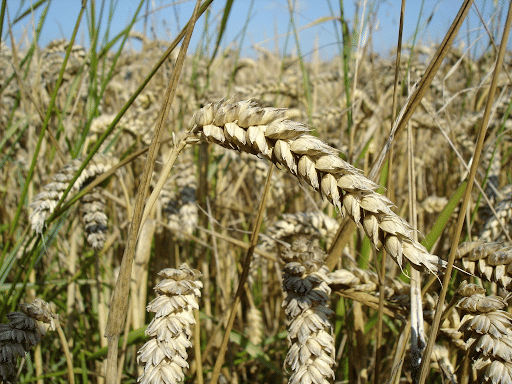
Wheat - An Important Monocot
What are Monocots or Monocotyledons?
- A monocotyledon, also known as a single cotyledon plant, is an angiosperm plant that has a single cotyledon in the seed.
- Monocotyledons have leaves with parallel veins, flower parts in multiples of three, and fibrous root systems.
- Their primary vascular bundles are dispersed throughout the stem rather than arranged in a ring, as in eu-dicotyledons.
- Monocots (and dicots) are flowering plants that bear their reproductive organs in a structure called a flower and cover their seeds by including them in a true fruit.
- Grass, palms, lilies, irises, and orchids are examples of monocotyledons.
- The majority of agricultural biomass is produced by monocotyledons. Forage grasses, sugar cane, and bamboos, as well as major grains, are examples of these (rice, wheat, maize, and so on).
- The orchids (family Orchidaceae) are the largest family in this group (and in the flowering plants), with approximately twenty thousand species.
- These have very complex (and eye-catching) flowers that are adapted to highly specific insect pollination.
- Other economically important monocotyledon crops include various palms (Arecaceae), bananas and plantains (Musaceae), gingers and relatives (Zingiberaceae), turmeric and cardamom (Zingiberaceae), asparagus (Asparagaceae), pineapple (Bromeliaceae), sedges (Cyperaceae) and rushes (Juncaceae), and leeks, onion, and garlic.
- A large proportion of houseplants are monocotyledon epiphytes.
- The majority of horticultural bulbs are monocotyledons, which include lilies, daffodils, irises, amaryllis, cannas, bluebells, and tulips.
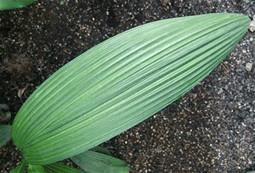
Monocotyledon Leaf
Monocotyledons - Characteristics
- Monocotyledons have almost always been recognized as a group, albeit with varying taxonomic ranks and names.
- Monocots can thus be distinguished from other angiosperms in terms of both uniformity and diversity.
- On the one hand, the shoot organization, leaf structure, and floral configuration are more uniform than in the remaining angiosperms, but within these constraints, there is a wealth of diversity, indicating a high degree of evolutionary success.
- In almost every way, monocot roots are structurally similar to eudicot roots.
- Many eudicots have a taproot or several strong roots, as well as several orders of branch roots, all of which stem from the embryonic root (radicle).
- The primary distinction between monocot and eudicot flowers is the number of parts of each kind.
- Monocot flower parts are typically found in groups of three, occasionally four..
- Monocot pollen has one furrow or pore, whereas dicot pollen has three.
- A monocot embryo has one cotyledon, whereas a dicot embryo has two.
- Monocot stem vascular bundles are dispersed, whereas dicot stem vascular bundles form a ring.
- In monocots, roots are adventitious (developing on a part other than the radical, such as stems and leaves), but in dicots, roots develop from the radicle (primary root and its lateral roots).
- Monocots have parallel major leaf veins, whereas dicots have reticulated major leaf veins.

Characteristics of Monocots
Conclusion
Monocots dominate vast areas of the planet and account for the vast majority of agricultural plants in terms of biomass production. This group contains between 50,000 and 60,000 species. Monocots are important not only ecologically, commercially, and as a food staple, but they also have aesthetic value.
FAQs
Question: What are Monocots or Monocotyledons?
Answer: Monocots or Monocotyledons are a class of angiosperms that have one cotyledon in their seeds. Examples include grasses, lilies, and palms. These plants typically have parallel-veined leaves and flower parts in multiples of three.
Question: What are the main characteristics of Monocots?
Answer: Monocots have one cotyledon, parallel-veined leaves, scattered vascular bundles, and flower parts in multiples of three. Examples include rice, wheat, and orchids. These plants often lack secondary growth in their stems.
Question: How do Monocots differ from Dicots?
Answer: Monocots have one cotyledon, while Dicots have two. Monocots feature parallel veins in their leaves, while Dicots have reticulate venation. Monocots also lack secondary growth, unlike Dicots that often exhibit it.
Question: What are the economic importance of Monocots?
Answer: Monocots are crucial in agriculture, providing staple crops such as rice, wheat, and maize. They are also important for their medicinal properties, ornamental uses, and as a source of fiber and fuel.
Question: What are some examples of Monocots?
Answer: Some common examples of Monocots include rice, wheat, corn, lilies, and palm trees. These plants are integral to both global agriculture and ecosystem balance.
MCQs
1. Which of the following is a characteristic feature of Monocots?
A) Two cotyledons
B) Parallel-veined leaves
C) Flower parts in multiples of five
D) Vascular bundles arranged in a circle
Answer: (B) See the Explanation
Explanation: Monocots have parallel-veined leaves, which is one of their defining characteristics. Unlike Dicots, which have reticulate venation, monocots feature long, parallel veins.
2. What is the number of cotyledons in Monocots?
A) One
B) Two
C) Three
D) Four
Answer: (A) See the Explanation
Explanation: Monocots are defined by having one cotyledon in their seeds, which is a key characteristic distinguishing them from Dicots, which have two cotyledons.
3. Which of the following is an example of a Monocot plant?
A) Sunflower
B) Mango
C) Wheat
D) Pea
Answer: (C) See the Explanation
Explanation: Wheat is an example of a Monocot plant. Other examples of Monocots include rice, corn, and lilies, all of which belong to the Monocotyledon class.
4. What type of venation is found in the leaves of Monocots?
A) Reticulate venation
B) Parallel venation
C) Pinnate venation
D) Palmate venation
Answer: (B) See the Explanation
Explanation: Monocot leaves typically exhibit parallel venation, which means the veins run parallel to each other, unlike the branching pattern found in the leaves of Dicots.
5. Which of the following does not belong to the Monocot group?
A) Rice
B) Banana
C) Sunflower
D) Maize
Answer: (C) See the Explanation
Explanation: Sunflower is a Dicotyledon, not a Monocot. Rice, banana, and maize are all examples of Monocot plants, distinguished by their single cotyledon and other unique features.
GS Mains Questions and Model Answers
Q1: Discuss the importance of Monocots in agriculture and their contribution to the global food supply.
Answer: Monocots, including important crops like wheat, rice, and maize, are vital to global agriculture as staple foods. These crops provide a significant portion of the world's caloric intake and are essential for feeding the growing global population. They also play a key role in the economies of many developing countries. Besides their contribution to food security, Monocots are also used in biofuel production, textiles, and medicine, highlighting their economic and ecological importance. Their efficient cultivation and adaptation to diverse climates make them indispensable in modern agriculture.
Q2: How do Monocots contribute to biodiversity? What role do they play in different ecosystems?
Answer: Monocots contribute significantly to biodiversity by supporting a wide range of ecosystems. They provide essential habitat and food for numerous species of animals and insects, particularly in grasslands and tropical forests. In addition to their role in maintaining plant diversity, Monocots like palms and bamboo are also critical for carbon sequestration, helping to mitigate climate change. Their ability to thrive in varied environmental conditions, from deserts to wetlands, makes them a versatile and important part of the planet’s flora, promoting ecosystem stability and resilience.
Q3: Examine the economic importance of Monocots beyond food production. How do they impact industries such as textiles and energy?
Answer: Beyond food production, Monocots have significant economic value in various industries. In textiles, fibers from plants like jute, hemp, and bamboo (all Monocots) are used to produce clothing, paper, and ropes. In the energy sector, certain Monocots like sugarcane are used for biofuel production, contributing to renewable energy initiatives. Additionally, plants such as palms provide oil, which is a key ingredient in cooking, cosmetics, and industrial products. Their versatility and broad range of applications in agriculture, energy, and industry make Monocots essential to the global economy.
Previous Year Questions on Monocots
1. UPSC CSE Prelims 2021:
Question: Which of the following is a characteristic feature of Monocots?
A) Presence of two cotyledons
B) Parallel venation in leaves
C) Presence of vascular cambium
D) Flower parts in multiples of four
Answer: (B)
Explanation: Monocots are characterized by parallel venation in their leaves. This feature differentiates them from Dicots, which exhibit reticulate venation.
2. UPSC CSE Mains 2020 (GS Paper 2):
Question: Analyze the significance of Monocots in the context of Indian agriculture. Discuss their role in food security and economic development.
Answer: Monocots, such as rice, wheat, and maize, are crucial to India's agriculture. These crops are not only key to food security but also support millions of farmers' livelihoods. They are cultivated in a variety of climates and soil conditions, contributing to crop diversification and stability. With the rising demand for food due to population growth, Monocots are integral to ensuring India's food security. Additionally, their role in industrial sectors like textiles and biofuels further strengthens their economic significance.
Download the PREPP App and attempt FREE IAS Exam Mock Tests and get complete study material!

Full Test - 04: UPSC CSE Prelims CSAT (Paper-II)
Full Test - 03: UPSC CSE Prelims CSAT (Paper-II)
UPSC CSE Prelims 2026 GS Paper 1 Question Paper (24-May-2026)
UPSC CSE Prelims 2026 CSAT Paper 2 Question Paper (24-May-2026)

17 February 2025 | The Hindu Must Read Articles | Current Affairs

16 February 2026 | The Hindu Must Read Articles | Current Affairs

13 February 2026 | The Hindu Must Read Articles | Current Affairs









Comments