Dicots or Dicotyledons - Agriculture Notes
The dicotyledons, also known as dicots, are one of the two groups that previously divided all flowering plants (angiosperms). The name alludes to one of the group's distinguishing features: the seed has two embryonic leaves, or two cotyledons in the seed. This group contains approximately 200,000 species. It is widely assumed that monocotyledons evolved from dicotyledons, and that the latter forms a paraphyletic group. This article will explain to you about the Dicots or dicotyledonous which will be helpful in preparing the Agriculture Syllabus for the UPSC Civil Service exam.
|
Table of Contents |
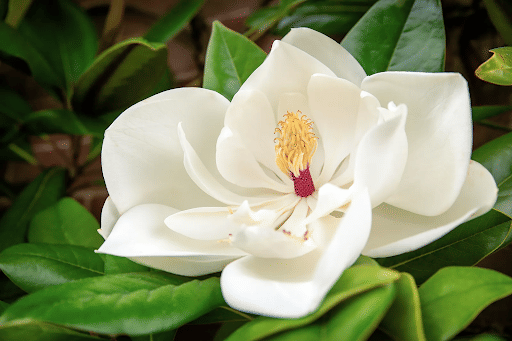
Magnolia - Dicotyledon Plant
What are Dicots or Dicotyledons?
- Dicotyledons, also known as "dicots," are a traditional, major group of flowering plants (angiosperms) whose members typically have two cotyledons, or embryonic leaves, in their seeds and whose flowers have parts in fours or fives, or multiples thereof.
- Flowering plants that are not dicotyledons are classified as monocotyledons, a flowering plant group whose seed typically contains one cotyledon and whose flower parts are generally in threes or multiples of threes.
- This group contains approximately two hundred thousand species, making it the larger of the two traditional angiosperm groups.
- Dicots are named after the number of cotyledons (embryonic leaves) found in the seed embryo—they have two (di-) cotyledons.
- Dicots, unlike monocots, are not a monophyletic group, which means that the evolution of dicot plants cannot be traced back to a single most common ancestor. Instead, a number of lineages diverged before the monocots.
- The primary examples of dicotyledons are oaks, daisies, roses, cacti, and legumes, such as peas, beans, lentils, and peanuts, which all have flowers that develop in clusters.
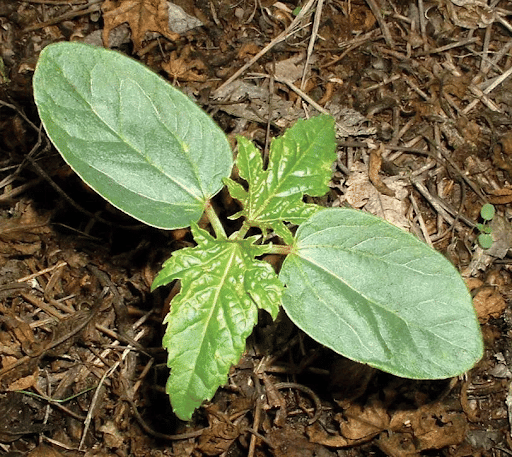
Dicot Plant
Dicotyledons - Characteristics
- A dicot plant's radicle develops into the plant's root. A dicot's root, in particular, is known as a tap root.
- Taproot systems have a long and deep primary root, with secondary root growths branching off of it laterally.
- Secondary growth is the ability of dicots to increase their diameter by producing wood and bark.
- The cork cambium and the vascular cambium are the result of two lateral meristems.
- An epidermis, hypodermis, endodermis, ground tissues, and vascular bundles can be found in a cross-section of a dicot stem.
- Dicot stems typically have multicellular epidermal hairs all over the epidermis, collenchymatous hypodermis, pith, differentiated ground tissues, and a limited number of vascular bundles arranged concentrically.
- The vascular bundles are typically four or eight in number and arranged in one or two rings near the stem's perimeter.
- Pollen grains from dicot plants have physical characteristics that set them apart from pollen grains of other monocot plants.
- The plant embryo is the section of the seed that contains all of the plant's precursor tissues as well as one or more cotyledons.
- A dicot's seed pods vary in size, shape, texture, and structure. Dicot seed pods can have any number of chambers, even zero.
- Dicot seed pods typically contain more seeds than monocot seed pods.
Features of Dicots or Dicotyledons
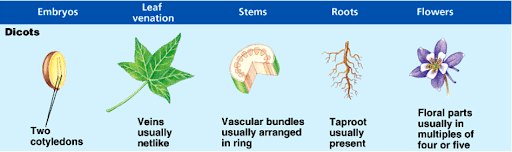
Features of Dicots
Flowers
- These flower parts are pentamerous in dicots. In other words, dicot flower parts are arranged, structured, or numbered in multiples of five, or occasionally four.
- This is not reliable, and it is not the easiest characteristic to look for in flowers with fewer or more parts.
Leaf Venation
- The pattern of veins in a leaf blade is referred to as venation. These veins are in charge of transporting water and carbohydrates throughout the plant.
- These veins are arranged in a net-like, or reticulated, pattern in dicots.
- The veins in such leaves appear to be a finely branched network running the length of the leaf blade, with finer veins reticulating between the major veins.
- Some flowers have reticulated venation but are monocots, such as aroids and dioscoreales families.
Roots
- The radicle, or embryonic root, is the first part of a plant to emerge from the seed.
- It burrows into the ground and begins absorbing nutrients and water from the soil.
- A dicot plant's radicle develops into the plant's root. A dicot's root, in particular, is known as a tap root.
- Tap root systems have a long and deep primary root, with secondary root growths branching off of it laterally.
Stems
- Secondary growth is the ability of dicots to increase their diameter by producing wood and bark.
- The cork cambium and the vascular cambium are the result of two lateral meristems.
- Throughout the life of the woody dicot plant, these lateral meristems continue to produce new cells, eventually increasing the plant's girth.
- Dicots can grow large, tall, and solid because the rigidity of wood and bark provides mechanical support against gravity and desiccation.
Pollen grains
- Pollen grains function similarly to plant male sex cells; they are male gametophytes that produce the plant's sperm cells (male gametes).
- Dicot pollen grains are tricolpate, which means they have three ridges that run through the outer layer.
- This structure evolved from the first angiosperms, which had pollen grains that were monosulcate (having one ridge).
- The monosulcate form, on the other hand, did not survive divergent evolution.
Embryos
- The plant embryo is the section of the seed that contains all of the plant's precursor tissues as well as one or more cotyledons.
- Dicots are distinguished by the presence of two (di-) cotyledons in the seed and two embryonic leaves emerging from the cotyledons.
- A dicot's seed pods vary in size, shape, texture, and structure. Dicot seed pods can have any number of chambers, even zero.
- Dicot seed pods typically contain more seeds than monocot seed pods.
Conclusion
Dicots have flower parts in groups of four or five, in addition to two seed leaves. Furthermore, rather than being randomly distributed, the vascular bundles that carry water and nutrients through the stems of dicots are arranged in concentric circles. They also have roots that grow from the developing seed's radicle, whereas monocot roots are adventitious and can grow from the plant's stems and other parts.
FAQs
Question: What are dicotyledons?
Answer: Dicotyledons (dicots) are a group of angiosperms that have two cotyledons or seed leaves. These plants typically exhibit net-veined leaves, flower parts in multiples of four or five, and a taproot system.
Question: How can dicotyledons be distinguished from monocotyledons?
Answer: Dicots have two cotyledons, net-veined leaves, and flower parts in multiples of four or five, whereas monocots have one cotyledon, parallel-veined leaves, and flower parts in multiples of three.
Question: What are the key characteristics of dicotyledons?
Answer: Key characteristics of dicots include two cotyledons, broad leaves with reticulate venation, presence of vascular bundles arranged in a circle, and flower parts typically in multiples of four or five.
Question: Can dicotyledons be classified into subclasses?
Answer: Yes, dicotyledons are classified into two major subclasses: Magnoliopsida (herbaceous plants) and Dicotyledoneae (woody plants), each with further classifications based on structural differences.
Question: What are some common examples of dicotyledons?
Answer: Common examples of dicotyledons include beans, sunflowers, roses, and oak trees. These plants show the typical features of dicotyledons, such as two cotyledons and broad leaves.
MCQs
1. Which of the following is a characteristic feature of dicotyledons?
A) Single cotyledon
B) Parallel venation
C) Two cotyledons
D) Flower parts in multiples of three
Answer: (C) See the Explanation
Explanation: Dicotyledons are characterized by two cotyledons, as opposed to monocots, which have one cotyledon. They also feature reticulate venation and flower parts in multiples of four or five.
2. What is the primary difference between dicotyledons and monocotyledons?
A) Number of cotyledons
B) Leaf venation
C) Flower part arrangement
D) All of the above
Answer: (D) See the Explanation
Explanation: The primary differences between dicots and monocots include the number of cotyledons (two in dicots, one in monocots), leaf venation (reticulate in dicots, parallel in monocots), and flower part arrangement (multiples of four or five in dicots, and three in monocots).
3. What type of root system is found in dicotyledons?
A) Fibrous root system
B) Taproot system
C) Adventitious root system
D) None of the above
Answer: (B) See the Explanation
Explanation: Dicotyledons typically exhibit a taproot system, where the main root grows thick and deep, branching into smaller lateral roots. In contrast, monocots have a fibrous root system.
4. Which of the following is a common feature of dicotyledons in terms of vascular tissue arrangement?
A) Vascular bundles scattered randomly
B) Vascular bundles arranged in a ring
C) Vascular bundles in parallel rows
D) None of the above
Answer: (B) See the Explanation
Explanation: In dicotyledons, vascular bundles are typically arranged in a ring. This is in contrast to monocots, where vascular bundles are scattered throughout the stem.
5. Which of the following is an example of a dicotyledon?
A) Rice
B) Corn
C) Sunflower
D) Wheat
Answer: (C) See the Explanation
Explanation: Sunflowers are an example of dicotyledons, which have two cotyledons, broad leaves with net-veined venation, and flower parts in multiples of four or five.
GS Mains Questions and Model Answers
Q1: Discuss the differences between dicotyledons and monocotyledons. How do these differences affect their growth and development?
Answer: Dicotyledons and monocotyledons differ in several key characteristics, including the number of cotyledons, venation of leaves, root system, and vascular bundle arrangement. Dicotyledons have two cotyledons, reticulate venation, a taproot system, and vascular bundles arranged in a ring, while monocotyledons have one cotyledon, parallel venation, a fibrous root system, and scattered vascular bundles. These differences lead to variations in growth patterns. For instance, the taproot system in dicots allows for deep rooting, providing stability and access to water, while the fibrous root system in monocots promotes rapid lateral root growth, aiding in the absorption of surface nutrients.
Q2: Explain the significance of dicotyledons in agriculture. What advantages do they offer over monocotyledons in certain crops?
Answer: Dicotyledons play a significant role in agriculture, particularly in crops like pulses, oilseeds, and vegetables. Their broad leaves and deep taproot systems enable them to better withstand drought conditions and provide higher yields under specific conditions. Additionally, dicots often possess a more extensive vascular system that supports larger plant growth. While monocots like cereals have higher yields in terms of volume per hectare, dicots offer advantages in terms of nutritional content and their ability to grow in less fertile soils. Furthermore, dicots are crucial for crop rotation systems, enhancing soil fertility and preventing pest build-up.
Q3: How does the classification of plants into dicotyledons and monocotyledons help in understanding plant evolution?
Answer: The classification of plants into dicotyledons and monocotyledons helps in understanding plant evolution by revealing distinct evolutionary paths. Dicotyledons, which emerged earlier in plant evolution, show more complex features like broad leaves and secondary growth, while monocotyledons, which are more recent, exhibit simpler features like parallel-veined leaves and lack secondary growth. The differences in their morphological and anatomical traits reflect adaptations to different environmental conditions. This classification provides insights into how plants have evolved to exploit different ecological niches, contributing to our understanding of plant diversity and evolution.
Previous Year Questions on Agriculture and Plant Biology
1. UPSC CSE Mains 2021 (GS Paper 3):
Question: "Describe the characteristics of dicotyledons and discuss their significance in agriculture."
Answer: Dicotyledons, characterized by two cotyledons, broad leaves with reticulate venation, and a taproot system, are essential in agriculture for crops like pulses, vegetables, and oilseeds. Their deep-root systems help in drought resistance, and they play an important role in crop rotation.
2. UPSC CSE Mains 2020 (GS Paper 1):
Question: "What are the distinguishing features of monocotyledons and dicotyledons? Explain their importance in plant classification and agricultural systems."
Answer: Monocots, with one cotyledon, parallel leaf venation, and fibrous roots, contrast with dicots that have two cotyledons, net-veined leaves, and a taproot system. The distinction helps in identifying plant species and influences their agricultural use, with dicots being crucial for food and fiber crops.
Download the PREPP App and attempt FREE IAS Exam Mock Tests and get complete study material!

Full Test - 04: UPSC CSE Prelims CSAT (Paper-II)
Full Test - 03: UPSC CSE Prelims CSAT (Paper-II)
UPSC CSE Prelims 2026 GS Paper 1 Question Paper (24-May-2026)
UPSC CSE Prelims 2026 CSAT Paper 2 Question Paper (24-May-2026)

17 February 2025 | The Hindu Must Read Articles | Current Affairs

16 February 2026 | The Hindu Must Read Articles | Current Affairs

13 February 2026 | The Hindu Must Read Articles | Current Affairs









Comments