Kitchen Cabinet – Indian Polity Notes
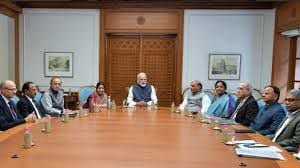
Kitchen cabinet is an informal body made up of the Prime Minister and two to four influential colleagues in whom he has faith and with whom he can discuss any issue. In the formal sense, the cabinet is the highest decision-making body, consisting of the prime minister as its head and 15 to 20 of the most important ministers. However, a much smaller real decision making body known as the 'Inner Cabinet' or 'Kitchen Cabinet' has emerged as the true seat of power.
|
Table of Contents |

What Is A Kitchen Cabinet?
- It is an informal body made up of the Prime Minister and two to four influential colleagues in whom he has faith and with whom he can discuss any issue.
- Every Indian prime minister has had an 'Inner Cabinet'–a circle within a circle. The 'Inner Cabinet,' also known as the 'Kitchen Cabinet,' was particularly powerful during Indira Gandhi's tenure.
|
Kitchen cabinet is an informal body made up of the Prime Minister and two to four influential colleagues in whom he has faith and with whom he can discuss any issue. |
Role And Significance
- It is a much more efficient decision-making body than a large cabinet because it is a smaller unit.
- It can meet more frequently and conduct business much more quickly than the large cabinet.
- It aids the Prime Minister in maintaining secrecy when making important political decisions.
- It advises the prime minister on key political and administrative issues and assists him in making critical decisions.
- It is made up of cabinet ministers as well as outsiders such as the prime minister's friends and family members.
Does The Kitchen Cabinet Have Constitutional Status?
- The Kitchen Cabinet does not have constitutional status.
- It acts as an extra-constitutional body to take decisions and improve the overall efficiency of the Council of Ministers.
Conclusion
The phenomenon of the 'kitchen cabinet' (in which decisions are cooked and presented to the cabinet for formal approval) is not unique to India. It also exists in the United States and the United Kingdom, where it wields considerable power in influencing government decisions.
FAQs
Question: What is a Kitchen Cabinet?
Answer: A Kitchen Cabinet is an informal advisory body of trusted colleagues and confidants of the Prime Minister that aids in quick decision-making.
Question: How does the Kitchen Cabinet differ from the formal Cabinet?
Answer: The formal Cabinet is constitutional and larger, while the Kitchen Cabinet is an informal, smaller group for confidential discussions.
Question: Does the Kitchen Cabinet have constitutional authority?
Answer: No, the Kitchen Cabinet is extra-constitutional and functions without formal authority.
Question: Why is the Kitchen Cabinet important in governance?
Answer: It allows the Prime Minister to make quick decisions and maintain confidentiality on sensitive matters.
Question: Is the Kitchen Cabinet unique to India?
Answer: No, similar informal advisory groups exist in other countries like the United States and the United Kingdom.
MCQs
1. What is the primary function of a Kitchen Cabinet?
A. Making formal decisions
B. Providing confidential advice to the Prime Minister
C. Appointing ministers
D. Drafting bills
Answer: (B) See the Explanation
A Kitchen Cabinet offers informal, confidential advice to the Prime Minister.
2. How many members typically constitute a Kitchen Cabinet?
A. 10-15
B. 2-4
C. 5-7
D. 15-20
Answer: (B) See the Explanation
The Kitchen Cabinet usually consists of 2-4 close confidants of the Prime Minister.
3. Which of the following is NOT a feature of the Kitchen Cabinet?
A. Constitutional authority
B. Confidential discussions
C. Informal advisory body
D. Quick decision-making
Answer: (A) See the Explanation
The Kitchen Cabinet does not have constitutional authority.
4. Who was known for having a strong Kitchen Cabinet during their tenure?
A. Indira Gandhi
B. Jawaharlal Nehru
C. Rajiv Gandhi
D. Manmohan Singh
Answer: (A) See the Explanation
Indira Gandhi was known for using her Kitchen Cabinet effectively.
5. Which of the following is a key role of the Kitchen Cabinet?
A. Enforcing laws
B. Managing public relations
C. Assisting in crisis management
D. Passing constitutional amendments
Answer: (C) See the Explanation
The Kitchen Cabinet often helps the Prime Minister manage crises swiftly.
GS Mains Questions and Model Answers
Q1: Examine the role of the Kitchen Cabinet in the Indian political system.
Answer: The Kitchen Cabinet plays a vital role in facilitating quick decision-making and maintaining confidentiality in India's political system. It enables the Prime Minister to discuss sensitive matters in a smaller, trusted group. Although informal and extra-constitutional, it is a crucial mechanism in managing crises and offering confidential advice. Its influence can be seen in the decision-making process, especially during times of political instability.
Q2: Discuss the advantages and disadvantages of the Kitchen Cabinet in comparison to the formal Cabinet.
Answer: The Kitchen Cabinet provides the advantage of quicker decision-making and confidentiality. It allows the Prime Minister to work with trusted advisors, free from formalities. However, its lack of transparency and constitutional accountability can raise concerns about undermining the formal Cabinet's authority. The informal nature of the Kitchen Cabinet might lead to bypassing collective responsibility.
Q3: Analyze the constitutional limitations of the Kitchen Cabinet in India.
Answer: The Kitchen Cabinet is an extra-constitutional entity with no formal powers. While it plays a role in offering confidential advice to the Prime Minister, it does not hold any legal authority. This creates a dichotomy where decisions influenced by the Kitchen Cabinet must still be ratified by the formal Cabinet, thus limiting its overall constitutional legitimacy.
Previous Year Questions on Kitchen Cabinet
1. UPSC CSE Prelims 2015
Question: Which of the following statements about the Kitchen Cabinet is correct?
A. It is a constitutional body
B. It has no constitutional authority
C. It consists of all Cabinet ministers
D. It makes binding decisions
Answer: B
Explanation: The Kitchen Cabinet is an informal and extra-constitutional advisory body.
2. UPSC CSE Mains 2014 (GS Paper 2)
Question: “The size of the Cabinet should be as big as governmental work justifies and as small as the Prime Minister can manage as a team.” Discuss the relevance of this statement in light of the Kitchen Cabinet.
Answer: The statement emphasizes the importance of efficiency in decision-making. A smaller, more manageable body like the Kitchen Cabinet allows the Prime Minister to work with trusted advisors efficiently. However, the lack of formal structure can also bypass collective decision-making processes, which may be a drawback. Thus, the Kitchen Cabinet offers both opportunities for quick governance and challenges in maintaining democratic accountability.
*email: contactus@prepp.in
Download the PREPP App and attempt FREE IAS Exam Mock Tests and get complete study material!
Live Test : UPSC IAS : GS - Modern History - Subject Knowledge Test

Live Test : UPSC CSE Prelims CSAT (Paper-II) (Oct 20 - 23)
Full Test - 04: UPSC CSE Prelims CSAT (Paper-II)
Full Test - 03: UPSC CSE Prelims CSAT (Paper-II)
UPSC CSE Prelims 2026 CSAT Paper 2 Question Paper (24-May-2026)
UPSC CSE Prelims 2026 GS Paper 1 Question Paper (24-May-2026)

17 February 2025 | The Hindu Must Read Articles | Current Affairs

16 February 2026 | The Hindu Must Read Articles | Current Affairs

13 February 2026 | The Hindu Must Read Articles | Current Affairs









Comments