Article 88 – Rights of Ministers as Respects the Houses - Indian Polity Notes
Article 88 of the Constitution deals with the Rights of Ministers as respects the houses. Every Minister and the Attorney-General of India shall have the right to speak and take part in the proceedings of either House, any joint sitting of the Houses and any Committee of Parliament of which he may be named a member. But he shall not be entitled to vote.
This article explains, Article 88 - Rights of Ministers as Respects the Houses is important for UPSC IAS exam preparation.
|
Table of Contents |
|
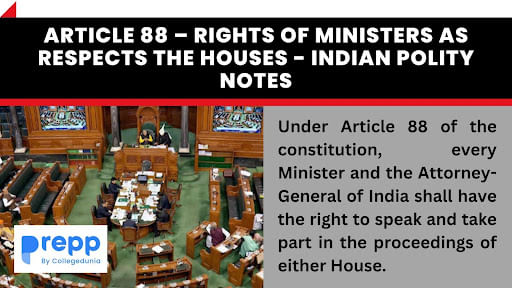
Under Article 88 of the constitution, every Minister and the Attorney-General of India shall have the right to speak and take part in the proceedings of either House. |
Article 88 – Rights of Ministers as Respects the Houses
- Ministerial rights in relation to the Houses of Parliament are discussed in Article 88 of the Indian Constitution.
- Article 88 states that: Every Minister and the Attorney-General of India shall have the right to speak in, and otherwise to take part in the proceedings of, either House, any joint sitting of the Houses, and any committee of Parliament of which he may be named a member, but shall not by virtue of this article be entitled to vote.
- They have the right to speak in and otherwise participate in:
- the proceedings of either House
- any joint sitting of the Houses
- any committee of Parliament to which he may be named a member
- But by virtue of this article, he/she shall not be entitled to vote in the discussions.
- For Instance, Ministers who are elected to the Lok Sabha participate in the discussion in Rajya Sabha and certain Parliamentary committees.
Conclusion
The idea behind the rights vested with the Ministers and the Attorney General of India as respects the houses is to ensure that they are held accountable by the Parliament as a whole. This would ensure their participation without altering the majority of the house or committees.
| Other Relevant Links | |
|---|---|
| Indian Polity UPSC Notes | Central Council of Ministers |
| Responsibility of Ministers | Role Of Cabinet |
| Kitchen Cabinet | Prime Minister |
| President | Governor |
| Vice-President | Chief Minister |
FAQs
Question: What is Article 88 of the Indian Constitution?
Answer: Article 88 of the Indian Constitution grants Ministers the right to speak in either House of Parliament, whether or not they are members of that House. This ensures that Ministers can participate in discussions related to their portfolios, even if they are not elected members of the respective House.
Question: Can a Minister vote in a House where they are not a member?
Answer: No, under Article 88, Ministers have the right to participate in discussions in both Houses of Parliament, but they do not have the right to vote in a House where they are not members.
Question: How does Article 88 ensure accountability of Ministers to Parliament?
Answer: Article 88 ensures that Ministers are accountable to both Houses of Parliament by allowing them to present their views, policies, and explanations in discussions, even if they are not members of the House. This promotes transparency and allows Ministers to address questions related to their ministries.
Question: Can a Minister from the Rajya Sabha participate in Lok Sabha discussions?
Answer: Yes, a Minister who is a member of the Rajya Sabha has the right to participate in discussions in the Lok Sabha under Article 88, but they do not have the right to vote in the Lok Sabha.
Question: Why is Article 88 important for the functioning of Parliament?
Answer: Article 88 is crucial for the smooth functioning of Parliament as it ensures that Ministers can present and defend their policies across both Houses, ensuring that their decisions are scrutinized by all representatives, regardless of which House they belong to.
MCQs
1. What right does Article 88 grant to Ministers in Parliament?
A) Right to vote in both Houses
B) Right to participate in discussions in both Houses
C) Right to make laws
D) Right to be members of both Houses
Answer: B See the Explanation
Explanation: Article 88 grants Ministers the right to participate in discussions in both Houses of Parliament, but not the right to vote unless they are members of the respective House.
2. Can a Minister who is a member of the Rajya Sabha vote in the Lok Sabha?
A) Yes
B) No
C) Only with permission
D) Depends on the Speaker's discretion
Answer: B See the Explanation
Explanation: A Minister who is a member of the Rajya Sabha cannot vote in the Lok Sabha, as Article 88 only grants the right to participate in discussions, not the right to vote in a House where they are not members.
3. Which of the following is a limitation of Article 88?
A) Ministers cannot vote in both Houses
B) Ministers cannot participate in discussions
C) Ministers must belong to both Houses
D) Ministers cannot address the Parliament
Answer: A See the Explanation
Explanation: The limitation of Article 88 is that Ministers cannot vote in a House where they are not members. They are, however, allowed to participate in discussions in both Houses.
4. How does Article 88 enhance parliamentary accountability?
A) By allowing Ministers to vote in both Houses
B) By enabling Ministers to participate in debates in both Houses
C) By limiting the powers of Ministers
D) By allowing Ministers to ignore parliamentary debates
Answer: B See the Explanation
Explanation: Article 88 enhances parliamentary accountability by allowing Ministers to participate in discussions in both Houses, enabling them to explain and defend their policies, thereby ensuring scrutiny by Parliament.
5. Under which Article of the Constitution can a Minister participate in discussions in either House of Parliament?
A) Article 77
B) Article 85
C) Article 88
D) Article 91
Answer: C See the Explanation
Explanation: Article 88 of the Indian Constitution grants Ministers the right to participate in discussions in either House of Parliament, regardless of whether they are members of that House or not.
GS Mains Questions and Answers
Q1: Discuss the significance of Article 88 in promoting the accountability of Ministers in the Indian parliamentary system.
Answer: Article 88 plays a critical role in ensuring the accountability of Ministers in the Indian parliamentary system by allowing them to participate in discussions in both Houses of Parliament, even if they are not members of a particular House. This provision enables Ministers to present their policies, explain government decisions, and address questions raised by members of Parliament. By facilitating such interaction, Article 88 promotes transparency and allows for effective legislative scrutiny of the executive. However, while it grants the right to participate in debates, it does not extend the right to vote unless the Minister is a member of the House.
Q2: Explain the limitations of Article 88 in the context of ministerial participation in parliamentary proceedings.
Answer: While Article 88 ensures that Ministers can participate in discussions in both Houses of Parliament, it comes with certain limitations. Most notably, it does not grant the right to vote in a House where the Minister is not a member. This means that while a Minister can debate and answer questions, they cannot influence decisions through voting in a House they do not belong to. This restriction helps maintain the balance of power between members of Parliament and the executive, ensuring that only elected or nominated members have the right to vote.
Q3: Evaluate the role of Article 88 in ensuring smooth coordination between the executive and the legislature in India.
Answer: Article 88 plays an important role in ensuring smooth coordination between the executive and the legislature in India. By allowing Ministers to participate in debates in both Houses, it facilitates direct communication between the government and Parliament. Ministers can explain government policies, respond to criticisms, and provide necessary clarifications, thereby bridging the gap between the legislative and executive branches. This interaction helps foster cooperation and coordination, ensuring that Parliament is well-informed about government activities and decisions. Despite this, the restriction on voting rights ensures that the executive does not overstep its bounds in legislative matters.
Previous Year Questions on Article 88
1. UPSC CSE Prelims 2019:
Question: Under which Article of the Indian Constitution can a Minister participate in discussions in both Houses of Parliament?
A) Article 77
B) Article 88
C) Article 85
D) Article 90
Answer: B
Explanation: Article 88 allows Ministers to participate in discussions in both Houses of Parliament, even if they are not members of the House, but it does not grant them the right to vote.
2. UPSC CSE Mains 2020 (GS Paper 2):
Question: Discuss how Article 88 contributes to the accountability of the executive to the legislature in India.
Answer: Article 88 of the Indian Constitution enhances the accountability of the executive by allowing Ministers to participate in discussions in both Houses of Parliament. This provision ensures that Ministers are answerable to Parliament for their decisions and policies, fostering transparency and enabling members of Parliament to scrutinize the executive effectively. However, the limitation that Ministers cannot vote unless they are members of the House ensures that the executive does not have undue influence over legislative decisions. This balance helps maintain the distinction between legislative and executive functions.
*email: contactus@prepp.in
Download the PREPP App and attempt FREE IAS Exam Mock Tests and get complete study material!
Live Test : UPSC IAS : GS - Modern History - Subject Knowledge Test

Live Test : UPSC CSE Prelims CSAT (Paper-II) (Oct 20 - 23)
Full Test - 04: UPSC CSE Prelims CSAT (Paper-II)
Full Test - 03: UPSC CSE Prelims CSAT (Paper-II)
UPSC CSE Prelims 2026 CSAT Paper 2 Question Paper (24-May-2026)
UPSC CSE Prelims 2026 GS Paper 1 Question Paper (24-May-2026)

17 February 2025 | The Hindu Must Read Articles | Current Affairs

16 February 2026 | The Hindu Must Read Articles | Current Affairs

13 February 2026 | The Hindu Must Read Articles | Current Affairs









Comments