Article 75 - Indian Polity Notes
Article 75 aims to govern the offices of the Prime Minister and Council of Ministers. According to Article 75 of the Indian Constitution, the Prime Minister must be appointed by the President, and the other ministers would be appointed by the President on the Prime Minister's suggestion. It is associated with the responsibility, oath, position, allocations, and pay of the council of ministers and the Prime Minister of India.
This article explains Article 75 which is important for UPSC IAS exam preparation.
|
Table of Contents |
|
Under Article 75 of the Indian Constitution, the Prime Minister must be appointed by the President, and the other ministers would be appointed by the President on the Prime Minister's suggestion. |
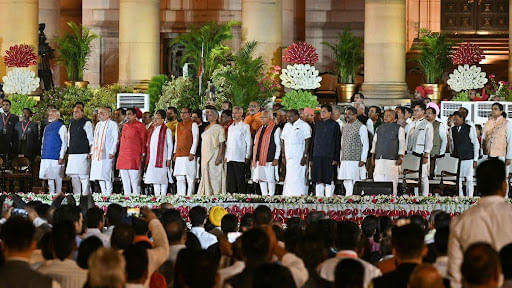
Constitutional Provisions and Explanation
The provisions related to the Council of Ministers are addressed in Article 75 of the Indian Constitution, which consists of six clauses:
| Article 75(1) | It provides that, while the President appoints the Prime Minister, the President appoints the Council of Ministers in accordance with the Prime Minister's suggestion. |
| Article 75(2) | The article states that a minister is meant to hold office at the President's pleasure. |
| Article 75(3) | The article mentions that the House of People, or Lok Sabha, holds the Central Council of Ministers collectively responsible. |
| Article 75(4) | The article states that the President is responsible for administering oaths of office and ministerial secrecy in accordance with the procedures outlined in the third schedule. |
| Article 75(5) | A Minister who for any period of six consecutive months is not a member of either House of Parliament shall at the expiration of that period cease to be a Minister. |
| Article 75(6) | The article provides that Ministers' salaries and allowances shall be as determined by Parliament by law from time to time, and until that time, shall be as described in the Second Schedule. |
- Article 75 was amended by the 91st Amendment Act of 2003, the added clause (1A) stated that the Prime Minister and the Council of Ministers, together with the total number of ministers, shall not exceed 15% of the overall strength of the Lower House of Parliament.
- Article 75(1B) mentions that members of a political party who have been disqualified for defection will be barred from being appointed as ministers, regardless of which House of Parliament they belong to.
| Other Relevant Links | |
|---|---|
| Role Descriptions by Munro | Article 74 |
| Role of The Prime Minister | Article 78 |
Conclusion
Article 75, therefore, plays a crucial role in shaping the structure, functioning, and accountability of the Union Executive in India.
FAQs
Question: What does Article 75 of the Indian Constitution pertain to?
Answer: Article 75 of the Indian Constitution relates to the appointment of the Prime Minister and the Council of Ministers. It states that the Prime Minister is appointed by the President of India and that the Council of Ministers is collectively responsible to the Lok Sabha. This article establishes the framework for the executive branch of the government and outlines the relationship between the Prime Minister, the Council of Ministers, and the President.
Question: How is the Prime Minister appointed according to Article 75?
Answer: According to Article 75, the Prime Minister is appointed by the President of India. The President usually appoints the leader of the party that has won the majority in the Lok Sabha elections. If no single party secures a majority, the President may appoint a leader who is likely to command the confidence of the House. This appointment is crucial in establishing the government and initiating the functioning of the executive branch.
Question: What is the significance of the Council of Ministers being collectively responsible to the Lok Sabha?
Answer: The collective responsibility of the Council of Ministers to the Lok Sabha is a cornerstone of parliamentary democracy in India. This means that the entire Council of Ministers, headed by the Prime Minister, must maintain the confidence of the Lok Sabha to remain in power. If the Lok Sabha passes a vote of no confidence against the Council, all ministers, including the Prime Minister, must resign. This provision ensures accountability and responsiveness of the executive to the legislature, reinforcing the principle of checks and balances within the government.
Question: Can the President dismiss the Prime Minister according to Article 75?
Answer: Article 75 does not explicitly grant the President the power to dismiss the Prime Minister unilaterally. The President can dismiss the Prime Minister only if the Prime Minister loses the confidence of the Lok Sabha. In practice, the dismissal of a Prime Minister typically occurs following a political crisis or when a new majority is formed in the Lok Sabha. This emphasizes the importance of parliamentary support for the Prime Minister's position.
Question: How does Article 75 address the formation of the Council of Ministers?
Answer: Article 75 provides the framework for the formation of the Council of Ministers by stating that the Prime Minister will appoint other ministers. The article allows the Prime Minister to determine the size and composition of the Council, which includes cabinet ministers, ministers of state, and deputy ministers. This flexibility enables the Prime Minister to assemble a team that can effectively manage the various departments and functions of the government, while also reflecting the political balance in the Lok Sabha.
MCQs
1. Who appoints the Prime Minister of India according to Article 75?
A) Chief Justice of India
B) Speaker of the Lok Sabha
C) President of India
D) Vice President of India
Answer: See the Explanation
Explanation: The Prime Minister of India is appointed by the President of India according to Article 75 of the Constitution.
2. What does collective responsibility mean in the context of the Council of Ministers?
A) Individual accountability of each minister
B) The Prime Minister's exclusive power
C) The entire council must maintain the confidence of the Lok Sabha
D) Dismissal of ministers by the President
Answer: See the Explanation
Explanation: Collective responsibility means that the entire Council of Ministers must maintain the confidence of the Lok Sabha, and if they lose it, they must resign together.
3. What happens if the Lok Sabha passes a vote of no confidence against the Council of Ministers?
A) The President appoints a new Prime Minister
B) The Council of Ministers must resign
C) The elections are held immediately
D) The Prime Minister continues in office
Answer: See the Explanation
Explanation: If the Lok Sabha passes a vote of no confidence against the Council of Ministers, the entire council, including the Prime Minister, must resign.
4. Can the President dismiss the Prime Minister without a vote of no confidence?
A) Yes, anytime
B) No, only with a vote of no confidence
C) Yes, if advised by the Cabinet
D) No, only by the Supreme Court
Answer: See the Explanation
Explanation: The President cannot dismiss the Prime Minister without a vote of no confidence; the Prime Minister must maintain the confidence of the Lok Sabha.
5. Who has the authority to appoint other ministers in the Council of Ministers?
A) The President
B) The Prime Minister
C) The Lok Sabha
D) The Chief Justice
Answer: See the Explanation
Explanation: The Prime Minister has the authority to appoint other ministers in the Council of Ministers according to Article 75.
GS Mains Questions and Model Answers
Q1: Analyze the implications of Article 75 on the functioning of the Indian parliamentary system.
Answer: Article 75 has significant implications for the functioning of the Indian parliamentary system as it establishes the Prime Minister as the head of the government and the Council of Ministers as accountable to the Lok Sabha. This relationship ensures that the executive branch remains responsive to the legislative body, promoting democratic governance. The collective responsibility principle mandates that the Council of Ministers must retain the confidence of the Lok Sabha, which can lead to a more stable government when the ruling party has a majority. However, it can also lead to political instability if the government loses the confidence of the House, resulting in a change of leadership or elections. Thus, Article 75 is essential for maintaining the balance of power and accountability in India's parliamentary democracy.
Q2: Discuss the relationship between the President and the Prime Minister as outlined in Article 75.
Answer: The relationship between the President and the Prime Minister, as outlined in Article 75, is fundamentally one of constitutional authority and mutual dependence. The President appoints the Prime Minister, who is typically the leader of the majority party in the Lok Sabha. This appointment reflects the democratic mandate of the electorate. While the President holds significant ceremonial powers, the Prime Minister exercises actual executive authority, making decisions on governance and policy implementation. The President can dismiss the Prime Minister only if the latter loses the confidence of the Lok Sabha, underscoring the importance of parliamentary support in the Prime Minister's role. This relationship embodies the principles of parliamentary democracy, where the executive derives its legitimacy from the legislature.
Q3: Evaluate the significance of collective responsibility as per Article 75 in maintaining democratic governance.
Answer: The significance of collective responsibility, as per Article 75, lies in its role in maintaining democratic governance and accountability in the Indian political system. This principle ensures that the entire Council of Ministers, led by the Prime Minister, is answerable to the Lok Sabha, promoting transparency and responsiveness in governance. Collective responsibility fosters a collaborative approach to decision-making, as ministers must work together to uphold the government's credibility and public trust. If the Council fails to secure the confidence of the Lok Sabha, it is compelled to resign, reinforcing the idea that the executive must reflect the will of the people. This system of accountability is fundamental to the functioning of democracy in India, ensuring that elected representatives have the power to hold the government accountable for its actions.
Previous Year Questions on Article 75
1. UPSC CSE Prelims 2021:
Question: Which article of the Indian Constitution deals with the appointment of the Prime Minister?
A) Article 74
B) Article 75
C) Article 76
D) Article 77
Answer: (B)
Explanation: Article 75 of the Indian Constitution deals with the appointment of the Prime Minister and the Council of Ministers.
2. UPSC CSE Mains 2019 (GS Paper 1):
Question: "Examine the role of Article 75 in shaping the executive power of the Indian government." Discuss its impact on accountability and governance.
Answer: Article 75 plays a crucial role in shaping the executive power of the Indian government by establishing the framework for the appointment of the Prime Minister and the functioning of the Council of Ministers. This article ensures that the Prime Minister is accountable to the Lok Sabha, which is essential for maintaining democratic governance. The requirement for collective responsibility means that the entire council must work cohesively and be prepared to resign if they lose the confidence of the House. This fosters a sense of accountability and encourages ministers to align their actions with the expectations of the electorate. The provisions of Article 75 thus significantly influence the dynamics of executive power, promoting a government that is both effective and accountable to the people.
*email: contactus@prepp.in
Download the PREPP App and attempt FREE IAS Exam Mock Tests and get complete study material!
UPSC IAS : CSAT - Mini Live Test

Live Test : UPSC CSE Prelims CSAT (Paper-II) (Oct 20 - 23)
Full Test - 04: UPSC CSE Prelims CSAT (Paper-II)
Full Test - 03: UPSC CSE Prelims CSAT (Paper-II)
UPSC CSE Prelims 2026 GS Paper 1 Question Paper (24-May-2026)
UPSC CSE Prelims 2026 CSAT Paper 2 Question Paper (24-May-2026)

17 February 2025 | The Hindu Must Read Articles | Current Affairs

16 February 2026 | The Hindu Must Read Articles | Current Affairs

13 February 2026 | The Hindu Must Read Articles | Current Affairs









Comments