Inquiry Into Cheetahs’ Deaths Points To Natural Causes, Centre Informs SC
Relevance: GS 3 - Environment; Conservation
(Source: The Hindu, 08/01/23)
Click here for Daily Current Affairs
Why in the news?
- Recently, the environment ministry and National Tiger Conservation Authority (NTCA) informed the Supreme Court that the deaths of eight cheetahs at Kuno National Park were likely due to natural causes.
- Under Project Cheetah, a total of 20 radio-collared cheetahs were brought from Namibia and South Africa to Kuno National Park, Madhya Pradesh, in a first ever transcontinental wild to wild translocation.
- Out of twenty Cheetahs translocated only fifteen adult cheetahs and one Indian-born cub has survived.
Table of Contents
What did the center say in court?
- Low survival rate: The government informed the court that cheetahs have a low survival rate of 50% even in adults and a survival rate of about 10% for cubs in an "introduced population" of cheetahs.
- No evidence of unnatural causes: It said that there was no evidence of unnatural reasons like poaching, sharing, road hits, electrocution, etc., or unsuitability at the Kuno site.
What are the causes of Cheetah Deaths?
- Three India-born cheetah cubs died at Kuno National Park due to extreme heat and weakness. The cubs were found to be severely dehydrated and underweight.
- Kidney-related ailment.
- Infighting during mating and also during establishing their territories.
- Some reports in the media have attributed the death of Cheetahs due to radio collar injuries.
What are steps taken to ensure the well-being of the surviving cheetahs?
- Investigating the cause of deaths: Independent national experts are currently conducting a review of the existing monitoring protocols, protection status, managerial inputs, veterinary facilities, and training and capacity building aspects.
- Consultation with international cheetah experts: Consultation with veterinary doctors from South Africa and Namibia is being done on a regular basis.
- Capturing and administering critical medical examinations to surviving Cheetahs.
What is Project Cheetah?
- Project Cheetah aims to bring back independent India’s only extinct large mammal – the cheetah.
- According to the action plan, the government and the NTCA plan to introduce 12-14 cheetahs annually from African countries over the next five years.
- However, this will depend on the availability of cheetahs from these countries and the conditions of the habitat, prey base, and on-ground protection measures.
Objectives of the project are
- To establish breeding cheetah populations in safe habitats across its historical range and manage them as a metapopulation.
- Using Cheetah as a flagship and umbrella species to attract resources for restoring open forest and savanna systems that will benefit biodiversity and ecosystem services.
- To enhance India’s capacity to sequester carbon through ecosystem restoration activities in cheetah conservation areas and thereby contribute towards the global climate change mitigation goals.
- Promoting eco-development and eco-tourism to enhance local community livelihoods.
About Cheetahs
- The cheetah is a big cat endemic to Africa and Southwest Asia.
- It is the fastest land animal, capable of running at speeds ranging from 80 to 98 km/h, and as such has evolved unique adaptations for speed, such as a light frame, long slender legs, and a long tail.
- The cheetah lives in a variety of settings, including savannahs in the Serengeti, dry mountain ranges in the Sahara, and mountainous desert terrain in Iran.
- The cheetah is threatened by a number of issues, including habitat degradation, interaction with humans, poaching, and high sensitivity to illness.
Protection status
|
African Cheetah |
Asiatic Cheetah |
|---|---|
|
|
About Kuno National Park
- Kuno National Park is a national park and wildlife sanctuary in Madhya Pradesh, India. It takes its name from the Kuno River.
- It was established in 1981 as a wildlife sanctuary with an initial area of 344.686 km2 in the districts of Sheopur and Morena. It was designated a national park in 2018.
- Chital, sambar, nilgai, wild pig, chinkara, and cattle are all present in good numbers.
- Kardhai, Salai, and Khair trees dominate the forested area of Kuno National Park, which is mostly mixed forest, allowing for a wide range of flora and fauna species.
(*Click this link to read prelims specific weekly current affairs articles)
FAQs
Question: What is National Tiger Conservation Authority (NTCA)?
Answer:
The National Tiger Conservation Authority (NTCA) is a statutory body under the Ministry of Environment, Forests, and Climate Change established under the enabling provisions of the Wildlife (Protection) Act, 1972, as amended in 2006, to strengthen tiger conservation in accordance with the powers and functions delegated to it by the Act. It is the apex body that administers ‘Project Tiger’.
Question: What was historical range of cheetahs in India?
Answer:
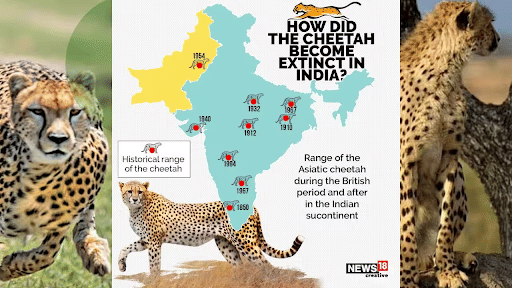
In India, the cheetah population used to be fairly widespread. The animal was found from Jaipur and Lucknow in the north to Mysore in the south, and from Kathiawar in the west to Deogarh in the east.
Question: What are the reasons for Extinction of Cheetah in India?
Answer:
The cheetah was officially declared extinct by the Indian government in 1952. Over-hunting was a major contributing factor for the cheetah’s extinction, the decimation of its relatively narrow prey base species and the loss of its grassland-forest habitat.
MCQ
Question: Consider the following statements:
- National Tiger Conservation Authority (NTCA) is a statutory body under the Ministry of Environment, Forests, and Climate Change.
- It is the apex body that administers ‘Project Tiger’
Which of the above statements is/are correct?
(a) 1 only
(b) 2 only
(c) Both 1 and 2
(d) Neither 1 nor 2
Answer: (c) See the Explanation
- The National Tiger Conservation Authority (NTCA) is a statutory body under the Ministry of Environment, Forests, and Climate Change established under the enabling provisions of the Wildlife (Protection) Act, 1972, as amended in 2006, to strengthen tiger conservation in accordance with the powers and functions delegated to it by the Act. Hence, statement 1 is correct.
- It is the apex body that administers ‘Project Tiger’. Hence, statement 2 is correct.
- Therefore, option (c) is the correct answer.
Download the PREPP App and attempt FREE IAS Exam Mock Tests and get complete study material!

Full Test - 04: UPSC CSE Prelims CSAT (Paper-II)
Full Test - 03: UPSC CSE Prelims CSAT (Paper-II)
UPSC CSE Prelims 2026 GS Paper 1 Question Paper (24-May-2026)
UPSC CSE Prelims 2026 CSAT Paper 2 Question Paper (24-May-2026)

17 February 2025 | The Hindu Must Read Articles | Current Affairs

16 February 2026 | The Hindu Must Read Articles | Current Affairs

13 February 2026 | The Hindu Must Read Articles | Current Affairs









Comments