The Promise Of Hybrid EVs In Cutting Short-Term Carbon Emissions
Relevance: GS3 - Infrastructure: Energy
(Source: The Hindu, 08/01/2023)
Click here for Daily Current Affairs
Why in the news?
- Hybrid EVs can help initiate the transition to a cleaner economy for most developing countries despite their lack of reliable power generation facilities and grid capacity, low proportion of renewable sources in power generation, and the poor availability of fast-charging infrastructure.
Table of Contents

What are the different types of EVs?
- An electric vehicle refers to any vehicle that is propelled by an electric drivetrain based on electric power from a portable electric energy source.
- Hybrid EV: It possesses an Internal Combustion Engine (ICE) which is used to produce electricity with an electric generator.
- A small battery, 1 - 5 kWh, is used as an energy buffer.
- It cannot be charged directly from the grid.
- Full EV: It does not have an ICE, which means that it does not produce emissions like conventional vehicles.
- It has a larger battery, 20-120 kWh, and can only be charged directly from the grid.
- Plug-in EV: A hybrid EV with a much larger battery i.e. around 5-15 kWh.
- It can be charged from the grid.
- It acts like a full EV as long as the battery has energy.
- It offers the best features of both full EVs and hybrid EVs.
- Fuel-cell EV: It uses a fuel cell to produce electricity for the drivetrain in coordination with a small battery buffer to manage variations.
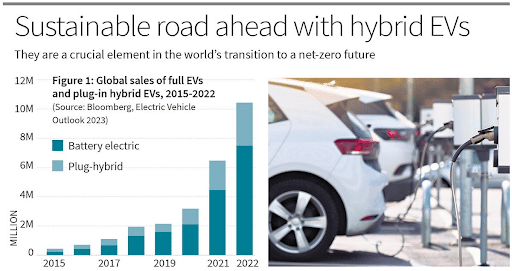
What are the advantages of hybrid EVs?
Fuel economy
- The higher fuel economy of hybrid EVs leads to reduced fuel costs, emissions, and oil imports.
- Hybrid EVs are also equipped with Regenerative braking which improves fuel economy in areas with frequent stop-go conditions like urban and hilly conditions. An engine start-stop mechanism helps save fuel at traffic junctions and in heavy traffic.
Net emissions
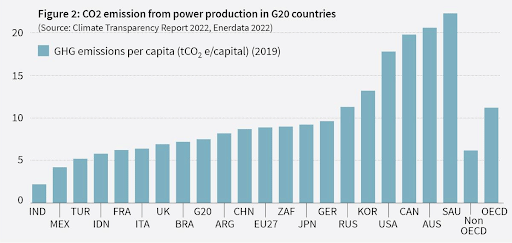
- The International Council on Clean Transportation, concluded that the transition to full EVs will reduce emissions from sedans by 19-34% and by 38-49% in SUVs despite the fossil-fuel-dominated energy mix available in India.
- The findings were based on a study of life-cycle emissions in the U.S.A., Europe, China, and India
- Impact of renewables: Emissions have been projected to reduce by 30-56% by 2030 when the share of renewables increases while it will reduce by 79% in an all-renewables grid.
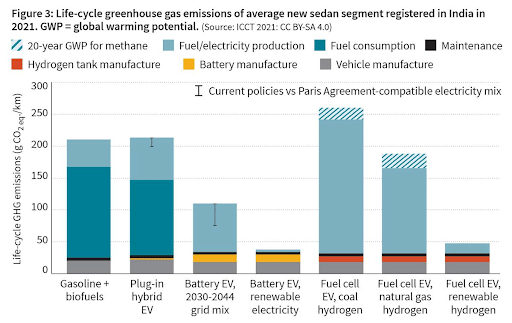
- The life-cycle emissions of hybrid EVs are 20-23% lower than that of conventional EVs in Europe.
Decarbonization
- Hybrid EVs help lower emissions more efficiently than full EVs which are characterized by grid reliability, charging infrastructure, and prohibitive vehicle costs.
- Plug-in hybrids provide most of the benefits in full EVs such as emissions and performance without requiring large batteries.
- However, its limited all-electric range means that it has limited usage.
- The purchase price of hybrid cars is only 5-15% higher than conventional vehicles and is independent of the vehicle range.
What are the challenges in transitioning to electric mobility in developing nations?
- Infrastructure: In order to successfully transition from ICE to EVs, fast-charging infrastructure will have to be installed along major highways and roads.
- This will ensure people can use their EVs for long trips with less/no range anxiety.
- Charging infrastructure is expensive with capital costs of $500-1,000 per kW, service and maintenance costs of 5% per year; and an installation cost of around 50% of the charger cost.
- Other expenses include the cost of making and installing a new transformer and cables; service-level agreements; DC charger plug options and quantities; customization costs; labor costs; and permits.
- The high costs limit the installation of charging infrastructure which in turn discourages people from adopting Evs.
- Unreliable grid: Economically developing countries do not have access to a reliable grid.
- The relatively high charging power requirements of the charging infrastructure affect its generation and transmission capacities.
- This could impact the transition to EVs.
- Adoption costs: Battery costs associated with EVs are extremely high.
- Larger batteries are required for vehicles with higher ranges, making them more expensive and thus unaffordable for people from less developing economies.
- Battery Technology and Supply Chain: Lithium-ion batteries, which are a key component of EVs, require specific minerals and rare earth elements which are not available everywhere in the world.
- Developing countries like India have to rely heavily on imports for battery manufacturing, which can be impacted by disruptions in the supply chain.
- Time: EVs have a longer charging time than the refueling time of ICE vehicles so people are discouraged from buying EVs over convenience and usability concerns.
- Limited Availability: The availability of electric vehicle models is relatively limited compared to conventional vehicles in developing nations.
Conclusion
- Ideally, countries that can work towards the goal of generating electricity solely from renewable sources must prioritize this.
- In other areas, where the transition to renewables will be in the long term, hybrid EVs are an effective short-term solution with fuel economy and emissions benefits.
(*Click this link to read prelims specific weekly current affairs articles)
FAQs
Question: What is net zero for vehicles?
Answer: Net zero for vehicles includes emissions at both the tailpipe of the vehicle and at the power plant. It requires emissions to be cut from both new and existing vehicles
Question: What is regenerative braking?
Answer: In regenerative braking, the kinetic energy of the vehicle is recovered while slowing down instead of being dissipated as heat in the braking system.
MCQs
Question: Consider the following statements:
- India introduced the EV30@30 scheme for increased EV deployment.
- FAME II incentivizes the purchase of passenger cars for personal use.
- Hydrogen cell EVs recharge faster than EVs based on Li-ion batteries.
How many of the above statements are correct?
(a) Only 1
(b) Only 2
(c) All 3
(d) None
Answer: (a) See the Explanation
Explanation:
- The EV30@30 scheme was introduced by the Clean Energy Ministerial to increase EV deployment and encourage the purchase of at least 30% more EVs by 2030. Hence statement 1 is incorrect.
- In FAME II, the purchase of passenger cars for personal use is not incentivized. Hence statement 2 is incorrect.
- Hydrogen cell EVs can be recharged within 5 minutes while Li-ion-based vehicles require around 6 hours of charging time on average. Hence statement 3 is correct.
Therefore, option (a) is the correct answer.
Download the PREPP App and attempt FREE IAS Exam Mock Tests and get complete study material!

Full Test - 04: UPSC CSE Prelims CSAT (Paper-II)
Full Test - 03: UPSC CSE Prelims CSAT (Paper-II)
UPSC CSE Prelims 2026 GS Paper 1 Question Paper (24-May-2026)
UPSC CSE Prelims 2026 CSAT Paper 2 Question Paper (24-May-2026)

17 February 2025 | The Hindu Must Read Articles | Current Affairs

16 February 2026 | The Hindu Must Read Articles | Current Affairs

13 February 2026 | The Hindu Must Read Articles | Current Affairs









Comments