Chip Tactics: On India’s Bid To Attract Major Global Chip Manufacturers
Relevance: GS3- Science and Technology- developments and their applications and effects in everyday life, Awareness in the fields of IT and Computers GS2 - Government policies and interventions for development in various sectors and issues arising out of their design and implementation.
(Source: The Hindu, 08/01/2023)
Click here for Daily Current Affairs
Why in the news?
- Recently, Prime Minister Narendra Modi stated at the Semicon India Summit that the Indian Government had implemented proactive measures to address areas of concern in the Indian Semiconductor industry.
- Countries are attempting to de-risk from Chinese dominance in the semiconductor manufacturing supply chain through friend-shoring arrangements.
Table of Contents
What is Friendshoring?
- It is a strategy in which countries source raw materials, components, and manufactured goods from similar-minded countries while reducing the dependence on countries that are considered a "threat" to the stability of the supply chains.
- It is also called "allyshoring".
- Friendshoring aims to insulate supply chains from nations that could disrupt and impact the country.
- Implications:
- It is a part of the deglobalization process and reverses the gains from globalization.
- It is a form of protectionism that could disrupt the global supply chain which has already been disrupted by the pandemic.
- It could lead to a sense of alienation among companies that have to rely on non-friendly countries for components and raw materials.
- This will make global cooperation for the common good more difficult.
- Malicious actors could use their market positions to gain geopolitical leverage or disrupt trade.
- Examples:
- The U.S.A. has announced $52 billion in financing support for semiconductor manufacturers in 2021 attracting $200 billion in commitments.
- Intel has committed $80 billion of investment in the European Union.
Projects in India
- For new manufacturing projects, the Union government has lowered the corporate tax and introduced other incentives.
- 50% financial assistance will be provided to set up new production facilities under the Semiconductor programme.
- Micron Technologies, a U.S. firm, has committed to establishing a $2.75 billion assembly, testing, marking, and packaging facility in Gujarat.
- While Micron will provide $825 million, the remaining finance will come from the government.
- Vedanta and Foxconn, a Taiwan-based company, had proposed to set up a $19.75 billion joint semiconductor venture in Gujarat to manufacture 28-nanometer semiconductors.
- However, Foxconn withdrew from the project in July 2023 citing financial constraints, regulatory challenges, lack of progress, and creative differences.
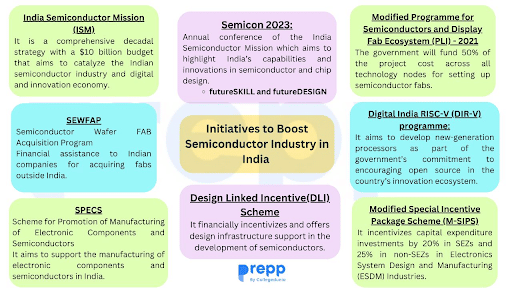
What are the initiatives for the semiconductor industry?
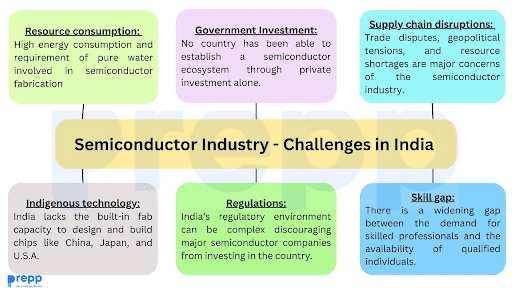
What are the challenges faced by the sector?
Way Forward
- Handholding: Hand Holding and governmental assistance to projects like Micron throughout the establishment process is necessary.
- This will encourage other firms to invest in India.
- Regulatory environment: Investors prefer a stable operational environment where policy-making is predictable and without any knee-jerk reactions such as export curbs.
- Tariffs: India’s bilateral and multilateral agreements related to tariffs on components must be at par with global standards.
- This would also indicate how good India’s trade relations with the rest of the world are, which could affect the availability of materials and components for the industries.
Conclusion
- The Indian semiconductor market is expected to be worth around $55 Billion by 2026 by growing at a CAGR of 20% between 2022 and 2026.
- This will coincide with the global growth in demand for semiconductors as a result of technological advancements.
- Therefore, the establishment of a strong manufacturing and design industry for semiconductors could allow India to emerge as a producer that can meet its domestic aspirations and global requirements.
(*Click this link to read prelims specific weekly current affairs articles)
FAQs
Question: What are supply chains?
Answer: Supply chains are networks of individuals and companies involved in the creation and delivery of products to the consumer. It is initiated at the raw material producer stage and continues till the finished product is delivered to the end user.
Question: What are tariffs?
Answer: Tariffs are taxes imposed by governments on imports or exports. High tariffs lead to an increase in the costs borne by foreign producers to sell their goods domestically. This is therefore advantageous for local producers. India has one of the highest tariff rates in the world.
MCQs
Question: Consider the following statements about the SPECS scheme:
- It provides financial incentives of 50% of capital expenditure.
- It has been implemented by the Ministry of Electronics and Information Technology.
Which of the above statements are correct?
- 1 only
- 2 only
- 1 and 2
- None
Answer: (b) See the Explanation
Explanation:
- The Scheme for Promotion of Manufacturing of Electronic Components and Semiconductors (SPECS) was notified on April 01, 2020 by the Ministry of Electronics and Information Technology. Hence statement 2 is correct.
- It provides a financial incentive of 25% on capital expenditure for the identified list of electronic goods such as electronic components, semiconductor/display fabrication units, ATMP units, specialized sub-assemblies, and capital goods for the above goods. Hence statement 1 is incorrect.
Therefore, option (b) is the correct answer.
Download the PREPP App and attempt FREE IAS Exam Mock Tests and get complete study material!

Full Test - 04: UPSC CSE Prelims CSAT (Paper-II)
Full Test - 03: UPSC CSE Prelims CSAT (Paper-II)
UPSC CSE Prelims 2026 GS Paper 1 Question Paper (24-May-2026)
UPSC CSE Prelims 2026 CSAT Paper 2 Question Paper (24-May-2026)

17 February 2025 | The Hindu Must Read Articles | Current Affairs

16 February 2026 | The Hindu Must Read Articles | Current Affairs

13 February 2026 | The Hindu Must Read Articles | Current Affairs









Comments