Women Do 7 Hours Of Housework, Men Under 3 Hours
Relevance: GS1 - Role of women and women’s organization, Effects of globalization on Indian society, Social empowerment, GS2 - Inclusive growth and issues arising from it
(Source: The Hindu, 08/01/2023)
Click here for Daily Current Affairs
Why in the news?
- Recently, the Government has highlighted the issue of unpaid care and domestic work performed by women in India.
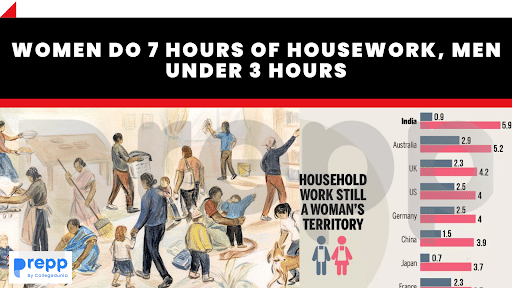
- Women, regardless of employment status, spend over 7 hours daily on domestic work, while men spend less than three hours.
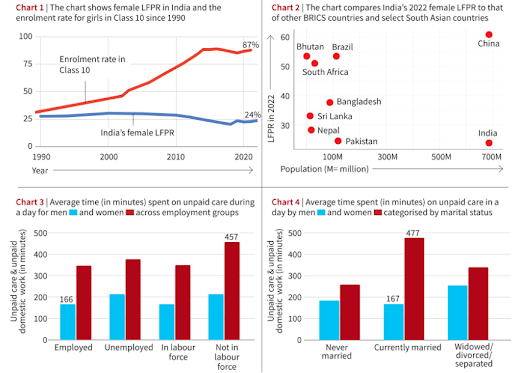
- India's female labor force participation rate has been declining for more than 20 years, despite the share of educated women surging in this period.
Table of Contents
India’s Labour Force Participation Rate (LFPR)
- Labour Force Participation Rate (LFPR) is defined as the percentage of the population in working age-groups that is employed, or is looking for work, but is unemployed.
- As per OECD, it is calculated as the labour force divided by the total working-age population, hence estimating an economy’s active workforce.
- Data from the Periodic Labour Force Survey shows that 29.4% of women (aged 15-59) were part of India’s labour force in 2021-22, as compared to 29.8% in the preceding year.
- In contrast, men’s LFPR improved from 80.1% in 2020-21 to 80.7 % in 2021-22.
Why is the recognition of Unpaid Work needed?
- Restricting opportunities: The relentless efforts of women in performing household work, without any financial compensation, promotions, or retirement benefits, often go unnoticed. This invisible labor creates a 24-hour job for women, which impacts their opportunities in the economy and life.
- Impact on Female Labor Force Participation: The lack of recognition for unpaid household work is one of the factors contributing to the low female labor force participation rate in India, currently at around 25%.
- Social Justice: In a report, the International Monetary Fund (IMF) also suggested that if women’s participation in the economy was raised to that of men, then India’s GDP can grow by 27%. Hence, recognition of unpaid work is needed to ensure social justice.
- Enhance quality of life: Recognizing unpaid work is crucial for enhancing the quality of life for those involved. For women, it often becomes a compulsion rather than a choice due to the patriarchal societal setup, limiting their potential and self-realization.
- Gender Inequality: Unpaid domestic work disproportionately falls on women, perpetuating gender inequality. Traditional gender roles and cultural norms often expect women to be responsible for household duties, leading to a disproportionate burden on them, which affects their ability to participate in paid work and pursue education and career opportunities.
Recent Efforts Made by the States
- Mukhyamantri Ladli Bahna Yojana: This scheme was launched by the Madhya Pradesh government. Under this scheme, each woman will be given ₹1000 per month and women in the age group of 23 to 60 years will be eligible for this scheme.
- Punjab Rs. 1000 Scheme for Women: The AAP government in Punjab will disburse Rs 1,000 a month to all women in the state.
- In June 2023, the Madras High Court held that homemakers are entitled to equal share in household properties purchased by the husband.
- Kalaignar Magalir Urimai Thittam’ Scheme: Tamil Nadu Chief Minister M K Stalin, recently, inaugurated a camp to facilitate registration of applications by women to avail the Rs 1,000 monthly basic income scheme (Kalaignar Magalir Urimai Thittam), a flagship programme which is set to be launched in September, 2023.
Way Ahead
- Women should be encouraged and helped to reach their full potential through quality education, access and opportunities of work.
- Efforts to address the domestic unpaid issue involve raising awareness about the importance of unpaid domestic work, promoting gender equality and advocating for policy changes to recognize and value domestic work.
- Initiatives like affordable childcare facilities, and promoting the sharing of household responsibilities can contribute to reducing the burden of unpaid domestic work on women in India.
(*Click this link to read prelims specific weekly current affairs articles)
FAQs
Question: What is unpaid domestic work?
Answer:
Unpaid care and domestic work refers to work that is done in the home by family members for maintenance and well-being of family without pay. Such work includes household specific tasks like cooking, cleaning, washing clothes, household management and maintenance, child care, etc.
Question: What is Labour Force Participation Rate (LFPR)?
Answer:
Labour Force Participation Rate (LFPR) is defined as the percentage of the population in working age-groups that is employed, or is looking for work, but is unemployed.
Question: What is the ‘Kalaignar Magalir Urimai Thittam’ Scheme?
Answer:
It is the major socio economic welfare scheme of Tamil Nadu Government. It will launch on 15th of September 2023. The main objective behind launching this scheme is to empower women financially so that their livelihood and standard of living will improve. Benefits of Scheme: Monthly Financial Assistance of Rs. 1,000/- per Month.
UPSC Mains Practice Questions:
|
Download the PREPP App and attempt FREE IAS Exam Mock Tests and get complete study material!

Full Test - 04: UPSC CSE Prelims CSAT (Paper-II)
Full Test - 03: UPSC CSE Prelims CSAT (Paper-II)
UPSC CSE Prelims 2026 GS Paper 1 Question Paper (24-May-2026)
UPSC CSE Prelims 2026 CSAT Paper 2 Question Paper (24-May-2026)

17 February 2025 | The Hindu Must Read Articles | Current Affairs

16 February 2026 | The Hindu Must Read Articles | Current Affairs

13 February 2026 | The Hindu Must Read Articles | Current Affairs









Comments