Hydrogen Color Codes / Types of Hydrogen - Environment Notes
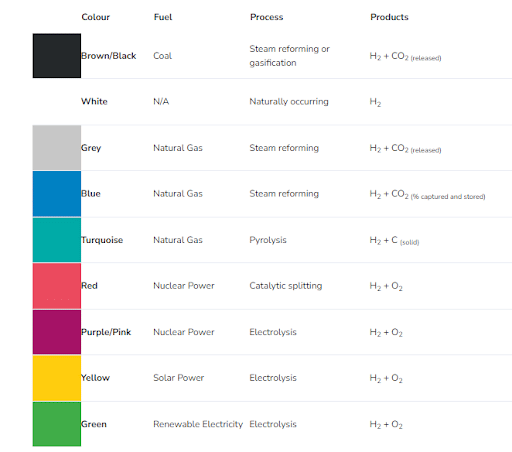
Hydrogen is a colourless gas in its natural state. However, the sources or methods used to create hydrogen are indicated by the colour codes for hydrogen such as Green, blue, grey, brown, or black, as well as turquoise, purple, pink, red, and white etc. Hydrogen is a more environmentally friendly alternative to methane, generally known as natural gas. It is the most plentiful chemical element, accounting for 75% of the universe's mass. One of hydrogen's main benefits over fossil fuels is that it is similarly independent of the method of production, allowing for improved market liquidity. This article explains about the Hydrogen Color Codes which is important for UPSC IAS exam preparation.
Table of Contents
Hydrogen Color Codes/ Types of Hydrogen
- All methods of manufacturing result in highly flammable, flavourless, colourless, and hydrogen gas in which the method utilised to create hydrogen is indicated by each colour feature.
- Although there is presently no standard for hydrogen colour coding, this might change depending on the industrial and geographical setting.
The Most Common colours of Hydrogen

Green hydrogen
- Green hydrogen is created by electrolyzing water with clean electricity generated by excess renewable energy sources such as solar or wind power.
- Electrolyzers employ an electrochemical reaction to divide water into its constituents, hydrogen and oxygen, while producing no carbon dioxide.
- Green hydrogen presently accounts for a small portion of total hydrogen production due to the high cost of generation.
- Green hydrogen will become more affordable as it becomes more widely available, much as wind energy has.
Blue Hydrogen
- Blue hydrogen is mostly created from natural gas using a process known as steam reforming, which combines natural gas with heated water in the form of steam.
- The output is hydrogen, but as a byproduct, carbon dioxide is created.
- As a result, the utilisation of carbon capture and storage (CCS) to collect and store this carbon is included in the definition of blue hydrogen.
- Blue hydrogen is frequently referred to as 'low-carbon hydrogen,' despite the fact that the steam reforming method does not prevent the production of greenhouse gases.
Grey Hydrogen
- Grey hydrogen is produced from natural gas, or methane, by steam methane reformation, but without collecting the greenhouse gases produced.
- This is now the most popular method of producing hydrogen.
- Grey hydrogen is similar to blue hydrogen, except it does not involve carbon capture and storage.
Black and Brown Hydrogen
- The hydrogen produced by using black coal or lignite (brown coal) is the polar opposite of green hydrogen in the hydrogen spectrum and the most ecologically harmful.
- To further complicate matters, any hydrogen produced from fossil fuels via the 'gasification' process is frequently referred to as black or brown hydrogen interchangeably.
- Recently, Japan and Australia unveiled a new brown coal-to-hydrogen project. This project will use brown coal to make liquefied hydrogen in Australia, which will subsequently be delivered to Japan for low-emission consumption.
Pink Hydrogen
- Pink hydrogen is created using nuclear-powered electrolysis. Purple hydrogen and crimson hydrogen are other names for nuclear-produced hydrogen.
- Furthermore, the extremely high temperatures produced by nuclear reactors might be utilised to produce steam for more efficient electrolysis or steam methane reforming using fossil gas.
Turquoise hydrogen
- This is a new addition to the hydrogen colour chart, and scale production has yet to be shown.
- Turquoise hydrogen is created by a process known as methane pyrolysis, which produces hydrogen and solid carbon.
- Turquoise hydrogen may be valued in the future as a low-emission hydrogen, if the heating process is fueled by renewable energy and the carbon is permanently stored or utilised.
Yellow hydrogen
- Yellow hydrogen is commonly used to describe hydrogen produced by solar-powered electrolysis.
- However, it is also used to describe electrolyzed hydrogen produced using a combination of renewable and fossil fuel power.
White hydrogen
- White hydrogen is a kind of naturally occurring hydrogen that may be found in subsurface deposits.
- Scientists have discovered that there are more deposits than originally anticipated.
- These are frequently and easily accessible by drilling a well. Since 2012, a well in Mali has been actively delivering white hydrogen. Brazil, Australia, and other countries are conducting exploratory programmes.
Gold Hydrogen
- Gold hydrogen, which is also used to describe hydrogen created by fermenting bacteria found in depleted oil wells.
- It not only provides another low-cost hydrogen method, but it also extends the life of oil fields rather than leaving them stranded assets.
- However, for carbon neutrality, the gold hydrogen synthesis and extraction process relies on CO2 collection.
The Future of Hydrogen as an Energy Source
- It is clear that hydrogen will play a big part in achieving net zero as we shift away from our historical reliance on fossil fuels and towards green options to power our homes, companies, and transportation.
- It is a promising energy carrier with the potential to address a number of energy-related concerns.
- It has the potential to replace conventional fuels and greatly cut CO2 emissions at the point of use.
- Furthermore, if green hydrogen is utilised as fuel, the entire value chain may be decarbonized, allowing for lower emissions and climate change hazards.
Hydrogen as fuel - Significance for India
- It will assist India's transportation industry (which accounts for one-third of the country's greenhouse-gas emissions), iron and steel, and chemical industries.
- Hydrogen energy can help India achieve its goal of decarbonizing by 2050 and achieving 175 GW of renewable energy capacity by 2022.
- The energy contained in 2.2 pounds (1 kilogramme) of hydrogen gas is about equivalent to the energy contained in 1 gallon (6.2 pounds, 2.8 kilogrammes) of petrol.
* To read more on this topic, click National Green Hydrogen Mission
Conclusion
Hydrogen and energy have a long history together, from powering the earliest internal combustion engines over 200 years ago to becoming an essential component of today's refining industry. It is lightweight, storable, and energy dense, with no direct emissions of pollutants or greenhouse gases. However, in order for hydrogen to make a meaningful contribution to clean energy transitions, it must be embraced in sectors where it is now almost entirely absent, such as transportation, buildings, and power production.
FAQs
Question: What are hydrogen color codes and why are they important?
Answer: Hydrogen color codes are a system used to classify hydrogen based on its production method and environmental impact. These codes help to distinguish between different types of hydrogen based on their carbon footprint and the processes used to produce them. The main hydrogen color codes are:
- Grey Hydrogen: Produced from natural gas via steam methane reforming (SMR), with significant CO2 emissions.
- Blue Hydrogen: Produced similarly to grey hydrogen, but with carbon capture and storage (CCS) to reduce CO2 emissions.
- Green Hydrogen: Produced through water electrolysis powered by renewable energy, with minimal or no CO2 emissions.
- Pink Hydrogen: Produced using nuclear energy to split water molecules, generating hydrogen without CO2 emissions.
- Turquoise Hydrogen: Produced through pyrolysis of natural gas, generating solid carbon rather than CO2 emissions.
Question: What are the types of hydrogen based on production methods?
Answer: Hydrogen can be classified into various types based on its production methods:
- Grey Hydrogen: Produced using non-renewable sources such as natural gas. It is the most common form of hydrogen but has high carbon emissions.
- Blue Hydrogen: Similar to grey hydrogen, but the CO2 emissions are captured and stored, reducing its environmental impact.
- Green Hydrogen: Produced through electrolysis powered by renewable sources like wind or solar energy, making it the cleanest form of hydrogen.
- Pink Hydrogen: Produced using nuclear energy for electrolysis, offering another low-emission alternative to traditional methods.
- Turquoise Hydrogen: Produced through pyrolysis, which converts natural gas into hydrogen and solid carbon, offering a way to avoid direct CO2 emissions.
Question: Why is green hydrogen considered the most environmentally friendly option?
Answer: Green hydrogen is considered the most environmentally friendly option because it is produced through water electrolysis using renewable energy sources like wind, solar, or hydroelectric power. The process does not involve any fossil fuels, making it a zero-emission solution. Unlike grey hydrogen, which releases significant CO2, green hydrogen has no direct carbon footprint, making it essential for achieving net-zero emissions and decarbonizing industries like transportation and heavy manufacturing.
Question: How does blue hydrogen differ from grey hydrogen in terms of environmental impact?
Answer: The main difference between blue and grey hydrogen lies in the carbon emissions associated with their production:
- Grey Hydrogen: Produced from natural gas via steam methane reforming (SMR), it results in significant CO2 emissions.
- Blue Hydrogen: Also produced using SMR, but it incorporates carbon capture and storage (CCS) to capture and store the CO2 produced, significantly reducing its carbon footprint.
Question: What role does hydrogen play in reducing global carbon emissions?
Answer: Hydrogen plays a critical role in reducing global carbon emissions by serving as a clean fuel for sectors that are difficult to electrify, such as heavy industry, transportation, and power generation. Green hydrogen, in particular, offers a zero-emission alternative to fossil fuels, allowing industries to reduce their reliance on carbon-intensive processes. It can also be used in fuel cells for clean electricity generation and as a storage solution for renewable energy, providing a means to store excess energy from intermittent sources like wind and solar power.
MCQs
1. Which type of hydrogen is produced using renewable energy sources such as wind or solar power?
A) Grey Hydrogen
B) Green Hydrogen
C) Blue Hydrogen
D) Pink Hydrogen
Answer: (B) See the Explanation
Explanation: Green hydrogen is produced through water electrolysis using renewable energy sources like wind or solar power, making it the cleanest hydrogen type.
2. Which hydrogen type involves the use of nuclear energy for the electrolysis process?
A) Green Hydrogen
B) Blue Hydrogen
C) Pink Hydrogen
D) Turquoise Hydrogen
Answer: (C) See the Explanation
Explanation: Pink hydrogen is produced through electrolysis powered by nuclear energy, offering a low-carbon alternative to traditional methods.
3. What is the main environmental benefit of blue hydrogen over grey hydrogen?
A) Lower production costs
B) Use of renewable energy
C) Carbon capture and storage (CCS)
D) Zero-emissions process
Answer: (C) See the Explanation
Explanation: Blue hydrogen incorporates carbon capture and storage (CCS), which reduces its carbon emissions compared to grey hydrogen, which produces significant CO2 without capture.
4. What is the production method for grey hydrogen?
A) Electrolysis using renewable energy
B) Steam methane reforming (SMR) from natural gas
C) Pyrolysis from natural gas
D) Water splitting using nuclear energy
Answer: (B) See the Explanation
Explanation: Grey hydrogen is produced through steam methane reforming (SMR) from natural gas, a process that results in high CO2 emissions.
5. Which hydrogen type uses natural gas but produces solid carbon instead of CO2?
A) Grey Hydrogen
B) Blue Hydrogen
C) Turquoise Hydrogen
D) Green Hydrogen
Answer: (C) See the Explanation
Explanation: Turquoise hydrogen is produced through the pyrolysis of natural gas, generating solid carbon instead of CO2, which offers a more environmentally friendly option than grey hydrogen.
GS Mains Questions and Model Answers
Q1: Discuss the importance of hydrogen in the global transition to a low-carbon economy. How do the various types of hydrogen contribute to this goal?
Answer: Hydrogen plays a key role in the global transition to a low-carbon economy by providing a clean energy alternative to fossil fuels, especially in sectors that are difficult to electrify, such as heavy industry and transportation. The different types of hydrogen—green, blue, pink, and turquoise—each contribute differently to achieving this goal:
- Green Hydrogen: Produced through electrolysis using renewable energy, green hydrogen offers a zero-emission solution for industries and transportation, supporting the decarbonization of energy systems.
- Blue Hydrogen: Although not entirely free from carbon emissions, blue hydrogen uses carbon capture and storage (CCS) to reduce its environmental impact, making it a transitional solution for industries relying on natural gas.
- Pink Hydrogen: Produced using nuclear power, pink hydrogen also offers a low-carbon option, albeit with concerns regarding nuclear waste.
- Turquoise Hydrogen: With pyrolysis, turquoise hydrogen provides a method to produce hydrogen without direct CO2 emissions, offering a novel approach for clean hydrogen production.
Overall, these diverse types of hydrogen can collectively contribute to reducing global carbon emissions and accelerating the transition to clean energy.
Q2: Evaluate the economic challenges and opportunities associated with the production of green hydrogen in India.
Answer: The production of green hydrogen in India presents both significant challenges and opportunities.
- Challenges: High costs associated with renewable energy infrastructure, particularly for wind and solar power, can make green hydrogen production expensive. Additionally, the technology for large-scale electrolysis is still developing, and infrastructure for hydrogen storage and transportation is limited.
- Opportunities: India’s vast renewable energy resources, including solar and wind, offer immense potential for the low-cost production of green hydrogen. Government policies and investments in clean energy, such as the National Hydrogen Mission, can help reduce production costs and create jobs. Green hydrogen can also reduce India’s dependence on fossil fuel imports and contribute to achieving net-zero emissions by 2070.
Overcoming these challenges with technology advancements and policy support will make green hydrogen a key element of India’s clean energy future.
Q3: Analyze the role of blue hydrogen in reducing carbon emissions and its potential in India’s energy transition.
Answer: Blue hydrogen plays a crucial role in reducing carbon emissions by enabling the use of natural gas for hydrogen production while capturing and storing the CO2 emissions. In India, blue hydrogen could serve as an important transitional technology, particularly for industries like steel, cement, and chemical manufacturing, which are heavy carbon emitters. The ability to capture CO2 through carbon capture and storage (CCS) makes blue hydrogen a viable option for reducing emissions in the short to medium term while transitioning to green hydrogen. India’s large reserves of natural gas and the development of CCS infrastructure provide significant opportunities for blue hydrogen production as part of its broader energy transition strategy.
Previous Year Questions on Hydrogen
1. UPSC CSE Prelims 2020:
Question: Which type of hydrogen is produced using renewable energy sources?
A) Grey Hydrogen
B) Blue Hydrogen
C) Green Hydrogen
D) Turquoise Hydrogen
Answer: (C)
Explanation: Green hydrogen is produced through electrolysis powered by renewable energy sources like wind or solar power.
2. UPSC CSE Mains 2019 (GS Paper 3):
Question: What are the potential benefits and challenges of adopting green hydrogen as a major energy source in India?
Answer: The potential benefits of adopting green hydrogen in India include reduced reliance on fossil fuels, lower carbon emissions, and greater energy security due to the abundance of renewable energy sources. Challenges include high production costs, the need for large-scale infrastructure development for hydrogen storage and distribution, and the reliance on intermittent renewable energy sources. However, with government support and technological advancements, green hydrogen can play a pivotal role in India’s energy transition and contribute to achieving the nation’s climate goals.
Download the PREPP App and attempt FREE IAS Exam Mock Tests and get complete study material!

Full Test - 04: UPSC CSE Prelims CSAT (Paper-II)
Full Test - 03: UPSC CSE Prelims CSAT (Paper-II)
UPSC CSE Prelims 2026 GS Paper 1 Question Paper (24-May-2026)
UPSC CSE Prelims 2026 CSAT Paper 2 Question Paper (24-May-2026)

17 February 2025 | The Hindu Must Read Articles | Current Affairs

16 February 2026 | The Hindu Must Read Articles | Current Affairs

13 February 2026 | The Hindu Must Read Articles | Current Affairs









Comments