National Green Hydrogen Mission - Environment Notes
National Green Hydrogen mission approved by the Union Government that aims to make India a ‘global hub’ for using, producing and exporting green hydrogen. The mission aims to make India the worldwide centre for green hydrogen generation and to attain net-zero carbon emissions by 2070. It is a programme designed to encourage commercial production of green hydrogen and turn India into a net exporter of the fuel. The Mission will make it easier to create demand for, produce, use, and export Green Hydrogen. This article explains about the National Green Hydrogen Mission which is important for UPSC IAS exam preparation.
Table of Contents
National Green Hydrogen Mission
- The National Hydrogen Mission, also known as the National Hydrogen Energy Mission, was an endeavour to maximise the use of hydrogen, one of the most plentiful elements on the planet.
- The main goal of this mission is to take advantage of this cleaner fuel.
- On India's 75th anniversary of independence, the Prime Minister unveiled the hydrogen strategy. According to this program, India aims to acquire 3/4 of its hydrogen from renewable sources by 2050.
- The National Hydrogen Mission will also aid in the achievement of long-term climate goals.
- Hydrogen is seen as a possible fuel that might eventually replace fossil fuels.
- Hydrogen may be used for long-term renewable energy storage, fossil fuel substitution in industry, clean transportation, and possibly for decentralised power production, aviation, and maritime transport.
| Other Relevant Links | |
|---|---|
| Net Zero Pledges | Carbon Leakage |
| Karakoram Anomaly | HPCL - Cowdung to Compressed Biogas Project |
| Triple Planetary Crisis | Arctic Amplification |
| CO2 Equivalent | Carbon Dioxide Levels -Keeling Curve |
| Panchamrit | India's GreenHouse Gas Emissions |
| UNEP Production Gap Report | UN World Water Conference |
| Global Alliance for Industry Decarbonisation | Green Coal |
National Green Hydrogen Mission - Background
- Energy consumption has more than quadrupled in the previous 20 years and is expected to rise by another 25% by 2031.
- India now imports more than 40% of its basic energy requirements, amounting to more than USD 90 billion per year.
- Major industries like transportation and industrial production rely heavily on imported fossil fuels.
- This needs a transition towards technologies that allow for a greater percentage of renewable sources in the energy mix while gradually reducing reliance on fossil fuels.
- Currently, India's significant commitment to ambitious Climate Goals has been well recognised by the international community.
- India has also emerged as one of the most appealing places for renewable energy investments.
- As India strives to achieve energy independence by 2047 and Net Zero by 2070, we realise the crucial significance of Green Hydrogen.
- With its massive renewable energy resources, India has the potential to manufacture Green Hydrogen for the rest of the globe.
- The goal of the National Green Hydrogen Mission is to develop a comprehensive action plan for building a Green Hydrogen ecosystem and catalysing a systemic response to the potential and difficulties of this emerging industry.
National Green Hydrogen Mission - Objectives
- The Mission's main objective is to make India the Global Hub for the production, use, and export of Green Hydrogen and its byproducts.
- This would help India achieve Atma Nirbhar (self-sufficiency) through clean energy and act as an inspiration for the worldwide Clean Energy Transition.
- The Mission will result in major decarbonization of the economy, reduced reliance on fossil fuel imports, and enable India to establish technological and market leadership in Green Hydrogen.
- The Mission also aspires to make India a leader in the technology and manufacture of electrolysers and other green hydrogen supporting technologies.
National Green Hydrogen Mission - Features
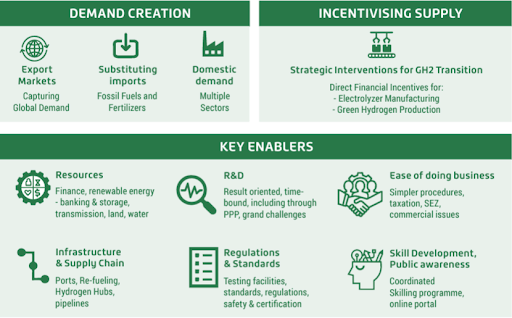
- The Mission will advocate for the substitution of renewable fuels and feedstocks based on Green Hydrogen for fossil fuels and feedstocks based on fossil fuels.
- This will include replacing fossil-fuel-derived Hydrogen with Green Hydrogen in ammonia production and petroleum refining, blending Green Hydrogen in City Gas Distribution systems, producing steel with Green Hydrogen, and using Green Hydrogen-derived synthetic fuels (including Green Ammonia, Green Methanol, and so on) to replace fossil fuels in various sectors such as mobility, shipping, and aviation.
- Green hydrogen producers may store renewable energy for up to 30 days by working with distribution businesses. Companies may be able to get distribution licence at reduced rates.
- Another benefit of the National Hydrogen Mission is that green hydrogen manufacturers will receive tax-free interstate gearboxes for the next 25 years.
- To assure on-time delivery and to attract investors, provide "grid to market" connection.
- A centralised portal to streamline company processes and operations
- Manufacturers can put up their infrastructure near ports for commercial operations, but they must pay fees to the port authorities who represent them.
- The Green Hydrogen route can help India achieve its goal of being a low-carbon, self-sufficient economy.
- As a result, now is an excellent time for India to start the National Green Hydrogen Mission in order to scale up Green Hydrogen production and utilisation across numerous sectors while also aligning with global trends in technology, applications, policy, and regulation.
What is Green Hydrogen?
- The element hydrogen is the most prevalent in the universe. However, pure, or elemental, hydrogen is extremely rare.
- Hydrogen is an important industrial fuel with a wide range of uses, including the manufacture of ammonia (a crucial fertiliser), steel, refineries, and power.
- It nearly usually appears in compounds, such as H2O, or water, with oxygen.
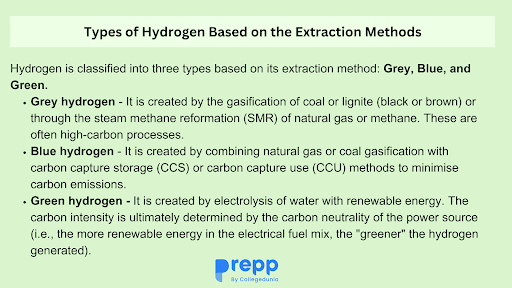
- When an electric current is run across water, it electrolytically divides it into elemental oxygen and hydrogen. If the power used in this process originates from a renewable source such as wind or solar, the hydrogen generated is known as green hydrogen.
- The colours associated with hydrogen denote the source of power needed to create the hydrogen molecule. When coal is utilised, for example, it is referred to as brown hydrogen.
Need for Producing Green Hydrogen
- Hydrogen is an excellent source of energy due to its high energy content per unit of weight, which is why it is utilised as rocket fuel.
- Green hydrogen, in instance, is one of the cleanest sources of energy, emitting almost no emissions.
- It may be employed in automotive fuel cells as well as in energy-intensive sectors such as fertiliser and steel making.
- Countries all across the globe are seeking to increase green hydrogen capability because it may help maintain energy security while simultaneously lowering carbon emissions.
- Green hydrogen has become a global phrase, especially as the world faces its worst energy crisis in history and the threat of climate change becomes a reality.
Green Hydrogen Production Potential
- India has a desirable geographic position as well as an abundance of sunshine and wind for the creation of green hydrogen.
- Green hydrogen solutions are being advocated in industries where direct electrification is not viable.
- Several of these areas include heavy duty, long-distance transport, several industrial sectors, and long-term storage in the electricity industry.
- The fledgling stage of this business allows for the establishment of regional centres that export high-value green products as well as engineering, procurement, and construction services.
Green Hydrogen Mission - Challenges
- Green hydrogen production is still in its early stages across the world, and while India has the potential to be a significant producer, it lacks the required infrastructure to carry out all of the intermediary phases.
- Economic Sustainability: One of the most significant issues that the industry has in commercialising hydrogen is the economic sustainability of harvesting green hydrogen.
- On a per-mile basis, hydrogen must be cost-competitive with conventional fuels and technology for transportation fuel cells.
Way Forward
- Incentives must be announced in order to persuade enough industrial hydrogen users to switch to green hydrogen.
- India must build supply chains in the form of pipelines, tankers, intermediate storage, and last-leg distribution networks, as well as implement an efficient skill development plan to teach thousands of people to adapt to a sustainable green hydrogen economy.
- By utilising low-cost renewable producing plants and cost-cutting knowledge obtained from solar and wind reverse auctions, India has the ability to reduce the cost of green hydrogen.
- Because of the young population and booming economy, the government will profit in the long run by promoting the use of hydrogen-based technology.
Conclusion
Green hydrogen is expected to play an important role in India's energy transition, notably in the decarbonization of difficult-to-abate industries. A start in this approach is the National Green Hydrogen Mission. The Mission is anticipated to promote the deployment of the Green Hydrogen ecosystem and to open up prospects for innovation and investment along the Green Hydrogen value chain, resulting in investments, employment, and economic growth. The involvement of the Government of India would kick start the process and give the push needed to unlock the market potential in many industries through cost reduction and economies of scale.
FAQs
Question: What is the National Green Hydrogen Mission?
Answer: The National Green Hydrogen Mission is an initiative by the Indian government aimed at making India a global hub for the production and export of green hydrogen. Green hydrogen is produced using renewable energy sources like wind, solar, and hydropower, and is seen as a sustainable alternative to fossil fuels. The mission’s primary objectives include reducing India’s carbon footprint, ensuring energy security, and creating new economic opportunities through the development of green hydrogen technologies.
Question: What are the objectives of the National Green Hydrogen Mission?
Answer: The key objectives of the National Green Hydrogen Mission include:
- Reducing Carbon Emissions: By promoting the use of green hydrogen as a clean energy source, the mission aims to reduce the carbon emissions in various sectors, including industry and transportation.
- Energy Security: The mission seeks to enhance energy security by developing indigenous hydrogen production capabilities, reducing dependency on imported energy sources.
- Economic Growth and Jobs: The mission aims to create new opportunities in green energy, including job creation in the green hydrogen sector and related industries.
- Global Leadership: India aims to become a global leader in green hydrogen production, tapping into international markets and promoting export potential.
Question: How does green hydrogen differ from conventional hydrogen?
Answer: Green hydrogen differs from conventional hydrogen in its production process. Conventional hydrogen is primarily produced through methods that involve fossil fuels, such as natural gas reforming (grey hydrogen), which releases significant carbon emissions. In contrast, green hydrogen is produced through the electrolysis of water using renewable energy sources like wind or solar power, making it a clean, carbon-free fuel. This makes green hydrogen a crucial component in reducing carbon emissions and transitioning to sustainable energy systems.
Question: How will the National Green Hydrogen Mission benefit India's energy transition?
Answer: The National Green Hydrogen Mission will benefit India's energy transition by promoting the use of renewable energy and decarbonizing sectors that are difficult to electrify, such as heavy industry and long-distance transport. Green hydrogen can be used as a storage medium for renewable energy, providing a solution to the intermittency problem of solar and wind power. It will also facilitate the development of a hydrogen-based economy, where industries can use hydrogen in their processes, reducing fossil fuel consumption and contributing to India's net-zero carbon emissions goal by 2070.
Question: What are the challenges to the successful implementation of the National Green Hydrogen Mission?
Answer: Some of the challenges to implementing the National Green Hydrogen Mission include:
- Cost of Production: The cost of producing green hydrogen is currently higher compared to conventional hydrogen, making it less competitive in the market.
- Infrastructure Development: Building the necessary infrastructure, such as electrolysis plants, storage facilities, and distribution networks, requires significant investment.
- Policy and Regulatory Framework: The development of a supportive policy and regulatory environment for green hydrogen is essential to attract investment and create a market.
- Technology and R&D: Ongoing advancements in hydrogen production and storage technology are needed to make green hydrogen more cost-effective and scalable.
MCQs
1. What is the primary objective of the National Green Hydrogen Mission?
A) To enhance the production of conventional hydrogen
B) To reduce the carbon footprint of the energy sector
C) To promote fossil fuel-based energy sources
D) To develop nuclear energy technologies
Answer: (B) See the Explanation
Explanation: The National Green Hydrogen Mission’s primary objective is to reduce the carbon footprint by promoting the use of green hydrogen as a clean energy source.
2. How is green hydrogen produced?
A) Through coal gasification
B) By using nuclear reactors
C) Through the electrolysis of water using renewable energy
D) From natural gas reforming
Answer: (C) See the Explanation
Explanation: Green hydrogen is produced by the electrolysis of water using renewable energy sources such as solar, wind, and hydropower, making it a clean and carbon-free fuel.
3. What is one of the main challenges to the National Green Hydrogen Mission?
A) High cost of production
B) Lack of global interest in green energy
C) Oversupply of hydrogen production technology
D) Lack of raw materials for production
Answer: (A) See the Explanation
Explanation: The main challenge is the high cost of producing green hydrogen compared to conventional hydrogen, which makes it less competitive in the market.
4. What is a key benefit of green hydrogen in energy systems?
A) It requires minimal infrastructure
B) It can be stored and used as a clean fuel
C) It is cheaper to produce than conventional energy sources
D) It generates carbon emissions during production
Answer: (B) See the Explanation
Explanation: Green hydrogen can be stored and used as a clean fuel, addressing the intermittency problem of renewable energy sources like wind and solar power.
5. How does the National Green Hydrogen Mission contribute to India's climate goals?
A) By increasing fossil fuel consumption
B) By reducing carbon emissions and promoting renewable energy
C) By increasing reliance on coal power
D) By encouraging the use of nuclear energy
Answer: (B) See the Explanation
Explanation: The mission contributes to India’s climate goals by reducing carbon emissions and promoting the use of renewable energy through green hydrogen production and its adoption in various sectors.
GS Mains Questions and Model Answers
Q1: Discuss the potential of green hydrogen in achieving India’s renewable energy goals and reducing its carbon footprint.
Answer: Green hydrogen has immense potential in helping India achieve its renewable energy targets and reducing carbon emissions. It can be used in sectors like heavy industry, transport, and energy storage, which are difficult to electrify with renewable energy sources. By leveraging renewable energy for hydrogen production, India can decarbonize critical sectors and reduce reliance on fossil fuels. Green hydrogen also provides a solution to the intermittency of renewable energy, as it can store excess power produced during peak renewable energy periods and release it when needed. This makes green hydrogen a key component of India's long-term strategy to meet its climate goals.
Q2: Analyze the role of the National Green Hydrogen Mission in enhancing India’s energy security.
Answer: The National Green Hydrogen Mission is crucial for enhancing India’s energy security by diversifying the country’s energy sources and reducing dependence on imported fossil fuels. By developing domestic green hydrogen production capabilities, India can ensure a sustainable and clean energy supply. Green hydrogen can also be used to produce power locally, reduce the need for energy imports, and support the transition to a hydrogen economy. As India moves towards becoming a leader in green hydrogen, the mission will provide a significant boost to energy self-sufficiency, aligning with the broader goal of a low-carbon economy.
Q3: How does the National Green Hydrogen Mission align with global efforts to combat climate change?
Answer: The National Green Hydrogen Mission aligns with global climate goals by promoting clean energy solutions that contribute to reducing global greenhouse gas emissions. Green hydrogen plays a pivotal role in decarbonizing sectors that are difficult to electrify, such as aviation, shipping, and heavy industries. By investing in green hydrogen production, India is not only addressing its domestic energy needs but also contributing to the global push for a transition to sustainable, low-carbon energy systems. The mission strengthens India’s commitment to the Paris Agreement and its goal of achieving net-zero emissions by 2070.
Previous Year Questions on Green Energy and Sustainability
1. UPSC CSE Prelims 2020:
Question: What is the main objective of the National Green Hydrogen Mission?
A) To develop nuclear energy capabilities
B) To promote renewable energy and reduce carbon emissions
C) To increase fossil fuel production
D) To encourage the use of coal as a primary energy source
Answer: (B)
Explanation: The main objective of the National Green Hydrogen Mission is to promote renewable energy and reduce carbon emissions by encouraging the production and use of green hydrogen.
2. UPSC CSE Mains 2019 (GS Paper 3):
Question: How does green hydrogen contribute to energy security and sustainability in India?
Answer: Green hydrogen contributes to energy security by reducing India's dependence on imported fossil fuels and providing a sustainable alternative energy source. It enhances sustainability by reducing carbon emissions, supporting the transition to clean energy, and improving energy resilience. The use of renewable energy for hydrogen production also strengthens India's long-term energy security.
Download the PREPP App and attempt FREE IAS Exam Mock Tests and get complete study material!

Full Test - 04: UPSC CSE Prelims CSAT (Paper-II)
Full Test - 03: UPSC CSE Prelims CSAT (Paper-II)
UPSC CSE Prelims 2026 GS Paper 1 Question Paper (24-May-2026)
UPSC CSE Prelims 2026 CSAT Paper 2 Question Paper (24-May-2026)

17 February 2025 | The Hindu Must Read Articles | Current Affairs

16 February 2026 | The Hindu Must Read Articles | Current Affairs

13 February 2026 | The Hindu Must Read Articles | Current Affairs









Comments