Coal Gasification - Environment Notes
Coal gasification is the process of converting coal and water into syngas, which contains carbon monoxide (CO), hydrogen (H2), carbon dioxide (CO2), methane (CH4), and water vapour (H2O). During gasification, coal is cooked under high pressure while being blasted with oxygen and steam. Oxygen and water molecules oxidise the coal and form syngas during the process. This article explains about Coal Gasification which is important for UPSC IAS exam preparation.
Table of Contents
Coal Gasification
- Coal gasification is the process of partly oxidising coal with air, oxygen, steam, or carbon dioxide to produce a fuel gas.
- This gas is then utilised to generate electricity instead of piped natural gas, methane, and other fuels.
- In-situ gasification of coal, also known as Underground Coal Gasification (UCG), is the process of turning coal into gas while it is still in the seam and retrieving it through wells.
- Rather of directly burning coal, gasification transforms all of its carbon into electricity, hydrogen, and other kinds of energy via partial oxidation.
- Syngas production: It generates Syngas, a mixture predominantly composed of methane (CH4), carbon monoxide (CO), hydrogen (H2), carbon dioxide (CO2), and water vapour (H2O).
- Syngas may be converted into a variety of fertilisers, fuels, solvents, and synthetic materials.
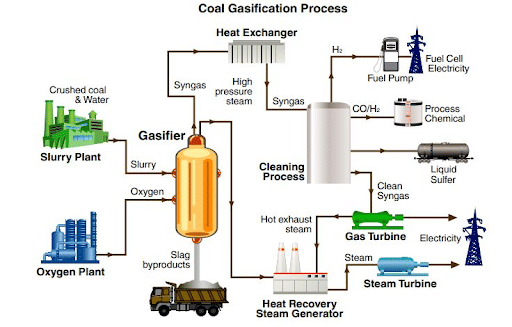
Coal Gasification - Process
- During gasification, oxygen and steam (water vapour) are forced through the coal while it is still being heated (and, in some circumstances, pressured).
- The term "allothermal" refers to a technique in which the coal is heated by external heat sources, whereas "autothermal" refers to a procedure in which the coal is heated by exothermic chemical processes that occur within the gasifier itself.
- It is crucial that the amount of oxidizer delivered is insufficient to completely oxidise (combust) the fuel.
- During the processes above, the coal is oxidised by oxygen and water molecules, producing a mixture of gases including carbon dioxide (CO2), carbon monoxide (CO), water vapour (H2O), and molecular hydrogen (H2).
By Products of Coal Gasification
- Coke, coal tar, sulphur, and ammonia are all byproducts of syngas production that are helpful.
- Coal gas is used in the production of colours, pharmaceuticals (particularly sulfa drugs), saccharin, and a wide range of chemical compounds.
- Coke is a non-smoking fuel that is also used to manufacture water gas and producer gas.
- Several chemicals are extracted from coal tar via fractional distillation, including
- Tar is used for road paving.
- Benzole is a kind of vehicle gasoline.
- Creosote is a Phenol-based wood preservative used in the production of polymers.
- Disinfectants and cresols
- Sulphur is used to make sulfuric acid, while ammonia is commonly used to make fertiliser.
Underground Coal Gasification
- Underground coal gasification (UCG) is simply an industrialised gasification process that occurs in unmined coal seams.
- It requires injecting a gaseous oxidising agent, often oxygen or air, and transferring the resulting product gas to the surface via production gas wells dug from the ground.
- The gas produced might be used as a chemical feedstock or as an energy source.
- The approach can be used to harvest materials that would otherwise be prohibitively costly.
- It is also a feasible alternative to standard coal mining methods.
- Although UCG has a lesser environmental and social effect than conventional coal mining with gasification, there are environmental concerns, including the danger of aquifer contamination.
Significance of Coal Gasification
- Coking coal is often used in the manufacturing process of steel businesses.
- The majority of coking coal is imported and hence costly.
- Facilities can utilise syngas from coal gasification facilities instead of coking coal to save expenses.
- It is mostly used to generate energy and chemical feedstock.
- The hydrogen produced by coal gasification may be utilised for a variety of applications, including the production of ammonia and the powering of a Hydrogen Economy.
- India's hydrogen consumption is expected to rise from 6.7 million tonnes per year today to 11.7 million tonnes by 2030.
- Now, the major users of hydrogen generated from natural gas are refineries and fertiliser factories. It may be manufactured using coal gasification techniques.
Coal Gasification - Advantages
- Coal gasification can also assist alleviate local environmental issues that have brought portions of the country to a halt in recent months.
- Gasification makes it easier to use coal's chemical qualities.
- It is seen as a greener alternative to coal combustion.
- Coal gas may be transformed into chemical energy, which is then utilised to produce iron from iron ore, as well as methanol and urea.
- Carbon Capture and Storage: Another advantage of coal gasification is that it allows you to separate the good from the bad and choose which bits to keep.
Coal Gasification - Disadvantages
- According to some research, coal gasification emits more CO2 than a typical coal plant.
- It has a higher total carbon intensity, making it unappealing from the standpoint of climate change.
- Coal gasification is one of the more water-intensive modes of energy generation, and the country already faces water scarcity.
Steps taken by the Government in Coal Gasification
- Revenue share concession of 20%: To encourage the use of clean fuels, the government has offered a revenue share concession of 20% on coal used for gasification.
- CIL also intends to build at least three gasification facilities (in addition to Dankuni) on a BOO basis through worldwide tendering and has inked an MOU with GAIL for the selling of synthetic natural gas.
- This would aid in harnessing the nation's reserves for maximum utilisation while moving the country towards sustainability in accordance with global norms.
- Technological developments provide better coal recovery, more operational flexibility, increased productivity, increased safety, and cheaper costs.
- Setting up of National Coal Gasification Mission: The Ministry of Coal has decided to establish the National Coal Gasification Mission in order to raise awareness among all stakeholders and to develop a workable road map with clear duties.
Conclusion
The process of partially oxidised coal with air, oxygen, steam, or carbon dioxide to generate a fuel gas is known as coal gasification. Coal gasification can help to relieve local environmental difficulties that have slowed down parts of the country in recent months. Gasification facilitates the utilisation of coal's chemical properties. Coal gas may be converted into chemical energy, which can subsequently be used to manufacture iron from iron ore, methanol, and urea.
FAQs
Question: What is Coal Gasification?
Answer: Coal gasification is a process that converts coal into syngas (synthetic gas), a mixture of hydrogen, carbon monoxide, and carbon dioxide, through high-temperature reactions with oxygen and steam. This process allows coal to be used as a cleaner source of energy, which can be further processed into electricity, chemicals, and fuels, reducing the direct impact of coal combustion on the environment.
Question: What are the environmental benefits of coal gasification?
Answer: Coal gasification reduces harmful emissions like sulfur dioxide (SO2), nitrogen oxides (NOx), and particulate matter, which are typically released during conventional coal combustion. The syngas produced can also be processed to remove carbon dioxide (CO2) before combustion, thus contributing to lower carbon emissions and making coal a more environmentally-friendly energy source.
Question: How does coal gasification compare with traditional coal combustion?
Answer: Traditional coal combustion directly burns coal, releasing large amounts of greenhouse gases and pollutants into the atmosphere. In contrast, coal gasification converts coal into syngas, which can be cleaned and processed before combustion, leading to lower emissions. Gasification also allows for more efficient energy production and makes it easier to capture and store CO2, further mitigating environmental impact.
Question: What are the challenges associated with coal gasification?
Answer: Some of the key challenges of coal gasification include high capital costs, the need for specialized equipment, and the complexity of the technology. Additionally, while it offers reduced emissions compared to conventional methods, coal gasification still results in significant CO2 emissions. Furthermore, sourcing clean and efficient feedstock for the process remains a challenge.
Question: Can coal gasification contribute to a sustainable energy future?
Answer: Coal gasification, when combined with carbon capture and storage (CCS) technology, has the potential to make coal a more sustainable energy source. It offers an opportunity to reduce emissions from coal use and produce valuable by-products like hydrogen. However, for coal gasification to contribute to a sustainable energy future, it must be paired with innovative technologies and an energy transition toward cleaner, renewable sources.
MCQs
1. What is the main output of coal gasification?
A) Coal tar
B) Syngas (synthetic gas)
C) Methane
D) Carbon dioxide
Answer: (B) See the Explanation
Explanation: The primary product of coal gasification is syngas (synthetic gas), which consists mainly of hydrogen, carbon monoxide, and carbon dioxide. This gas mixture is used as a fuel for electricity generation, or can be further processed into chemicals, fuels, and other products.
2. What is the environmental benefit of using coal gasification compared to conventional coal combustion?
A) Increased sulfur dioxide emissions
B) Lower carbon emissions
C) More particulate matter emissions
D) Higher methane emissions
Answer: (B) See the Explanation
Explanation: Coal gasification offers significant environmental benefits by reducing the emission of harmful pollutants like sulfur dioxide (SO2), nitrogen oxides (NOx), and particulate matter. In addition, the carbon dioxide (CO2) produced in the gasification process can be captured and stored, reducing the overall carbon footprint compared to traditional coal combustion.
3. What is the main challenge of coal gasification technology?
A) High cost of installation
B) Lower energy output
C) Limited raw material availability
D) Higher sulfur dioxide emissions
Answer: (A) See the Explanation
Explanation: The main challenge of coal gasification technology is its high capital cost, which involves the construction of specialized infrastructure, such as gasifiers, syngas processing units, and carbon capture facilities. Although gasification is more efficient and environmentally friendly than traditional coal combustion, the initial costs make it a less attractive option for many energy producers.
4. How does coal gasification contribute to cleaner energy?
A) By increasing sulfur and nitrogen emissions
B) By reducing emissions of pollutants like SO2 and NOx
C) By using coal without any processing
D) By enhancing the efficiency of coal combustion
Answer: (B) See the Explanation
Explanation: Coal gasification contributes to cleaner energy by reducing emissions of harmful pollutants such as sulfur dioxide (SO2), nitrogen oxides (NOx), and particulate matter, which are typically released during conventional coal combustion. The process also allows for the easier capture of carbon dioxide (CO2), further reducing the carbon footprint of coal-based energy production.
5. What role does coal gasification play in reducing carbon dioxide emissions?
A) It increases CO2 emissions
B) It captures and stores CO2
C) It does not affect CO2 emissions
D) It uses CO2 as a fuel source
Answer: (B) See the Explanation
Explanation: Coal gasification plays a crucial role in reducing carbon dioxide (CO2) emissions by allowing for the capture and storage of CO2 before it is released into the atmosphere. This is typically achieved by integrating carbon capture and storage (CCS) technology with the gasification process, making it a cleaner alternative to traditional coal combustion.
GS Mains Questions and Model Answers
Q1: Discuss the technological and environmental challenges associated with coal gasification in India.
Answer: Coal gasification in India faces technological challenges related to the high capital cost, complexity of operations, and the need for advanced infrastructure. The process requires specialized gasifiers, syngas treatment units, and a reliable supply of coal with consistent quality. Environmental challenges include the need for efficient carbon capture and storage (CCS) mechanisms to prevent CO2 emissions. While gasification is more environmentally friendly compared to traditional coal combustion, the infrastructure required for CCS remains underdeveloped in India. Furthermore, coal gasification is still reliant on coal, a non-renewable resource, raising concerns about its long-term sustainability in an era of growing emphasis on renewable energy sources.
Q2: How does coal gasification contribute to India’s energy security and sustainability goals?
Answer: Coal gasification can enhance India’s energy security by enabling the country to utilize its vast coal reserves in a cleaner and more efficient way. By converting coal into syngas, it is possible to produce electricity and fuels with lower emissions than traditional coal combustion. Additionally, coal gasification allows for the use of domestic resources, reducing dependence on imported fuels. For sustainability, coal gasification can be paired with carbon capture and storage (CCS) technologies to mitigate the environmental impact, aligning with India's climate goals. However, it must be recognized that the shift towards renewables remains crucial for long-term energy sustainability.
Q3: Evaluate the economic feasibility of implementing coal gasification technology in India.
Answer: The economic feasibility of coal gasification technology in India is currently limited by its high capital costs and the relatively underdeveloped nature of the required infrastructure. The initial investment for setting up gasifiers, syngas treatment units, and carbon capture systems is substantial. However, if integrated with renewable energy projects, the long-term cost savings in terms of lower emissions and improved efficiency may make it a viable alternative to conventional coal-based energy production. Government subsidies, technological advancements, and better financing options could improve the economic viability of coal gasification, especially in the context of India’s growing energy demand and environmental concerns.
Previous Year Questions on Coal Gasification
1. UPSC CSE 2021:
Question: Examine the role of coal gasification in promoting cleaner energy and reducing carbon emissions in India.
Answer: Coal gasification promotes cleaner energy by converting coal into syngas, which can be processed to remove pollutants before combustion. When combined with carbon capture and storage (CCS), coal gasification has the potential to significantly reduce carbon emissions. However, it still faces challenges like high capital costs and the need for technological advancements. Its role in India’s energy transition depends on balancing environmental concerns with economic feasibility and technological innovation.
2. UPSC CSE 2020:
Question: Assess the potential of coal gasification as a sustainable alternative to conventional coal combustion in India.
Answer: Coal gasification presents a more sustainable alternative to conventional coal combustion by converting coal into syngas, which is cleaner and more efficient. It allows for the capture of CO2 emissions, making it environmentally advantageous. However, its high initial costs and dependence on coal as a feedstock limit its scalability. For it to become a fully sustainable alternative, coal gasification must be paired with renewable energy sources and the development of advanced carbon capture technologies.
Download the PREPP App and attempt FREE IAS Exam Mock Tests and get complete study material!

Full Test - 04: UPSC CSE Prelims CSAT (Paper-II)
Full Test - 03: UPSC CSE Prelims CSAT (Paper-II)
UPSC CSE Prelims 2026 GS Paper 1 Question Paper (24-May-2026)
UPSC CSE Prelims 2026 CSAT Paper 2 Question Paper (24-May-2026)

17 February 2025 | The Hindu Must Read Articles | Current Affairs

16 February 2026 | The Hindu Must Read Articles | Current Affairs

13 February 2026 | The Hindu Must Read Articles | Current Affairs









Comments