Double Cropping - Agriculture Notes
Double cropping refers to the practice of farmers who, within the same year, plant and harvest two crops on the same land one after another. It enables farmers to maximize the limited planting season. Planting winter wheat and a row of double-cropping soybeans is the best example of this method. After winter wheat, farmers can boost their net returns by double planting soybean. Without the need to farm more land, the returns are increased. Double cropping is mostly prevalent in the Northeast, Southeast, and Southwest areas when measured as shares of each region's total cropland. This article will explain to you about Double Cropping which will be helpful in preparing the Agriculture Syllabus for the UPSC Civil Service exam.
|
Table of Contents |
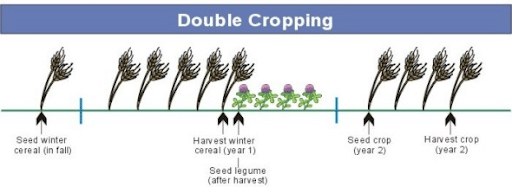
Double Cropping
What is Double Cropping?
- Double-cropping is a type of multiple cropping practices in agriculture in which, following the harvest of the first crop, a second crop is grown on the same land such as rice coming after wheat, potatoes, or mustard; maize after groundnuts; and wheat after cotton.
- Cropping intensity is 200 percent in double-cropping.
- The double-cropped system, which is frequently achieved by rotating a winter annual and a summer annual, can boost ecological services while also generating additional revenue for farmers.
- An example of double cropping would be to harvest a wheat crop during the early summer and then plant corn or soybeans on that same land for harvest in the fall.
- Only areas with long growing seasons are able to engage in this technique.
|
|
|
|---|---|
| Multiple cropping | Monoculture |
| Triple cropping | Quadruple cropping |
| Sole cropping | Mono cropping |
Double Cropping - Considerations
- Seeding Rate: In double-cropped soybeans, a higher-than-average plant population may result in higher yields for types with a shorter growing season.
- Row Width: Narrow rows let crop canopies grow more quickly. One method to do that is to double back and split 30-inch middles using an Early Riser planter.
- Weed Control: When using herbicide-tolerant cultivars, weed control can be postponed until after planting. But for double-crop soybeans to produce the highest yields, reducing competition is essential.
- Crop Residue Management: In order to have a suitable seedbed for the double crop vegetable, crop residue management is essential.
- Herbicide Plant Limits: It's also imperative to pay special attention to herbicide plant back limits.
- Pest Management: Double crop plantings may have certain pest issues. Some insects will start looking for a new food supply once a crop is harvested, which could put the newly emerging double crop planting at risk.
- Additionally, insects, and mites may travel from field boundaries into the planting of the double crop. Examples include grasshoppers and two-spotted spider mites.
- Herbicide Programs: Programs for using herbicides should be created to address any problems with regrowth from previous crops.
- Examples include dealing with spring brassica crops that went to seed as volunteer weeds or efficiently eliminating plasticulture strawberries so that vine crops can be twice farmed on the beds.
Double Cropping - Benefits
- Two distinct crops planted one after the other can have many advantages.
- The second crop's increased revenue is certainly the first factor.
- It provides an additional source of revenue, acting as a safety net in case the farm's main cash crop is harmed by drought, illness, pests, or market swings.
- Another benefit of including a second crop is that it can thwart pests and diseases that only affect the first crop.
- Gross profits per acre can be increased by dividing fixed costs between two crops.
Conclusion
Although not every nation of the world grows food where double-cropping is feasible or even viable, but for some grain-growing pantropical nations, double-cropping may be a way to improve grain production without enlarging cropland over undeveloped areas.
|
|
|
|---|---|
| Agriculture Notes | Cropping |
| Cropping system | Mixed cropping |
| Sequential cropping | Cropping intensity |
| Intercropping | Ratoon cropping |
FAQs
Question: What is double cropping in agriculture?
Answer: Double cropping refers to the practice of growing two different crops on the same piece of land within a single agricultural year. This practice increases the efficiency of land use, especially in regions with favorable climatic conditions. Double cropping can be done in two main ways: growing two crops in a single season, or growing one crop and then replanting the land with a second crop after harvesting the first. It helps to maximize production and is commonly used in areas with adequate water supply and longer growing seasons.
Question: What are the benefits of double cropping?
Answer: The main benefits of double cropping include increased agricultural output, more efficient use of arable land, and higher income for farmers. By growing two crops in one year, farmers can make better use of the resources available to them, such as water, soil, and labor. This practice is particularly useful in regions where the growing season is long enough to support two harvests. Double cropping can also contribute to improved food security by producing a greater variety of crops in a shorter period, which helps diversify the agricultural economy.
Question: What are the challenges associated with double cropping?
Answer: While double cropping has several advantages, it also presents challenges. One of the primary issues is the depletion of soil nutrients, as the land is worked more intensively. Continuous cropping can lead to soil degradation if proper crop rotation, fertilization, and soil management techniques are not followed. Double cropping also requires a more significant water supply, which can be problematic in areas where irrigation is not available or water is scarce. Additionally, the risk of crop failure increases if the second crop is dependent on the weather conditions, such as the monsoon.
Question: Which regions in India commonly practice double cropping?
Answer: Double cropping is commonly practiced in regions of India that have a favorable climate and adequate irrigation infrastructure. The major regions that practice double cropping include the Indo-Gangetic plains, particularly in states like Punjab, Haryana, Uttar Pradesh, and Bihar. The southern states like Tamil Nadu and Andhra Pradesh also practice double cropping in areas with sufficient water resources. The success of double cropping in these regions is largely due to the availability of irrigation systems and a longer growing season.
Question: How does double cropping impact the agricultural economy?
Answer: Double cropping positively impacts the agricultural economy by increasing productivity per unit of land, thereby boosting overall agricultural output. This practice contributes to food security by producing more food in a shorter time frame. Additionally, double cropping allows farmers to earn higher incomes, as they can sell two harvests in a single year. However, this increased production can lead to market saturation in some cases, potentially reducing prices. Proper management of soil health, water resources, and crop diversification is essential to maintaining the sustainability of double cropping systems in the long term.
MCQs
1. What does double cropping involve?
A) Growing one crop in a year
B) Growing two crops on the same land in a year
C) Growing two crops on different lands
D) Using the same seed for two harvests
Answer: (B) See the Explanation
Explanation: Double cropping refers to growing two different crops on the same piece of land in a single agricultural year, maximizing land use efficiency.
2. What is a key challenge of double cropping?
A) Depletion of soil nutrients
B) Lower income for farmers
C) Decreased agricultural output
D) Reduced water usage
Answer: (A) See the Explanation
Explanation: One of the key challenges of double cropping is the depletion of soil nutrients due to continuous cultivation, which can degrade soil health if not managed properly.
3. Which region in India is most known for practicing double cropping?
A) Rajasthan
B) Punjab
C) Uttar Pradesh
D) Kerala
Answer: (B) See the Explanation
Explanation: Punjab is one of the key regions in India where double cropping is widely practiced due to its favorable climate and extensive irrigation infrastructure.
4. Double cropping primarily helps in which of the following?
A) Reducing soil erosion
B) Increasing food production per unit of land
C) Improving water quality
D) Increasing crop failure rates
Answer: (B) See the Explanation
Explanation: Double cropping increases food production per unit of land by allowing farmers to grow two crops in a single agricultural year, thereby maximizing land productivity.
5. Which factor is essential for the success of double cropping?
A) Availability of irrigation water
B) High soil fertility
C) Shorter growing seasons
D) Limited crop variety
Answer: (A) See the Explanation
Explanation: Availability of irrigation water is crucial for the success of double cropping, as the second crop requires sufficient moisture to grow properly.
GS Mains Questions and Model Answers
Q1: Analyze the impact of double cropping on the agricultural sustainability of India.
Answer: Double cropping can have both positive and negative impacts on the agricultural sustainability of India. On the positive side, it leads to increased productivity per hectare, resulting in higher food production and better income for farmers. This practice is especially beneficial in areas with abundant water resources and longer growing seasons. However, over-reliance on double cropping can lead to soil depletion, as the land is worked continuously without proper soil regeneration. If adequate measures such as crop rotation, organic farming practices, and balanced fertilization are not implemented, double cropping can result in reduced soil fertility over time. Furthermore, increased demand for water can stress already scarce resources, making water management a critical factor for the long-term success of double cropping. Therefore, while double cropping has the potential to boost agricultural production, it requires careful management of natural resources to ensure sustainability.
Q2: Discuss the role of irrigation in enabling double cropping in India.
Answer: Irrigation plays a pivotal role in enabling double cropping, especially in regions where the monsoon season is insufficient or unpredictable. In India, areas like Punjab, Haryana, and Uttar Pradesh are known for practicing double cropping due to the extensive use of irrigation systems, including canals and tube wells. Irrigation ensures a consistent water supply, allowing farmers to grow two crops in a single year, even in regions with relatively dry or erratic rainfall patterns. The success of double cropping is highly dependent on the availability of irrigation, as the second crop requires enough water to reach maturity. The spread of modern irrigation techniques, such as drip irrigation and sprinklers, has further facilitated the expansion of double cropping in areas where traditional irrigation systems were less efficient. However, over-reliance on irrigation can lead to groundwater depletion and environmental concerns, which must be managed carefully for sustainable agriculture.
Q3: Examine the environmental implications of double cropping in India.
Answer: Double cropping can have significant environmental implications, both positive and negative. On the positive side, it maximizes land use efficiency, leading to higher food production and a potential reduction in the need to expand agricultural land into forests or other natural areas, which could help conserve biodiversity. However, the environmental costs of double cropping include increased water consumption, which can strain local water resources, especially in regions reliant on irrigation. Overuse of chemical fertilizers and pesticides to maintain soil fertility can also lead to soil degradation, water pollution, and loss of soil biodiversity. Additionally, continuous cropping can deplete essential soil nutrients, leading to the need for more frequent fertilization and further exacerbating environmental concerns. To mitigate these effects, sustainable farming practices such as crop rotation, organic farming, and water-efficient irrigation systems are essential in the long-term management of double cropping systems.
Previous Year Questions on Double Cropping
1. UPSC CSE Prelims 2017:
Question: Double cropping refers to:
A) Growing two crops on different lands
B) Growing two crops on the same land within a single agricultural year
C) Using the same crop for two harvests
D) Using double fertilizers for crop growth
Answer: (B)
Explanation: Double cropping refers to growing two different crops on the same land within a single agricultural year, which is a practice to increase land productivity.
2. UPSC CSE Mains 2019 (GS Paper 3):
Question: "Assess the advantages and challenges of double cropping in Indian agriculture."
Answer: Double cropping increases agricultural productivity and income by utilizing the land for two harvests per year. This leads to higher food production, reduced food insecurity, and improved farmer income. However, it also poses challenges like soil degradation, water resource depletion, and the need for greater chemical inputs to maintain soil fertility. Ensuring sustainable water and soil management practices is essential for mitigating these challenges and maintaining the long-term benefits of double cropping.
Download the PREPP App and attempt FREE IAS Exam Mock Tests and get complete study material!

Full Test - 04: UPSC CSE Prelims CSAT (Paper-II)
Full Test - 03: UPSC CSE Prelims CSAT (Paper-II)
UPSC CSE Prelims 2026 GS Paper 1 Question Paper (24-May-2026)
UPSC CSE Prelims 2026 CSAT Paper 2 Question Paper (24-May-2026)

17 February 2025 | The Hindu Must Read Articles | Current Affairs

16 February 2026 | The Hindu Must Read Articles | Current Affairs

13 February 2026 | The Hindu Must Read Articles | Current Affairs









Comments