Constituent Assembly of India - Indian Polity Notes
Constituent assembly was formed to frame the constitution for India in 1946 on the basis of the Cabinet Mission plan. The Constituent Assembly was an elected body tasked with drafting a constitution.After completion of framing the Constitution, the assembly was dissolved. It is considered a kind of representative democracy because members of the constituent assembly were indirectly elected and some were nominated members. In 1934, M.N. Roy proposed the idea of a constituent assembly for the first time.
Table of Contents
- Constituent Assembly – Meaning
- Historical Background
- Objective of the Constituent Assembly for India
- Composition of the Constituent Assembly
- Working of the Constituent Assembly
- Changes in Constituent Assembly after the Independence Act 1947
- Constituent Assembly - Provisions
- Significance
- Constituent Assembly Of India – Important Facts
- Conclusion
- FAQs
- MCQs
Constituent Assembly – Meaning
A constituent assembly is a body of representatives that is elected to create or change their country's constitution.
Constituent Assembly of India – Historical Background
- M.N. Roy, a pioneer of the communist movement in India was the first person to put forward the ideas of the Constituent Assembly for India in 1934.
- Indian National Congress (INC) for the first time officially demanded a Constituent Assembly to draft the Indian Constitution in 1935.
- On behalf of the INC, Jawaharlal Nehru declared in 1938 that " the Constitution of free India must be framed, without outside interference, by a Constituent Assembly elected on the basis of adult franchise."
- British Government finally accepted the demand in the 'August Offer' of 1940.
- Cripps Proposal also underlined setting up a Constitution-making body for India after World War II.
- The Cabinet Mission of 1946 rejected the idea of two Constituent Assemblies for two dominions India and Pakistan.It proposed a scheme for the single Constituent Assembly which was not acceptable to the Muslim League.
Objective of the Constituent Assembly for India
- To develop India as an independent sovereign republic.
- To create a democratic Union with self-government for all constituent parts.
- To guarantee and secure to all Indians. Justice: Social, economic, and political.
- Equality of status and opportunities for all
- Freedom of thought, expression, belief, faith, worship, vocation association, and action.
- To provide adequate safeguards for backward and tribal areas, minorities as well as the poor and other disadvantaged groups.
- To uphold the Republic's territorial integrity and sovereign rights on land, sea, and air in accordance with the justice and law of civilized nations.
- To ensure India's rightful and honoured place in the world.
- To contribute to the advancement of world peace and the well-being of humanity.
|
Constitution empowers those who traditionally have been deprived of it and gives vulnerable people the power to achieve collective good. Rajeev Bhargava
|
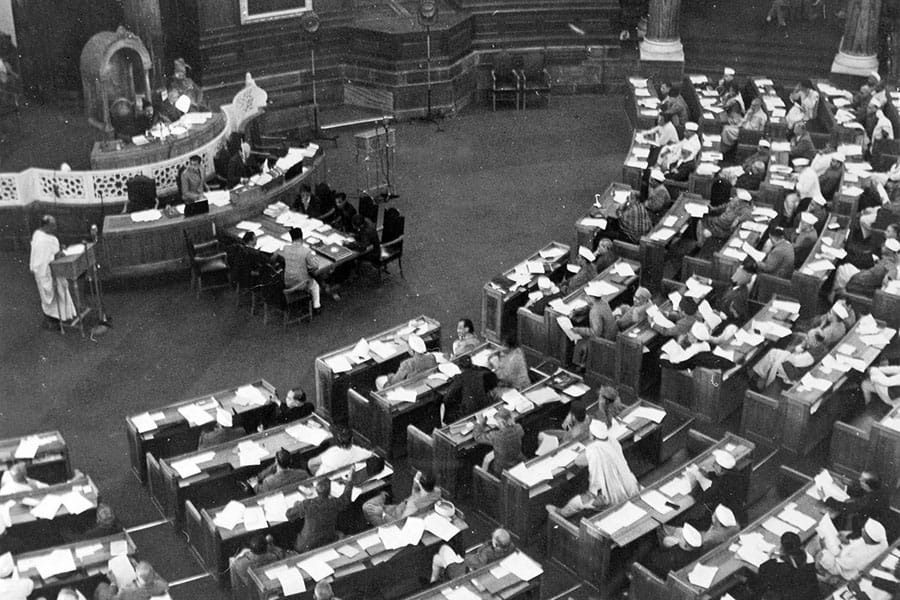
Composition of the Constituent Assembly
| Constituent Assembly of India: Overview Aspect of the Constituent Assembly | Details |
|---|---|
| Total Number of Members | 389 |
| Allocation of Seats | 296 seats to British India, 93 seats to princely states |
| Seat Allocation Basis | Proportion to population; approximately one seat per million population |
| Division of Seats in British Provinces | Among Muslims, Sikhs, and General communities in proportion to their population |
| Election of Representatives | Representatives of communities elected by members of that community in the provincial legislative assembly |
| Princely States Representatives | Nominated by the heads of the Princely states |
| Nature of the Assembly | Partly elected and partly nominated |
| Voting Method | Proportional representation using single transferable vote |
| Direct Election | No direct election by the people of India based on Universal adult franchise |
Working of the Constituent Assembly
| Aspect | Details |
|---|---|
| Establishment | In Accordance with Cabinet Mission Plan of 1946 |
| Recognised by | Indian Independence Act of 1947,Section 8 |
| First Convened | December 9,1946 |
| Provisional President | Dr.Sachhidananda Sinha |
| Chairman Elected | Dr.Rajendra Prasad on December 11,1946 |
| Objective Resolution Moved | By Jawaharlal Nehru on December 13,1946 |
| Resolution adopted | January 22,1947 |
| First Draft Published | February,1948 |
| Public Discussion and Amendments | 8 months for feedback |
| Special Committee Formed Post Feedback | - |
| Final Draft introduced | By Dr.B.R.Ambedkar on November 4,1948 |
| Constitution adopted | November 26,1949 |
| Constitution Contents | A preamble,395 Articles and 8 Schedules |
| Duration of the Assembly Meetings | 11 sessions over two years,11 months and 18 days |
| Review Process | Reviewed Constitutions of around 60 countries, cost 64 lakhs. |
Changes in Constituent Assembly after the Independence Act 1947
- The representation of Princely states who had stayed away from the Constituent Assembly gradually increased.
- Constituent Assembly became the fully sovereign body, which could frame any Constitution it pleased.
- It was assigned two prime functions like framing the Constitution for independent India and to act as a provisional parliament to frame ordinary laws.
- The total strength of the Assembly was reduced from 389 to 299 after with withdrawal of Muslim League members who joined the dominion of Pakistan.
Constituent Assembly - Provisions
- Section 8 of the Indian Independence Act of 1947 established the Assembly.
- The Constituent Assembly of India was established in accordance with the provisions of the Cabinet Mission Plan of May 1946.
- The Assembly was made up of 389 members who represented provinces (292), states (93), Chief Commissioner Provinces (3), as well as Balochistan (1)
- On December 9, 1946, the Assembly convened for the first time and elected Dr. Sachhidannand Sinha, the Assembly's oldest member, as Provisional President.
- Dr. Rajendra Prasad was elected as the Assembly's permanent Chairman on December 11, 1946.
- The Assembly was to be composed of proportional representation from existing provincial legislatures and princely states.
- The Assembly was to be divided into three sections: Punjab &the North-West, Bengal-Assam, and the rest of India.
- The constitutions were to be drafted for the Indian Union, each Section, and each of the Provinces within them.
- The Muslim League, which had won the majority of the 80 Muslim seats and dominated two smaller Sections, chose not to participate, and as a result, the Assembly never convened separately in sections.
- Following the passage of the Indian Independence Act by the British Parliament, it was decided that members who wanted to keep their seats in the provincial legislature would vacate their seats in the Assembly.
- However, several members of the provincial legislature continued to attend and participate in the Assembly until a provision was made in the Constitution itself prohibiting this.
- The declaration of Partition of India caused the greatest change in membership.
- Following an initial lack of interest, the princely states began negotiating their representation with a committee of the Assembly.
- Hundreds of princely states were grouped into larger associations over time, and provisions were made for them to elect their representatives to the Assembly.
- New members continued to join up until the Assembly's final day. Until the very end, Hyderabad did not send a representative.
- According to records, the Assembly's maximum membership near the end of its tenure was 307.
- Several non-members assisted the Assembly in developing the Constitution.
- Outside the Assembly, prominent public figures were asked to serve on committees formed by the Assembly to focus on specific features or segments.
- These committees were responsible for much of the constitution's development, both procedurally and substantively.
- Resolutions were moved and adopted after discussions to establish committees as needed.
- The Constituent Assembly established 13 committees to draft the constitution.
- A seven-member committee prepared a draft of the constitution based on the reports of these committees.
- The draft constitution was published in January 1948, and the public had eight months to discuss it and propose amendments.
- Following the receipt of comments in response to the Draft Constitution of February 1948, the so-called Special Committee was formed to determine the next course of action.
- After the draft was discussed by the people, the press, the provincial assemblies, and the constituent Assembly in light of the suggestions received, it was finally adopted and signed by the President of the Assembly on November 26, 1949.
- Following the authentication of the Constitution's copies, the Constituent Assembly was naturally dissolved, with its Chairperson elected President of India and its staff diverted to other avenues.
- However, the majority of the Assembly continued to function as the provisional Parliament of India until the first general elections were held.
- This provisional Parliament did, in fact, make the first amendment to the Indian Constitution in the summer of 1951.
Presiding Officers
- On December 9, 1946, the Assembly convened for the first time and elected Dr. Sachhidannand Sinha, the Assembly's oldest member, as Provisional President.
- Dr. Rajendra Prasad was elected as the Assembly's permanent Chairman on December 11, 1946.
Composition
- The Assembly was to be composed of proportional representation from existing provincial legislatures and princely states.
- The Assembly was to be divided into three sections: Punjab &the North-West, Bengal-Assam, and the rest of India.
- The constitutions were to be drafted for the Indian Union, each Section, and each of the Provinces within them.
- The Muslim League, which had won the majority of the 80 Muslim seats and dominated two smaller Sections, chose not to participate, and as a result, the Assembly never convened separate sections.
- Following the passage of the Indian Independence Act by the British Parliament, it was decided that members who wanted to keep their seats in the provincial legislature would vacate their seats in the Assembly.
- However, several members of the provincial legislature continued to attend and participate in the Assembly until a provision was made in the Constitution itself prohibiting this.
Changes after the declaration of Partition
- The declaration of Partition of India caused the greatest change in membership.
- Following an initial lack of interest, the princely states began negotiating their representation with a committee of the Assembly.
- Hundreds of princely states were grouped into larger associations over time, and provisions were made for them to elect their representatives to the Assembly.
- New members continued to join up until the Assembly's final day. Until the very end, Hyderabad did not send a representative.
- According to records, the Assembly's maximum membership near the end of its tenure was 307.
Contribution of Non-Constituent Assembly Members
- Several non-members assisted the Assembly in developing the Constitution.
- Outside the Assembly, prominent public figures were asked to serve on committees formed by the Assembly to focus on specific features or segments.
- These committees were responsible for much of the constitution's development, both procedurally and substantively.
- Resolutions were moved and adopted after discussions to establish committees as needed.
Draft Committee
- The Constituent Assembly established 13 committees to draft the constitution.
- A seven-member committee prepared a draft of the constitution based on the reports of these committees.
- The draft constitution was published in January 1948, and the public had eight months to discuss it and propose amendments.
- Following the receipt of comments in response to the Draft Constitution of February 1948, the so-called Special Committee was formed to determine the next course of action.
- After the draft was discussed by the people, the press, the provincial assemblies, and the constituent Assembly in light of the suggestions received, it was finally adopted and signed by the President of the Assembly on November 26, 1949.
Dissolution of Constituent Assembly
- Following the authentication of the Constitution's copies, the Constituent Assembly was naturally dissolved, with its Chairperson elected President of India and its staff diverted to other avenues.
- However, the majority of the Assembly continued to function as the provisional Parliament of India until the first general elections were held.
- This provisional Parliament did, in fact, make the first amendment to the Indian Constitution in the summer of 1951.
Significance
- The Constituent Assembly, established under the Cabinet Mission Plan of 1946, drafted the Constitution.
- The drafting of the Constitution is now regarded as a monumental democratic achievement for which the members deserve enormous credit.
- Despite being a multicultural group of people from various communities, these individuals were collectively committed to completing the historic task of establishing a democratic republic in India.
- The decision to grant universal adult franchise was a huge risk for the Indian state, but it was also one of the most visible displays of democratic zeal.
- It is because of the members of the constituent assembly that our flag flutters proudly over the Parliament in Delhi.
- Issues were debated until decisions as unanimous as possible could be made and proceedings were open to members of the public and the press.
Challenges
- The main criticism against the Assembly was spearheaded essentially by the Muslim League that it was a Congress Hindu dominated body.
- Because of this belief and conviction, the League never enthusiastically participated in the deliberations of the Constituent Assembly and eventually withdrew.
- Another challenge facing the assembly was to create a political framework that would keep the various communities and princely states happy in India and prevent Balkanisation.
- To draft a constitution that would benefit the oppressed segments of society.
- The fathers wanted their vision of the country to live on after their deaths to ensure democratic processes for citizens in perpetuity.
- To draft a constitution that can effectively deal with communal violence. This was largely motivated by the violence that occurred as a result of the partition.
- To draft a constitution capable of incorporating princely states and their various demands.
Key Members Involved
- Rajendra Prasad was elected President of the Constituent Assembly, with VT Krishnamachari and HC Mookerji as Vice Presidents.
- HVR Iyengar was the Assembly's secretary-general, and SN Mukherji was the Chief Draftsman.
- Dr. B.R. Ambedkar, was the Chairman of the Drafting Committee of the Assembly which earned him the popular moniker of ‘Father of the Indian Constitution.
- After receiving input from constitutional experts both at home and abroad, Dr. B.N. Rau compiled the initial draught that the assembly debated.
| Name of the Committee | Chairman |
|---|---|
| Committee on the Rules of Procedure | Rajendra Prasad |
| Steering Committee | Rajendra Prasad |
| Finance and Staff Committee | Rajendra Prasad |
| Credential Committee | Alladi Krishnaswami Ayyar |
| House Committee | B. Pattabhi Sitaramayya |
| Order of Business Committee | K.M. Munshi |
| Ad hoc Committee on the National Flag | Rajendra Prasad |
| Committee on the Functions of the Constituent Assembly | G.V. Mavalankar |
| States Committee | Jawaharlal Nehru |
| Advisory Committee on Fundamental Rights, Minorities and Tribal and Excluded Areas | Vallabhbhai Patel |
| Minorities Sub-Committee | H.C. Mookherjee |
| Fundamental Rights Sub-Committee | J.B. Kripalani |
| North-East Frontier Tribal Areas and Assam Excluded & Partially Excluded Areas Sub-Committee | Gopinath Bardoloi |
| Excluded and Partially Excluded Areas (Other than those in Assam) Sub-Committee | A.V. Thakkar |
| Union Powers Committee | Jawaharlal Nehru |
| Union Constitution Committee | Jawaharlal Nehru |
| Drafting Committee | B.R. Ambedkar |
Constituent Assembly Of India – Adoption of National Symbols
- On July 22, 1947, it adopted the national flag.
- On January 24, 1950, it adopted the national anthem.
- On January 24, 1950, it adopted the national anthem.
- On January 24, 1950, it chose Dr. Rajendra Prasad as India's first President.
The Constituent Assembly met for 11 sessions over the course of two years, 11 months, and 18 days. The Draft Constitution was debated for 114 days after the Constitution-makers reviewed the constitutions of around 60 countries. The overall cost of creating the Constitution was 64 lakhs.
Constituent Assembly Of India – Adoption of National Symbols
- On July 22, 1947, it adopted the national flag.
- On January 24, 1950, it adopted the national anthem.
- On January 24, 1950, it adopted the national song.
- On January 24, 1950, it elected Dr. Rajendra Prasad as India's first President.
Enactment and Adoption of the Indian Constitution
- The Indian Constitution was adopted on November 26, 1949, which means it was finalized by the Constituent Assembly on that date.
- However, it came into effect two months after its adoption, on January 26, 1950, also known as the date of its "commencement."
- Some of its provisions, such as those relating to citizenship, elections, a provisional Parliament, temporary and transitional provisions, came into effect on November 26, 1949 only.
- The date January 26 was specifically chosen as the date of commencement of the Constitution because of its historical importance. January 26, 1930, was celebrated as Purn Swaraj Day following the 1929 Lahore session resolution of the INC.
Dissolution of Constituent Assembly
- Following the authentication of the Constitution's copies, the Constituent Assembly was naturally dissolved, with its Chairperson elected President of India and its staff diverted to other avenues.
- However, the Assembly continued to function as the provisional Parliament of India until the first general elections were held.
- This provisional Parliament, in fact, made the first amendment to the Indian Constitution in 1951.
Constituent Assembly Of India – Criticism
The critics have criticized the Constituent Assembly on various grounds. These are as follows:
- Not a Representative Body: The Constituent Assembly was not a representative body, according to opponents, because its members were not directly elected by the people of India using the universal adult franchise.
- Not a Sovereign Entity: Critics said that the Constituent Assembly was not a sovereign body because it was established by British government suggestions. They further claimed that the Assembly met with the authorization of the British government.
- Time-consuming: Critics claim that the Constituent Assembly took an excessive amount of time to draught the Constitution. They claimed that the framers of the American Constitution finished their work in just four months.
- Congress-dominated Constituent Assembly: Critics said that the Congress party dominated the Constituent Assembly. 'The Constituent Assembly was a one-party assembly in an essentially one-party society,' said Granville Austin, a British constitutional expert. The Congress was the Assembly, and India was the Congress.'
- Lawyer - Politician Domination: The Constituent Assembly was likewise dominated by attorneys and politicians, according to detractors. They argued that other aspects of society were not adequately reflected. This, they believe, is the primary cause for the Constitution's volume and complication of language.
- Hindu-dominated: Some critics claim that the Constituent Assembly was Hindu-dominated. Lord Viscount Simon referred to it as "a Hindu body." Winston Churchill, likewise, stated that the Constituent Assembly represented "just one large community in India."
Constituent Assembly Of India – Important Facts
- The elephant was chosen as the Constituent Assembly's symbol (seal).
- Sir B.N. Rau was appointed as the Constituent Assembly's constitutional advisor (legal advisor).
- The Secretary of the Constituent Assembly was H.V.R. Iyengar.
- S.N. Mukherjee was the chief draftsman of the Constitution.
- Prem Behari Narain Raizada was the calligrapher of the Indian Constitution,wrote the original constitution in a flowing italic style.
- Artists from Shantiniketan, such as Nand Lal Bose and Beohar Rammanohar Sinha, beautified and adorned the original form.
- Prem Behari Narain Raizada's original Preamble was illuminated, beautified, and adorned by Beohar Rammanohar Sinha.
- Vasant Krishan Vaidya calligraphed the Hindi translation of the original constitution, which Nand Lal Bose exquisitely embellished and illuminated.
Conclusion
Constituent Assembly not only sealed the fate of a nascent nation but also set the course for a pluralistic, inclusive, and egalitarian society. The Constitution of India, adopted on January 26, 1950, embodies the aspirations of a diverse population, guaranteeing fundamental rights, justice, and equality to all citizens.
FAQs
Question: What was the Constituent Assembly of India?
Answer: The Constituent Assembly was a body established to draft the Constitution of India, and it held its first session on December 9, 1946.
Question: Who was the President of the Constituent Assembly?
Answer: Dr. Rajendra Prasad was elected as the permanent President of the Constituent Assembly.
Question: How were the members of the Constituent Assembly elected?
Answer: Members were indirectly elected by the Provincial Legislative Assemblies, following the Cabinet Mission Plan of 1946.
Question: When was the Constitution of India adopted?
Answer: The Constitution was adopted by the Constituent Assembly on November 26, 1949 and came into effect on January 26, 1950.
Question: What was the significance of the Objectives Resolution?
Answer: The Objectives Resolution, moved by Jawaharlal Nehru, laid down the philosophy and principles of the Constitution and was adopted by the Constituent Assembly in 1947.
MCQs
- Who presided over the first session of the Constituent Assembly?
a) B.R. Ambedkar
b) Dr. Rajendra Prasad
c) Dr. Sachchidananda Sinha
d) Jawaharlal Nehru
Answer: (C) See the Explanation
Dr. Sachchidananda Sinha was the interim President of the Constituent Assembly in its first session.
- What was the primary role of the Constituent Assembly of India?
a) Formulate economic policies
b) Draft the Constitution
c) Create international treaties
d) Regulate foreign trade
Answer: (B) See the Explanation
The primary role of the Constituent Assembly was to draft the Constitution of India.
- Which document laid the framework for India’s Constitution during the Constituent Assembly debates?
a) Cabinet Mission Plan
b) Government of India Act, 1935
c) Objectives Resolution
d) Nehru Report
Answer: (C) See the Explanation
The Objectives Resolution, introduced by Jawaharlal Nehru, laid the guiding principles for the Indian Constitution.
- When did the Constituent Assembly adopt the final draft of the Indian Constitution?
a) January 26, 1950
b) August 15, 1947
c) November 26, 1949
d) December 9, 1946
Answer: (C) See the Explanation
The Constitution was adopted on November 26, 1949, and came into force on January 26, 1950.
- Which of the following was not a member of the Constituent Assembly?
a) B.R. Ambedkar
b) Mahatma Gandhi
c) Jawaharlal Nehru
d) Sardar Vallabhbhai Patel
Answer: (B) See the Explanation
Mahatma Gandhi was not a member of the Constituent Assembly, though many of his ideas influenced the Constitution.
GS Mains Questions and Model Answers
Q1: Analyze the significance of the Constituent Assembly in laying the foundation for Indian democracy.
Answer: The Constituent Assembly was instrumental in laying the foundation for Indian democracy by drafting a Constitution that guaranteed fundamental rights, democratic institutions, and an independent judiciary. The Assembly represented a wide cross-section of Indian society, ensuring that diverse voices were heard. It incorporated the ideals of justice, liberty, and equality, and established the principles of parliamentary democracy and federalism. By adopting a written Constitution, the Assembly ensured that the rule of law would govern the country, laying the foundation for India’s enduring democratic structure.
Q2: Discuss the challenges faced by the Constituent Assembly in drafting the Constitution of India.
Answer: The Constituent Assembly faced several challenges, including managing the diverse demands of India’s population, addressing communal tensions, and balancing the interests of different regions and communities. The partition of India complicated matters further, and the Assembly had to ensure the new Constitution would promote unity and integrity while respecting diversity. There were debates over federalism, minority rights, and the role of the state in social and economic development. Despite these challenges, the Assembly produced a document that laid the foundation for a democratic, secular, and inclusive India.
Q3: Evaluate the role of the Drafting Committee, chaired by Dr. B.R. Ambedkar, in shaping the Indian Constitution.
Answer: The Drafting Committee, under the chairmanship of Dr. B.R. Ambedkar, was crucial in translating the discussions of the Constituent Assembly into a comprehensive constitutional document. Ambedkar ensured that the Constitution balanced individual rights with social justice, and emphasized constitutional morality over majoritarianism. The committee addressed the complexities of governance, fundamental rights, and safeguards for minorities, ensuring the Constitution was both flexible and strong enough to guide India’s future. Ambedkar’s leadership in the committee established him as the principal architect of the Indian Constitution.
Previous Year Questions on Constituent Assembly of India
1. UPSC CSE Prelims 2018:
Question: The Constituent Assembly was formed based on which plan?
A. Simon Commission
B. Cripps Mission
C. Cabinet Mission Plan
D. Mountbatten Plan
Answer: C
Explanation: The Constituent Assembly was formed following the Cabinet Mission Plan of 1946, which laid down the process for drafting the Indian Constitution.
2. UPSC CSE Mains 2017 (GS Paper 2):
Question: Discuss the role and contribution of the Constituent Assembly in shaping India’s Constitution.
Answer: The Constituent Assembly played a pivotal role in drafting the Indian Constitution. It brought together representatives from various regions and communities, who deliberated on issues like fundamental rights, federalism, and governance structures. The Assembly adopted democratic principles and incorporated ideals from other constitutions while ensuring they suited India’s unique context. The Objectives Resolution, introduced by Nehru, provided a philosophical framework. The Assembly worked in committees, and its deliberations ensured the Constitution’s provisions were inclusive and forward-thinking, shaping the future governance of India.
3. UPSC CSE Prelims 2017:
Question: Who among the following was the Chairman of the Drafting Committee of the Constitution?
A. Dr. Rajendra Prasad
B. B.R. Ambedkar
C. K.M. Munshi
D. Alladi Krishnaswamy Iyer
Answer: B
Explanation: Dr. B.R. Ambedkar was the Chairman of the Drafting Committee, which played a crucial role in shaping the final Constitution of India.
*email: contactus@prepp.in
Download the PREPP App and attempt FREE IAS Exam Mock Tests and get complete study material!

Full Test - 04: UPSC CSE Prelims CSAT (Paper-II)
Full Test - 03: UPSC CSE Prelims CSAT (Paper-II)
UPSC CSE Prelims 2026 GS Paper 1 Question Paper (24-May-2026)
UPSC CSE Prelims 2026 CSAT Paper 2 Question Paper (24-May-2026)

17 February 2025 | The Hindu Must Read Articles | Current Affairs

16 February 2026 | The Hindu Must Read Articles | Current Affairs

13 February 2026 | The Hindu Must Read Articles | Current Affairs









Comments