Carbon Leakage - Environment Notes
Carbon leakage happens when greenhouse gas emissions in one nation increase as a result of emissions reductions in a second country with rigorous climate policies. The transfer of carbon-intensive firms out of industrialised economies is referred to as carbon leakage. They relocate production to countries with less rigorous carbon regulations. This article explains about the Carbon leakage which is important for UPSC IAS exam preparation.
Table of Contents
What is Carbon leakage?
- "Carbon leakage is defined as the increase in CO2 emissions outside of countries that are taking domestic mitigation action divided by the reduction in emissions from these countries."
- It is given as a percentage and might be larger or less than 100%.
- Changes in trading patterns can cause carbon leakage, which is frequently assessed as the balance of emissions embodied in trade (BEET).
- This may result in an increase in their overall emissions. Certain energy-intensive industries may be more vulnerable to carbon leakage.
- One sort of spill-over impact is carbon leakage. Spillover effects can be good or bad; for example, emission reduction policies may result in technical advances that help in emission reductions outside of the policy region.
- This implies that the domestic strategy for mitigating climate change is less efficient and more expensive in limiting emission levels, which is a real worry for policy-makers.
- Carbon Tax, also known as Carbon Cess, is one example of the strictest regulations that is imposed in several nations.
| Other Relevant Links | |
|---|---|
| India's GreenHouse Gas Emissions | Net Zero Pledges |
| Karakoram Anomaly | HPCL - Cow Dung to Compressed Biogas Project |
| Triple Planetary Crisis | Arctic Amplification |
| CO2 Equivalent | Carbon Dioxide Levels – Keeling Curve |
| Updated NDCs | Panchamrit |
| UNEP Production Gap Report | UN World Water Conference |
| Global Alliance for Industry Decarbonisation | Green Coal |
Carbon leakage Working
Let us consider two nations, A and B.
- Country A has a highly severe emission regulation, and as a result, the costs associated with production rise.
- Nation B has a less stringent and more flexible emission policy, and as a result of this flexibility, the costs associated in manufacturing are lower in comparison to nation A, assuming all other parameters remain equal.
- As a result of the severe climate policy, a firm in nation A suffers increasing expenses owing to carbon pricing.
- The company would take some action, and as a result, it may opt to reduce, close, or relocate manufacturing to Country B, which has less rigorous climate legislation.
- This indicates that whereas Country A was able to reduce emissions, Country B will now raise emissions due to the transfer of greenhouse gas-intensive businesses from Country A to Country B. As a result, more GreenHouse Gases are emitted and more industrial employment is created.
- This transition might occur from country to country, province to province, region to region, or in any other fashion.
Reasons of Carbon leakage
Carbon leakage can occur for a variety of reasons, including:
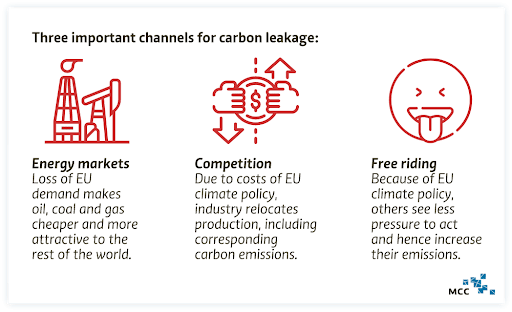
- If a country's emissions policy boosts local costs, another country with a more lenient policy may have a trading advantage.
- If demand for these commodities remains constant, production may shift offshore to a cheaper nation with lesser regulations, with no reduction in world emissions.
- If one country's environmental regulations raise the price of particular fuels or commodities, demand will fall and the price will fall.
- Countries that do not charge a premium for certain commodities may fill the demand and use the same supply, negating any gain.
- There is no agreement on the size of the long-term leaking consequences. This is critical for the issue of climate change.
Conclusion
Carbon leakage is the situation that can occur if companies move their manufacturing to nations with emission restrictions as a result of the expenses associated with implementing climate regulations. Carbon leakage is the movement of carbon-intensive companies outside of developed economies. Production is moved to nations with laxer carbon rules.
FAQs
Question: What is Carbon Leakage
Answer:
Carbon leakage is the situation that can occur if companies move their manufacturing to nations with emission restrictions as a result of the expenses associated with implementing climate regulations. Their total emissions may rise as a result of this. Some businesses that use a lot of energy could be more prone to carbon leakage.
Question: What is the Carbon emissions embodied in trade?
Answer:
Estimating the volume of GHGs emitted during production, transit, and consumption along supply chains within and across nations is how carbon emission accounting evaluates the amount of GHG emissions inherent in economic activities, including international commerce.
Question: What is Carbon Border Tax?
Answer:
A tax on imports known as the "Carbon Border Tax" is based on how much carbon was emitted during the production of the item. By serving as a carbon fee, it reduces emissions. It affects exports and output as a trade-related statistic. The goal of the plan is to make Europe the first continent to achieve carbon neutrality by 2050 as part of the European Green Deal.
MCQs
Question: Consider the following statements
- A carbon tax is a type of environmental tax that levies a price on the production, distribution, and consumption of fossil fuels.
- Carbon taxes efficiently reduce greenhouse gas emissions.
- Carbon taxes stimulate the use of renewable energy sources while discouraging the use of highly emissive materials/energy sources.
Which of the above statements is/are correct about Natural gas?
(a) 1 only
(b) 2 and 3 only
(c) 1, 2 and 3
(d) 1 and 3 only
Answer: (c) See the Explanation
- A carbon tax is a type of pollution tax in which a fee is imposed on the production, distribution, and use of fossil fuels depending on the quantity of carbon produced during combustion. Hence statement 1 is correct.
- A carbon tax might be an alternative to the protocol's existing 'cap and trade' mechanism.
- This tax is calculated depending on the quantity of carbon in a fuel, such as coal.
- The purpose of this tax is to minimise the usage of fossil fuels while simultaneously encouraging the development of alternative energy sources.
- According to studies, carbon taxes efficiently reduce greenhouse gas emissions. Hence statement 2 is correct.
- Carbon taxes, according to most economists, are the most efficient and effective strategy to tackle climate change while incurring the least economic impact.
- Carbon taxes stimulate the use of renewable energy sources while discouraging the use of highly emissive materials/energy sources. Hence statement 3 is correct.
Therefore, option (c) is the correct answer.
Question: The increasing amount of carbon dioxide in the air is slowly raising the temperature of the atmosphere, because it absorbs: (UPSC 2012)
(a) the water vapour of the air and retains its heat
(b) the ultraviolet part of the solar radiation
(c) all the solar radiations
(d) the infrared part of the solar radiation
Answer: (d) See the Explanation
- Due to its ability to absorb the infrared portion of solar energy, the atmosphere's temperature is gradually rising as carbon dioxide concentrations rise.
- The only substance that can both absorb and emit infrared radiation is water vapour.
- Energy having a wavelength of 15 m (micrometres) is substantially absorbed by carbon dioxide.
- Due to its ability to absorb wavelengths in the infrared radiation area of the spectrum, carbon dioxide is a suitable absorbing material.
Therefore, option (d) is the correct answer.
*email: contactus@prepp.in
Download the PREPP App and attempt FREE IAS Exam Mock Tests and get complete study material!

Full Test - 04: UPSC CSE Prelims CSAT (Paper-II)
Full Test - 03: UPSC CSE Prelims CSAT (Paper-II)
UPSC CSE Prelims 2026 GS Paper 1 Question Paper (24-May-2026)
UPSC CSE Prelims 2026 CSAT Paper 2 Question Paper (24-May-2026)

17 February 2025 | The Hindu Must Read Articles | Current Affairs

16 February 2026 | The Hindu Must Read Articles | Current Affairs

13 February 2026 | The Hindu Must Read Articles | Current Affairs









Comments