Karakoram Anomaly - Environment Notes
Karakoram Anomaly is defined as the stability or abnormal expansion of glaciers in the central Karakoram, in contrast to the loss of glaciers in other surrounding Himalayan and global mountain ranges. A recent research studied why glaciers in Central-South Asia's Karakoram Range have not been as damaged by Climate Change as others. They relate the Karakoram Anomaly to the recent resurgence of Western Disturbances (WDs). This article explains about Karakoram Anomaly which is important for UPSC IAS exam preparation.
Table of Contents
What is Karakoram Anomaly?
- The phrase "Karakoram Anomaly" refers to the stability or abnormal expansion of glaciers in the centre of the Karakoram, as opposed to the retreat of glaciers in other surrounding Himalayan mountain ranges and other mountain ranges throughout the world.
- The current comeback of western disturbances (WDs) has been connected to this occurrence.
- According to a report released by the Ministry of Earth Sciences in June 2020, the high elevation Karakoram Himalayas have experienced greater winter snowfall, protecting the area from glacier shrinkage despite a recent trend of declining snowfall and glacier retreat in several areas of the Hindukush Karakoram Himalayas.
- Surprisingly, the central Karakoram's glaciers have barely altered or perhaps slightly risen during the past few decades.
- Glaciologists have been baffled by this phenomena, which has given opponents of global warming a very unusual straw to grasp onto.
| Other Relevant Links | |
|---|---|
| India's GreenHouse Gas Emissions | Net Zero Pledges |
| Carbon Bombs | HPCL - Cow Dung to Compressed Biogas Project |
| Triple Planetary Crisis | Arctic Amplification |
| CO2 Equivalent | Carbon Dioxide Levels – Keeling Curve |
| Updated NDCs | Panchamrit |
| UNEP Production Gap Report | UN World Water Conference |
| Global Alliance for Industry Decarbonisation | Green Coal |
The key Findings of the Study
- According to the study, the recent resurgence of western disturbance has played a crucial role in both initiating and maintaining the Karakoram Anomaly since the turn of the twenty-first century.
- The significance of increased WD (Western Disturbance) precipitation input during the accumulation period in altering regional climate anomalies has never before been studied.
- It was also said that throughout the winter, WDs serve as the region's main source of snowfall.
- They are clearly the most significant source of moisture, as they are estimated to account for around 65% of the total seasonal snowfall volume and about 53% of the total seasonal precipitation.
- In the past two decades, the precipitation intensity of WDs that affect the Karakoram has grown by around 10%, which only strengthens their contribution to maintaining the regional anomaly.
- According to the study, snowfall has a key influence in mass balance estimates.
- This is the first time that the significance of precipitation on feeding the anomaly has been addressed; earlier research had focused on the function of temperature in creating and maintaining the anomaly through time.
- In recent decades, the amount of snowfall from WDs has grown across the core glacier areas of the Karakoram by around 27%, whereas precipitation from non-WD sources has drastically dropped by about 17%.

Karakoram Anomaly
Karakoram Range
- The Karakoram Range is located in Kashmir and spans the boundaries of Pakistan, China, and India, making this distant region of enormous strategic importance.
- It expands to Afghanistan and Tajikistan in the northwest. The majority of the Karakoram Mountain range is located in Pakistan-controlled Gilgit-Baltistan.
- K2 is the highest mountain in the Karakoram range and the world's second highest summit.
- They have the world's highest concentration of high mountains and the longest glaciers outside of the poles, including the Siachen Glacier, Biafo Glacier, Hispar Glacier, Batura Glacier, and others.
- The Karakorams are part of an Asian mountain range complex that includes the Hindu Kush to the west, the Pamirs to the northwest, the Kunlun Mountains to the northeast, and the Himalayas to the south.
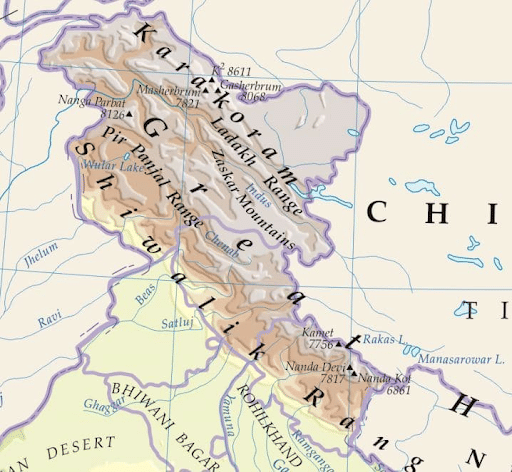
Karakoram Range
- The significance of Himalayan glaciers - Himalayan glaciers are critical in the Indian setting, particularly for the millions of people who live downstream and rely on these perennial rivers for their daily water demands.
- They are rapidly disappearing due to the effects of global warming, and suffocating demand on water supplies is unavoidable in the next decades.
Conclusion
The stability or anomalous extension of glaciers in the middle Karakoram, in contrast to the loss of glaciers in other adjacent Himalayan and globe mountain ranges, is referred to as the Karakoram Anomaly. The existence of ice in the Karakoram area was first exposed in 2014 by a unique and isolated cold and dry summer season. Last year, researchers from Newcastle University in the United Kingdom pointed to a concentrated vortex in the region that was successfully isolating the region from overall warming.
FAQs
Question: What is Karakoram Anomaly?
Answer:
Karakoram Anomaly is characterised as the stability or anomalous extension of glaciers in the middle Karakoram, as opposed to glacier decline in other Himalayan and globe mountain ranges. A recent study investigated why glaciers in Central-South Asia's Karakoram Range have not been as badly affected by Climate Change as others.
Question: What is Western Disturbance?
Answer:
A western disturbance is an extratropical cyclone that forms in the Mediterranean area and sends heavy winter rain to the northern Indian subcontinent, extending as far east as northern Bangladesh and south-eastern Nepal.
Question: What are the significance of Himalayan glaciers?
Answer:
In the Indian context, Himalayan glaciers are vital, particularly for the millions of people who reside downstream and rely on these perennial rivers for their daily water needs. They are quickly dwindling as a result of global warming, and choking pressure for water resources is unavoidable in the next decades.
MCQs
Question: Which of the following statement is/are correct
- The majority of the Karakoram mountain range is under the authority of Gilgit-Baltistan, which is administered by China.
- The Karakoram mountain pass is located on the boundary between the Indian Union Territory of Ladakh with the Chinese Xinjiang Autonomous Region.
Choose the correct answer from codes given below:
(a) 1 only
(b) 2 only
(c) Both 1 and 2
(d) Neither 1 nor 2
Answer: (b) See the Explanation
- The Karakoram is a mountain range in Kashmir that borders Pakistan, China, and India, with the range's northwest extremity reaching into Afghanistan and Tajikistan.
- The majority of the Karakoram mountain range is governed by Pakistan and is under the authority of Gilgit-Baltistan. Hence statement 1 is correct.
- Karakoram Pass is a mountain pass in the Karakoram Range that connects India and China.
- The mountain pass connects Leh with Yarkand and is located on the border between the Indian Union Territory of Ladakh and the Chinese Xinjiang Autonomous Region. Hence statement 2 is correct.
- Because of the high-speed wind that blows regularly in the area, the pass has neither vegetation nor snow. There is also no animal life in the region. Temperatures are cold, and blizzards are prevalent.
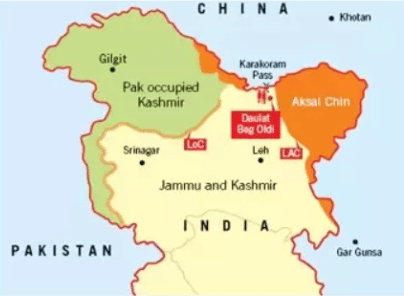
Therefore, option (b) is the correct answer.
Question: Siachen Glacier is situated to the (UPSC 2020)
(a) East of Aksai Chin
(b) East of Leh
(c) North of Gilgit
(d) North of Nubra Valley
Answer: (d) See the Explanation
- The Siachen Glacier is located in the Himalayas' Eastern Karakoram range, slightly northeast of Point NJ9842, where the Line of Control between India and Pakistan terminates.
- It is the world's biggest glacier outside of the polar and subpolar areas.
- It's west of Aksai Chin, north of Nubra Valley, and about east of Gilgit.
Therefore, option (d) is the correct answer.
*email: contactus@prepp.in
Download the PREPP App and attempt FREE IAS Exam Mock Tests and get complete study material!

Full Test - 04: UPSC CSE Prelims CSAT (Paper-II)
Full Test - 03: UPSC CSE Prelims CSAT (Paper-II)
UPSC CSE Prelims 2026 GS Paper 1 Question Paper (24-May-2026)
UPSC CSE Prelims 2026 CSAT Paper 2 Question Paper (24-May-2026)

17 February 2025 | The Hindu Must Read Articles | Current Affairs

16 February 2026 | The Hindu Must Read Articles | Current Affairs

13 February 2026 | The Hindu Must Read Articles | Current Affairs









Comments