Net Zero Pledges - Environment Notes
Net zero refers to reducing greenhouse gas emissions to as near to zero as feasible, with any leftover emissions reabsorbed from the environment, for example, by seas and forests. At the COP27 in Egypt's Sharm el-Sheikh, India recently announced a plan report titled 'Long Term Low Emission Development plan' (LT-LEDS) to attain net zero emissions by 2070. India also vowed to satisfy 50% of its energy consumption with renewable sources. This article explains about the Net Zero Pledges which is important for UPSC IAS exam preparation.
Table of Contents
Net Zero Pledges
- The term "Net-Zero Pledge or Target" refers to carbon neutrality, which does not imply that a country's emissions will be reduced to zero.
- Rather, it is a situation in which a country's emissions are offset by the removal and absorption of greenhouse gases from the atmosphere.
- Furthermore, emissions can be reduced by establishing more carbon sinks, such as forests.
- While removing gases from the environment necessitates cutting-edge technology such as carbon capture and storage.
- More than 70 nations have pledged to achieve Net Zero emissions by the middle of the century, or by 2050.
- At the Conference of Parties-26 (COP) meeting, India agreed to reduce its emissions to net zero by 2070.
- India's decarbonisation programme was founded on wealthy nations' willingness to offer financial assistance to underdeveloped countries.
- India would require "trillions of dollars" to reach its aim, as defined at COP27 in Sharm El-Sheikh, Egypt.
- India has also specified the numerical figures required to meet this aim. Climate change adaptation might cost India more than Rs 85 trillion by 2030.
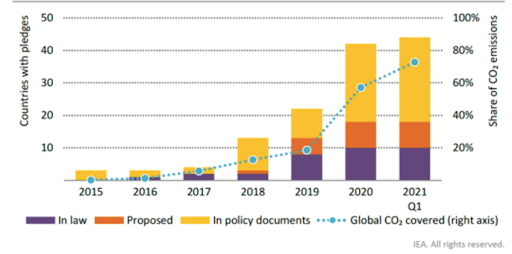
Emissions covered by net zero pledges
| Other Relevant Links | |
|---|---|
| India's GreenHouse Gas Emissions | Net Zero Pledges |
| Karakoram Anomaly | HPCL - Cow Dung to Compressed Biogas Project |
| Triple Planetary Crisis | Arctic Amplification |
| CO2 Equivalent | Carbon Dioxide Levels – Keeling Curve |
| Updated NDCs | Panchamrit |
| UNEP Production Gap Report | UN World Water Conference |
| Global Alliance for Industry Decarbonisation | Green Coal |
Getting India to Net Zero Report
- The report, titled 'Getting India to Net Zero', was recently launched in New Delhi.
- According to the research, attaining net-zero emissions by 2070 would improve yearly GDP by up to 4.7% by 2036 and create up to 15 million new employment by 2047.
- Investment: If India wants to meet its net zero emission objective by 2050, it would need to invest USD 13.5 trillion.
- Nationally Determined Contribution (NDC): India's 2015 NDC objectives are anticipated to be fulfilled early in the next few years under present policy.
- Suggestions: Various measures to enhance renewables and electrification might enable net zero energy by mid-century.
- Ending new coal production by 2023 and shifting from unabated coal power by 2040 would have a significant influence on attaining net zero emissions by mid-century.
India's Contribution Towards Net Zero
India's Renewable Energy ambitions
- Since the declaration of 175 GW by 2022 in Paris, India's renewable energy ambitions have continuously increased, from 175 GW by 2022 to 450 GW by 2030 at the UN Climate Summit, and now 500 GW by 2030 at COP26.
- India has also established a target of 50% installed power production capacity from non-fossil energy sources by 2030, up from the current objective of 40%, which is nearly met.
- In addition, India has declared a Hydrogen Energy Mission for grey and green hydrogen.
- During its first and second cycles, the market-based Perform, Achieve, and Trade (PAT) system saved 92 million tonnes of CO2 equivalent emissions.
Transport Sector Reforms
- With the Faster Adoption and Manufacturing of (Hybrid &) Electric Vehicles Scheme, India is hastening its e-mobility transition.
- India advanced from Bharat Stage-IV (BS-IV) to Bharat Stage-VI (BS-VI) emission standards by April 1, 2020, with the latter initially intended for implementation in 2024.
- A voluntary car scrapping policy to phase out old and inoperable automobiles supplements current programmes.
- The Indian Railways is likewise moving quickly, with the goal of fully electrifying all broad-gauge routes by 2023.
India's EV Support
- India is one of a few nations that supports the global EV30@30 movement, which seeks to have at least 30% of new vehicle sales be electric by 2030.
- India's promotion of five climate change aspects — "Panchamrit" — at the COP26 in Glasgow is a commitment to the same.
- India has taken a number of steps to build and promote the EV ecosystem, including:
- Faster Adoption and Manufacturing of Electric Vehicles (FAME II) programme for the supplier side Production-Linked Incentive (PLI) scheme for Advanced Chemistry Cell (ACC)
- The freshly announced PLI programme for Auto and Automotive Components for electric car makers.
Government Policies
- The Pradhan Mantri Ujjwala Yojana has assisted 88 million families in switching from coal-based cooking fuels to LPG connections.
- The UJALA initiative has distributed over 367 million LED bulbs, resulting in a CO2 reduction of 38.6 million tonnes per year.
- Between 2005 and 2016, these two and other comparable measures helped India achieve a 24% reduction in the emission intensity of its GDP.
Panchamrit strategy
|
The Role of Industry in the Low-Carbon Transition:
- India's public and private sectors are already playing critical roles in addressing the climate crisis, aided by increased consumer and investor awareness, as well as increased regulatory and transparency obligations.
- For example, the Indian cement industry has taken innovative steps and set one of the most significant sectoral low-carbon milestones in the world.
- There is increased alignment between India's climate policy and its business sector activities and promises.
Associated Challenges
Issues in a Smooth Transition to Renewables
- Identifying land with Renewable Energy potential and the time-consuming land clearing processes.
- Another impediment is integrating a greater proportion of renewables into the system.
- Challenges are also predicted in allowing renewables penetration in so-called hard-to-decarbonize industries.
Coal-Powered Companies Face Difficulties
- For enterprises in the services industry, the shift from coal to non-fossil fuel based power generation/transportation is quite simple.
- However, the low-carbon transition challenge is worse for firms that rely heavily on coal and account for more than half of our country's emissions.
Lack of EV Manufacturing Technology and Skilled Labour
- India is technologically poor in the manufacture of electronics that are the backbone of the EV sector, such as batteries, semiconductors, controllers, and so on.
- EVs have higher maintenance costs and demand more skill levels. There are no designated training programmes in India for such skill development.
Consumer Concerns About EVs
- In 2018, India was reported to have just 650 charging stations, far fewer than its neighbouring competitors, who already had over 5 million charging stations.
- The lack of charging facilities makes it unsuitable for consumers to traverse lengthy distances.
- Furthermore, the cost of a basic electric automobile is significantly greater than the typical cost of a conventionally powered car.
Way forward
- An Energy Mix of Renewables: Because continuous supply of sources such as wind and sunshine is not possible everywhere, it is prudent to choose for a varied energy mix of solar, wind, and hydrogen-based energy.
- In the short and immediate future, India should focus on infrastructure investment, capacity creation, and improved grid integration.
- Encourage Private Sector Participation: Because industries contribute to GHG emissions, any climate action must cut or offset emissions from industrial and commercial activities.
- Service providers may easily cut emissions by increasing their usage of renewable energy and collaborating with supply chain partners. They may achieve carbon neutrality by obtaining 50% of their energy from renewable sources.
- This 'energy-transition movement' provides a chance for coal-powered enterprises to invest in climate technology and extend their usage of renewable energy sources.
- Electric Vehicles as a Path Forward: EVs will help to improve overall energy security because the country imports more than 80% of its total crude oil requirements, totaling nearly $100 billion.
- Charging infrastructures that take power from local electrical supply can be built up at private dwellings, public utilities such as fuel and CNG pumps, and parking facilities of commercial enterprises such as malls, train stations, and bus depots to alleviate EV charging concerns.
Conclusion
India's net-zero ambitions and revised NDCs are clearly aspirational, taking into account the country's development needs in the post-COVID recovery period. However, fit a wider pattern of global climate action that lacks the collective feeling of urgency necessary to limit global warming to 1.5 degrees Celsius below pre-industrial levels. Furthermore, whether India and the rest of the world can proceed with modest short-term carbon reductions and ambitious long-term climate action plans remains to be seen.
FAQs
Question: What is Net-Zero Target?
Answer:
The term "Net-Zero Pledge or Target" refers to carbon neutrality, not the reduction of a country's emissions to zero. It is a condition in which a country's emissions are balanced by the removal and absorption of greenhouse gases from the atmosphere. Furthermore, by building more carbon sinks, such as forests, emissions can be lowered.
Question: What is the Hydrogen Energy Mission?
Answer:
The National Hydrogen Mission, also known as the National Hydrogen Energy Mission, was an endeavour to maximise the use of hydrogen, one of the most plentiful elements on the planet. The National Hydrogen Mission will lead to the production of clean fuel, reducing India's reliance on fossil fuels and crude oil imports.
Question: What is Panchamrit?
Answer:
At COP26, India announced new climate objectives as part of its "Panchamrit strategy." It has taken an important step towards renewing its commitment to renewable energy and telling the public about its long-term climate change policy. Indian Prime Minister Narendra Modi announced the five-pronged climate change policy, known as Panchamrit, during the current COP26 summit in Glasgow.
MCQs
Question: In the context of Net Zero Pledges, consider the following statements:
- India issued a plan paper titled 'Long Term Low Emission Development plan' (LT-LEDS) to reach net zero emissions by 2070.
- Achieving net-zero emissions by 2070 would enhance yearly GDP by up to 4.7% by 2036 by ‘Getting India to Net Zero’ report.
Which of the statements given above are correct?
(a) 1 only
(b) 2 only
(c) Both 1 and 2
(d) Neither 1 nor 2
Answer: (c) See the Explanation
- At the COP27 in Egypt's Sharm el-Sheikh, India recently announced a plan paper titled 'Long Term Low Emission Development plan' (LT-LEDS) to attain net zero emissions by 2070. Hence statement 1 is correct.
- India announced its intention to attain net zero emissions by 2070, as committed at the last COP summit (COP26).
- India discussed the means to accomplish the aforementioned aim at the COP27 meeting in Egypt in November 2022.
- The report, titled 'Getting India to Net Zero', was recently launched in New Delhi.
- According to the report, reaching net-zero by 2070 would increase yearly GDP by up to 4.7% by 2036 and create up to 15 million new employment by 2047. Hence statement 2 is correct.
Therefore, option (c) is the correct answer.
Question: Consider the following statements about UJALA initiative
- Launched in 2015, it was initially known as the LED-based Domestic Efficient Lighting Programme (DELP).
- This program's implementing agency has been identified as Energy Efficiency Services Limited (EESL).
Which of the above statements is/are correct
(a) 1 only
(b) 2 only
(c) Both 1 and 2
(d) Neither 1 nor 2
Answer: (c) See the Explanation
- The UJALA Initiative was launched in 2015 and was previously known as the LED-based Domestic Efficient illumination Programme (DELP). Its goal is to promote energy efficiency for everybody, including consumption, savings, and illumination. Hence statement 1 is correct.
- The implementing agency for this plan has been designated as Energy Efficiency Services Limited (EESL), a government enterprise under the administrative jurisdiction of the Ministry of Power. Hence statement 2 is correct.
- Under the Scheme, every domestic home with a metered connection from their individual Electricity Distribution Company is eligible to receive LED lights.
- The Ministry of Power has concluded seven years of distribution and sale of LED lights under its flagship UJALA (Unnat Jyoti by Affordable LEDs for All) scheme.
Therefore, option (c) is the correct answer.
*email: contactus@prepp.in
Download the PREPP App and attempt FREE IAS Exam Mock Tests and get complete study material!

Full Test - 04: UPSC CSE Prelims CSAT (Paper-II)
Full Test - 03: UPSC CSE Prelims CSAT (Paper-II)
UPSC CSE Prelims 2026 GS Paper 1 Question Paper (24-May-2026)
UPSC CSE Prelims 2026 CSAT Paper 2 Question Paper (24-May-2026)

17 February 2025 | The Hindu Must Read Articles | Current Affairs

16 February 2026 | The Hindu Must Read Articles | Current Affairs

13 February 2026 | The Hindu Must Read Articles | Current Affairs









Comments