Armed Force Special Powers Act (AFSPA)- Indian Polity Notes
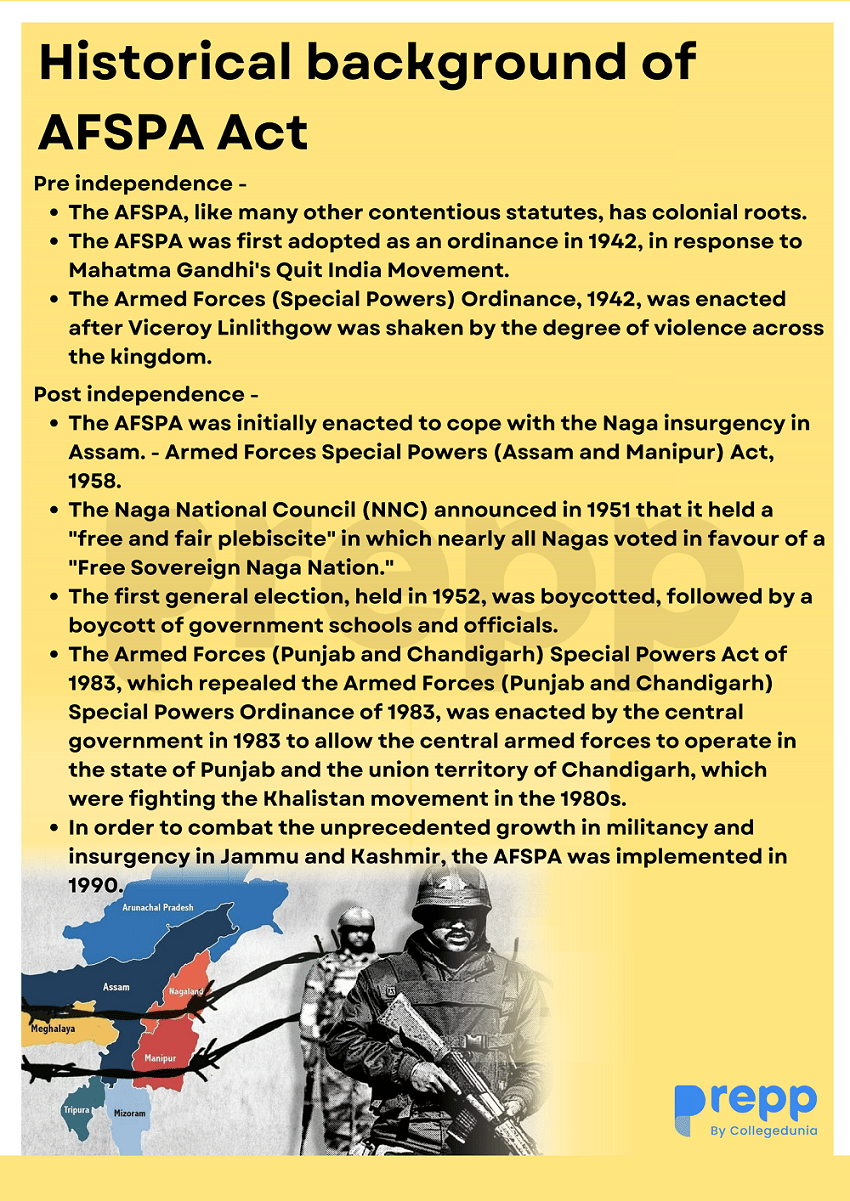
Armed Forces (Special Powers) Act (AFSPA) 1958 is a parliamentary act that gives armed forces the power to maintain public order in “disturbed areas”. AFSPA is presently applicable in 31 districts across four Northeast states, and only partially in another 12 for example Jammu and Kashmir, Nagaland, Assam, Arunachal Pradesh, Manipur etc. The army can also arrest a person without a warrant, enter or search a person's home without a warrant, and prohibit the possession of firearms if there is probable suspicion.
This article explains the Armed Forces (Special Powers) Act (AFSPA), provisions and criticism are useful for UPSC IAS exam preparation.
| To Read update on this topic: |
|
Table of Contents |
Armed Force Special Powers Act 1958 ( AFSPA )
- The Act empowers the army, state and police forces to shoot to kill, search homes, and demolish any property that is "likely" to be utilised by insurgents in regions designated by the home ministry as "disturbed."
- When a situation of militancy or insurgency occurs and India's territorial integrity is threatened, the AFSPA is activated.
- Even if there is "reasonable suspicion," security personnel can "arrest a person without warrant" who has done or is "about to commit a cognizable offence."
- It also grants security forces legal protection for actions taken in troubled areas.
- While the military and administration claim the act's need as a means of combating militancy and insurgency, critics have pointed to incidents of probable human rights violations tied to it.
- Normally, the Ministry of Home Affairs would implement this Act if appropriate, but there have been instances where the Centre elected to abdicate its authority and left the choice to the state governments.
Disturbed Area
|
Armed Force Special Powers Act ( AFSPA ) - Provisions
- The Governor of a State and the Central Government have the authority to declare any part or entire state as a disturbed area.
- The Governor of the state, the Administrator of the Union Territory, or the Central Government can proclaim a region to be a "disturbed area."
- By publishing a notice in the official gazette, the entire land or a portion of it can be deemed disturbed.
- State governments can recommend whether or not the Act should be enforced. However, the governor or the Centre can overrule their decision under Section (3) of the legislation.
- If they believe it is necessary to disrupt terrorist activity or any other activity that may jeopardise India's sovereignty or insult the national flag, anthem, or Constitution.
- Section (3) of the AFSPA states that the Central government has the right to deploy military forces to assist civilian authorities if the governor of a state submits an official announcement in the Gazette of India.
- According to The Disturbed Areas Act of 1976, once a region is deemed "disturbed," it must maintain the status quo for a minimum of three months.
- Section (4) of the AFSPA, army officers in troubled areas have extraordinary authority to fire (even if it kills) anyone who breaks the law or is suspected of breaking the law (this includes gatherings of five or more persons, carrying weapons, and so on). The sole need is that the officer issue a warning before firing.
- Security forces can detain anyone without a warrant and conduct searches without permission.
- When a person is captured, he or she must be taken to the local police station as soon as possible.
- The Central Government must first grant approval for the officer on duty to be prosecuted for alleged violations of human rights.
States under AFSPA Act
|
States |
Description |
|---|---|
|
Assam |
|
|
Jammu & kashmir |
|
|
Tripura |
|
|
Manipur |
|
|
Arunachal pradesh |
|
|
Meghalaya |
|
|
Mizoram |
|
|
Nagaland |
|
Need for AFSPA Act
- The Army considers that the AFSPA is extremely necessary to suppress insurgency and preserve the country's frontiers.
- Security forces cannot function in the face of a vicious insurgency without the protection of the AFSPA. Without it, there would be concern, which would benefit the militants.
- The need to safeguard the army's morale and integrity is also cited by army leaders as a reason for not investigating claims against army personnel.
Criticism
- Absolute power: The act gives security personnel full power without requiring them to answer for it. As a result, security agencies commit different crimes and violations of human rights.
- Human rights violations: The Universal Declaration of Human Rights (UDHR), the International Covenant on Civil and Political Rights (ICCPR), and the Convention Against Torture are all violated by the AFSPA ( India is a signatory, but it has not ratified it).
- Fundamental Rights are violated: The military forces' authority of arbitrary arrest and imprisonment violates Article 22, which provides protections for preventive and punitive detentions.
- The Supreme Court has indicated unequivocally that the apprehended individual must be brought before the court within 24 hours of the FIR being filed.
- Even in an emergency, the right to life and liberty (Article 21) and some other rights (Article 20) cannot be suspended.
- However, the ultimate authority granted to the armed forces nullifies the inherent rights granted under the basic rights, and all powers are vested in the commanders.
- Immunity from Punitive Action: The greatest affront to AFSPA is the immunity granted to the military forces. No prosecution, suit, or other legal process may be started without the prior approval of the central government. This protection, which protects guards while also allowing the armed forces to make rash choices at times, is certainly dubious.
Way forward
- To prevent the danger of it being abused, AFSPA should be changed to make it more comprehensive, with detailed guidelines governing the method in which alleged human rights abuses are investigated.
- Human rights breaches should be seen as the greatest danger to the Army's reputation and 62-year track record of battling insurgencies. To deal with the situation, it must restore the legitimacy of its legal system.
- All court-martials held in connection with human rights abuses should be made public by the Army. It must conduct thorough investigations into all alleged human rights breaches in Manipur and abroad.
- Through negotiation with rebel organisations, the government should endeavour to end the long-running insurgency in the North-eastern states.
- The government should take immediate action to establish new avenues of growth through industrialization and infrastructure development in the North-east region, which is thought to be a significant cause of insurgency.
Government Initiatives
Jeevan Reddy committee
- The Central Government constituted a five-member committee led by Justice B P Jeevan Reddy in November 2004 to assess the provisions of the act in the northeastern states.
- The committee suggested that AFSPA be abolished and that relevant measures be added to the Unlawful Activities (Prevention) Act of 1967.
- The Unlawful Activities Act should be amended to explicitly define the powers of the armed forces and paramilitary forces, and grievance cells should be established in every area where the armed forces are stationed.
Santhosh Hegde committee
- A committee chaired by Supreme Court Judge Santosh Hegde was constituted in 2013 to investigate the encounter killings of 1528 individuals in Manipur since 1979.
- According to the Santosh Hegde committee's findings, five of the six encounters were "not real," "disproportionate force" was used against people with "no known criminal history," and AFSPA extended "sweeping powers" to men in uniform without providing individuals with protection against their exploitation.
- Furthermore, the committee believed that granting more power would result in stronger control and a better framework to avoid exploitation or abuse, but this option was not present in the case of Manipur.
Second ARC report
- The AFSPA was also recommended for repeal in the Fifth Report of the Second Administrative Reforms Commission (ARC) on Public Order.
- These proposals, however, have not been adopted.
Conclusion
It is past time for the four parties — civil society, the Armed Forces, the States, and the Government of India — to make ongoing and concentrated efforts to find a durable and peaceful solution to the festering problem, with a little consideration from all corners. It is never too late to bring society's peace and harmony. The new Supreme Court decision is expected to have far-reaching implications in regions where security forces have been protected from prosecution under AFSPA while conducting counter-insurgency operations.
FAQs
Question: What is the Armed Forces (Special Powers) Act (AFSPA)?
Answer: The Armed Forces (Special Powers) Act (AFSPA) is a law enacted by the Parliament of India in 1958. It grants special powers to the Indian Armed Forces to maintain public order in "disturbed areas." These powers include the authority to prohibit gatherings, use force, and arrest individuals without a warrant. The Act aims to assist in controlling insurgency and maintaining law and order in regions identified as disturbed.
Question: Which areas in India are currently under AFSPA?
Answer: As of November 2024, AFSPA is in effect in certain districts of Nagaland, Manipur, and Arunachal Pradesh. The Act has been withdrawn from several areas over the years due to improved security situations. For instance, in April 2022, the Indian government repealed AFSPA from parts of the Northeast, including 23 districts in Assam and parts of Nagaland and Manipur. However, recent developments have led to its reimposition in specific areas facing renewed unrest.
Question: What are the main provisions of AFSPA?
Answer: AFSPA grants the armed forces the following powers in designated disturbed areas:
- Prohibit gatherings of five or more individuals.
- Use force, including lethal force, against individuals violating laws or carrying weapons.
- Arrest individuals without a warrant on suspicion of committing offenses.
- Enter and search premises without a warrant to make arrests or recover weapons.
- Destroy arms dumps, hideouts, or shelters used by insurgents.
These provisions aim to empower the armed forces to effectively manage insurgency and maintain public order.
Question: What are the criticisms of AFSPA?
Answer: AFSPA has faced criticism on several grounds:
- Human Rights Violations: Allegations of extrajudicial killings, torture, and wrongful detentions have been reported in areas under AFSPA.
- Lack of Accountability: The Act provides immunity to armed forces personnel from prosecution without central government sanction, leading to concerns about impunity.
- Impact on Civilians: The broad powers granted can adversely affect the daily lives of civilians, leading to fear and mistrust.
These criticisms have led to calls for the repeal or amendment of the Act to ensure better protection of human rights.
Question: Has there been any judicial scrutiny of AFSPA?
Answer: Yes, AFSPA has been subject to judicial scrutiny. In 1997, the Supreme Court of India upheld the constitutionality of the Act in the Naga People's Movement of Human Rights vs. Union of India case. However, the Court also laid down guidelines to prevent misuse, emphasizing that the powers conferred should be used in a reasonable manner and that the Act does not provide absolute immunity to the armed forces.
MCQs
1. In which year was the Armed Forces (Special Powers) Act enacted?
A) 1947
B) 1958
C) 1962
D) 1976
Answer: (B) See the Explanation
Explanation: The Armed Forces (Special Powers) Act was enacted in 1958 to address the rising insurgency in the northeastern states of India.
2. Which Article of the Indian Constitution is often cited in discussions about the legality of AFSPA?
A) Article 14
B) Article 21
C) Article 32
D) Article 355
Answer: (D) See the Explanation
Explanation: Article 355 of the Indian Constitution imposes a duty on the Union to protect states against external aggression and internal disturbance, which is often cited to justify the enactment of AFSPA.
3. Which committee recommended the repeal of AFSPA in 2005?
A) Sarkaria Commission
B) Jeevan Reddy Committee
C) Verma Committee
D) Shah Commission
Answer: (B) See the Explanation
Explanation: The Jeevan Reddy Committee, established in 2004, recommended the repeal of AFSPA in its 2005 report, suggesting that it be replaced with a more humane law.
4. Which state was the first to have AFSPA imposed in 1958?
A) Nagaland
B) Manipur
C) Assam
D) Tripura
Answer: (C) See the Explanation
Explanation: AFSPA was first imposed in the Naga Hills, then part of Assam, in 1958 to curb the insurgency in the region.
5. Which section of AFSPA provides immunity to armed forces personnel from prosecution?
A) Section 3
B) Section 4
C) Section 6
D) Section 7
Answer: (D) See the Explanation
Explanation: Section 7 of AFSPA provides immunity to armed forces personnel from prosecution without the central government's prior sanction, which has been a major point of contention and criticism.
GS Mains Questions and Model Answers
Q1: Analyze the impact of AFSPA on internal security and human rights in India. How has it influenced the security situation in "disturbed areas"?
Answer: AFSPA has been a contentious law due to its impact on internal security and human rights in India. On the one hand, it grants the armed forces special powers to combat insurgency and maintain public order in "disturbed areas." This has helped in reducing insurgency and restoring normalcy in several regions over time. However, the Act has also faced criticism for alleged human rights violations, including extrajudicial killings, torture, and arbitrary detentions. The immunity provided to armed forces personnel has raised concerns about accountability and justice. The challenge lies in balancing security needs with human rights protections. Efforts to reform or repeal AFSPA have been recommended by various committees, but a comprehensive approach addressing both security concerns and human rights is necessary for lasting peace in affected areas.
Q2: Discuss the recommendations made by the Jeevan Reddy Committee regarding AFSPA. What were the main objectives behind these recommendations?
Answer: The Jeevan Reddy Committee, established in 2004, recommended the repeal of AFSPA, stating that it had become a symbol of oppression and discrimination. The Committee proposed replacing AFSPA with a more humane law that balances security and human rights. Key recommendations included removing the immunity granted to armed forces personnel under the Act and adopting a more comprehensive framework for tackling insurgency, emphasizing respect for human rights and transparent operations. The objectives behind these recommendations were to reduce human rights violations, ensure accountability for security forces, and create a more democratic and humane approach to maintaining law and order.
Q3: Examine the role of the judiciary in upholding or challenging the constitutionality of AFSPA. What guidelines have been issued to prevent its misuse?
Answer: The judiciary has played a crucial role in upholding and challenging the constitutionality of AFSPA. In the landmark Naga People's Movement of Human Rights vs. Union of India case (1997), the Supreme Court upheld the validity of AFSPA but issued several guidelines to prevent its misuse. These included ensuring that the use of force is proportional and necessary, regular review of the "disturbed area" status, and accountability for actions taken under the Act. The judiciary has consistently emphasized the need for armed forces to exercise their powers responsibly and has called for transparency and oversight mechanisms to ensure that the Act does not lead to human rights violations.
Previous Year Questions on AFSPA
1. UPSC CSE Prelims 2021:
Question: Which section of the Armed Forces (Special Powers) Act grants immunity from prosecution to armed forces personnel?
A) Section 3
B) Section 5
C) Section 6
D) Section 7
Answer: (D)
Explanation: Section 7 of AFSPA grants immunity from prosecution to armed forces personnel, requiring central government sanction for any legal proceedings, leading to debates over accountability.
2. UPSC CSE Mains 2020 (GS Paper 2):
Question: "Evaluate the balance between national security and human rights in the context of the implementation of AFSPA in India. How can reforms address existing concerns?"
Answer: The implementation of AFSPA in India has been a balancing act between ensuring national security and upholding human rights. While AFSPA empowers the armed forces to combat insurgency, allegations of human rights violations have raised questions about its impact on civil liberties. Critics argue that immunity provisions undermine accountability, leading to potential misuse. Reforms such as periodic reviews of "disturbed areas," oversight by independent bodies, and greater transparency in military operations can address concerns. Building trust with affected communities through socio-economic initiatives and respect for human rights is essential for long-term stability and peace.
Download the PREPP App and attempt FREE IAS Exam Mock Tests and get complete study material!

Live Test : UPSC CSE Prelims CSAT (Paper-II) (Oct 20 - 23)
Full Test - 04: UPSC CSE Prelims CSAT (Paper-II)
Full Test - 03: UPSC CSE Prelims CSAT (Paper-II)
UPSC CSE Prelims 2026 GS Paper 1 Question Paper (24-May-2026)
UPSC CSE Prelims 2026 CSAT Paper 2 Question Paper (24-May-2026)

17 February 2025 | The Hindu Must Read Articles | Current Affairs

16 February 2026 | The Hindu Must Read Articles | Current Affairs

13 February 2026 | The Hindu Must Read Articles | Current Affairs









Comments