Women Want Change, Society Needs Change
Relevance: GS1 - Salient features of Indian Society; Role of Women; GS2 - Issues relating to development and management of Social Sector/Services;
(Source: The Hindu, 10/11/2023)
Click here for Daily Current Affairs
Why in the news?
- This article is based on ‘Women want change, society needs change,’ which was published in ‘The Hindu,’ on 10/11/2023. It has discussed the global gender gap.
- The 17th edition of the Global Gender Gap Report, released by the World Economic Forum on June 20, 2023, analyzed data from 146 countries and found that at the current rate of progress, it will take 131 years to close the global gender gap.
- In the case of populous South Asian countries, including India, this gap is estimated to take 149 years to close.
Table of Contents
- Gender Disparity in Global Workforce and Leadership Positions
- The Women's Reservation Bill in India
- Challenges of Young Women in Politics
- Challenges in Achieving Gender Parity in Leadership Roles
- India’s Performance in Global Gender Gap Report, 2023
- Gender Parity of Southern Asian Region
- Indian Initiatives to reduce Gender Gap
- What is the way ahead?
- FAQs
- MCQs
Gender Disparity in Global Workforce and Leadership Positions
- Women’s representation in the global workforce is around 41.9%, but they only account for 32.2% of senior leadership positions.
- Industries like consumer services, retail, and education exhibit better gender representation in leadership positions between 64% and 68%.
- Industries like construction, financial services, and real estate show lower representation (less than 50%) of women in C-suite roles.
- In terms of political representation, there has been progress since 2013, with the percentage of women parliamentarians rising to 22.9% globally.
- Some countries, like Iceland and Costa Rica, have achieved more than 33 per cent representation, while others, including Canada and Japan, lag behind with less than one-third of their parliamentarians being women.
The Women's Reservation Bill in India
- In September 2023, the new Indian Parliament building marked the commencement of parliamentary proceedings and a significant moment for Indian citizens with the passage of the Women's Reservation Bill, also known as the Constitution (One Hundred Twenty-Eighth Amendment) Bill, 2023.
- This legislation, after considerable delays, was overwhelmingly approved by both Houses, signifying a groundbreaking event in independent India.
- Despite India's early adoption of universal adult suffrage, the role of women in shaping the country's political future has remained limited.
Challenges of Young Women in Politics
- Globally, there is a trend of young political leaders emerging. However, it raises the question of whether an ordinary Indian woman, solely through her commitment and ambition, can aspire to become the Prime Minister of India at a young age, akin to Jacinda Ardern, the former Prime Minister of New Zealand.
- Throughout the world, women have traditionally been appreciated in supportive and emotional roles rather than leadership positions. Ambitious women often face societal resistance and denigration.
- For example: the case of Hillary Clinton, whose political experience and competence were considered superior to Donald Trump's. However, America, the world’s so-called top democracy, chose an inexperienced Mr. Trump over her to lead them.
Challenges in Achieving Gender Parity in Leadership Roles
- Privileges and Education: Historical evidence suggests that most women in leadership positions didn't get there solely based on their hard work, competence, or intelligence, but many women in leadership roles had certain privileges, such as access to higher education, support from influential mentors or families, or belonging to higher social classes or castes.
- If there was a survey for this, it would likely show that nearly all female legislators had university education, while this percentage would be much lower among male legislators.
- Delayed Leadership Entry: Despite privileges, women often face delays in assuming leadership roles. Indira Gandhi did not immediately become Prime Minister upon Jawaharlal Nehru's death in 1964; she had to wait until 1966, following Lal Bahadur Shastri's passing, to assume the role of Prime Minister.
- In contrast, Rajiv Gandhi, as her son, quickly assumed a leadership role following her assassination. This raises questions about whether non-privileged Indian women can attain top leadership positions promptly.
- Lack of Empathy: The privileged women who reach leadership positions may not always empathize with the struggles of less fortunate women who lack basic needs like nutrition, education, and financial independence. These privileged women may underestimate the advantages they have enjoyed in their journey to leadership.
- Regressive Views on Gender Equality: The major obstacle lies in regressive views on gender equality, even among otherwise progressive individuals like C. Rajagopalachari, who opposed Radhabai Subbarayan's bid for a general seat.
- Mulayam Singh's 2010 accusation, dismissing the women's reservation Bill as favoring educated, urban, and elite women, overlooked the Bill's aim of creating opportunities for less privileged women.
- Political analysts believed that opposition from Mulayam Singh and Lalu Prasad Yadav was rooted in protecting men's dominance in elections within a patriarchal society.
India’s Performance in Global Gender Gap Report, 2023
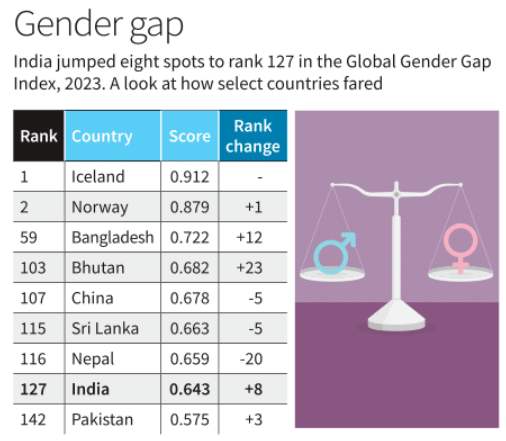
- India has made some progress in terms of gender parity. It has moved up eight positions compared to the previous year and is now ranked 127th out of 146 countries. In the 2022 edition, India was ranked 135th.
- India has improved by 1.4 percentage points and eight positions since the last edition, marking a partial recovery towards its 2020 parity level.
- India has achieved parity in enrolment across all levels of education, which is a positive development.
- India has closed 64.3% of the overall gender gap.
- However, when it comes to economic participation and opportunity, India still lags behind, with only 36.7% parity in this area.
- In comparison to its neighboring countries, India ranks higher than Pakistan (142), but lags behind Nepal (116), Sri Lanka (115), Bhutan (103), Bangladesh (59) and China (107).
- The most gender-equal country in the world is Iceland. Iceland has held this position for 14 consecutive years and has managed to close more than 90% of its gender gap.
Gender Parity of Southern Asian Region
- The Southern Asian region has achieved a gender parity of 63.4%, which is the second-lowest among the eight regions.
- However, there has been a slight improvement of 1.1 percentage points in the South Asian score since the last edition.
- This improvement can be partially attributed to the increased scores of populous countries such as India, Pakistan, and Bangladesh.
Indian Initiatives to reduce Gender Gap
- Beti Bachao Beti Padhao: It ensures the protection, survival and education of the girl child.
- Mahila Shakti Kendra: It aims to empower rural women with opportunities for skill development and employment.
- Mahila Police Volunteers: It envisages engagement of Mahila Police Volunteers in States/UTs who act as a link between police and community and facilitates women in distress.
- Rashtriya Mahila Kosh: It is an apex microfinance organization that provides micro-credit at concessional terms to poor women for various livelihood and income generating activities.
- Sukanya Samriddhi Yojna: Under this scheme girls have been economically empowered by opening their bank accounts.
- Female Entrepreneurship: To promote female entrepreneurship, the Government has initiated Programmes like Stand-Up India and Mahila e-Haat (online marketing platform to support women entrepreneurs/ SHGs/NGOs), Entrepreneurship and Skill Development Programme (ESSDP).
- Kasturba Gandhi Balika Vidyalaya: They have been opened in Educationally Backward Blocks (EBBs).
- Political Reservation:
- Government has reserved 33% of the seats in Panchayati Raj Institutions for women.
- Recently, the Women's Reservation Bill was passed which proposes to reserve 33% of seats in the Lok Sabha and State Legislative Assemblies for women.
What is the way ahead?
- Implementation of Legislation: Swift implementation of policies and legislation, such as the Women's Reservation Bill in the Indian context, is crucial. These legal frameworks can provide a formal structure for promoting women's participation in leadership roles.
- Education and Skill Development: Focus should be on providing quality education and skill-building opportunities for women to enhance their competence and capabilities. This can help women qualify for leadership positions on an equal footing.
- Awareness and Advocacy: Increase awareness and advocacy for gender equality, challenging regressive views and biases that hinder progress. Public campaigns and educational initiatives can play a significant role in changing societal attitudes.
- Empowerment Programs: Develop empowerment programs and initiatives aimed at less privileged women who lack access to basic needs, ensuring that they have the resources and support to pursue leadership roles.
- Data and Research: Continuously collect and analyze data on gender disparities and the effectiveness of policies and initiatives. Data-driven decision-making can guide efforts to close the gender gap.
- International Collaboration: Collaboration should be made on a global scale to share best practices and learn from other countries' experiences in promoting gender equality.
- Continuous Evaluation: Regularly assess the progress made in reducing the gender gap and make necessary adjustments to policies and strategies based on the evolving landscape.
(*Click this link to read prelims specific weekly current affairs articles)
FAQs
Question: What is the Gender Gap?
Answer:
Gender Gap is the disparity between men and women in terms of their social, political, intellectual, cultural, or economic empowerment, achievements or developments.
Question: How is India’s performance in the Global Gender Gap Index?
Answer:
India has made some progress in terms of gender parity. It has moved up eight positions compared to the previous year and is now ranked 127th out of 146 countries. In the 2022 edition, India was ranked 135th.
Question: What is the Women’s Reservation Bill?
Answer:
The Constitution 108th Amendment Bill, 2008 seeks to reserve one-third (33%) of the total number of seats in state legislative Assemblies and Parliament for women.
MCQ
Question: Which of the following gives ‘Global Gender Gap Index’ ranking to the countries of the world? (UPSC 2017)
(a) World Economic Forum
(b) UN Human Rights Council
(c) UN Women
(d) World Health Organization
Answer: (a) See the Explanation
The Global Gender Gap Index (GGGI) is an annual report published by the World Economic Forum (WEF). It measures the relative gaps between women and men across four key areas: health, education, economy, and politics.
Therefore, option (a) is the correct answer.
Download the PREPP App and attempt FREE IAS Exam Mock Tests and get complete study material!
Live Test : UPSC IAS : GS - Modern History - Subject Knowledge Test

Live Test : UPSC CSE Prelims CSAT (Paper-II) (Oct 14 - 17)
Full Test - 04: UPSC CSE Prelims CSAT (Paper-II)
Full Test - 03: UPSC CSE Prelims CSAT (Paper-II)
UPSC CSE Prelims 2026 GS Paper 1 Question Paper (24-May-2026)
UPSC CSE Prelims 2026 CSAT Paper 2 Question Paper (24-May-2026)

17 February 2025 | The Hindu Must Read Articles | Current Affairs

16 February 2026 | The Hindu Must Read Articles | Current Affairs

13 February 2026 | The Hindu Must Read Articles | Current Affairs









Comments