Dancing Frogs Of Western Ghats Among Most Threatened Amphibians Globally
Relevance: GS3- Conservation, environmental pollution and degradation, environmental impact assessment. Prelims - Environment
(Source: Down To Earth, 10/11/2023)
Click here for Daily Current Affairs
Why in the news?
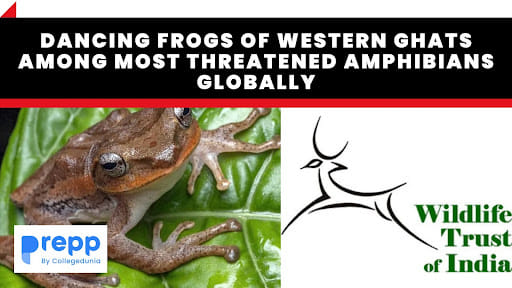
- Recently, the Wildlife Trust of India classified dancing frogs endemic to the Western Ghats as the most threatened amphibian genus of India.
- The Wildlife Trust of India arrived at this analysis on the basis of the second edition of the Global Amphibian Assessment.
Table of Contents
What has the WTII said about dancing frogs?
- The dancing frogs are considered the most threatened amphibian species in India as two of the 24 species assessed were found to be critically endangered while 15 were classified as endangered.
- They are also the fifth most threatened amphibian genus globally, with 92% of the species falling in the threatened category.
- According to the IUCN Red List, 139 out of a total of 426 amphibian species in India are categorized as 'Critically Endangered,' 'Endangered,' or 'Vulnerable,'.
- In the Western Ghats alone, 64 amphibian species are listed as endangered including dancing frogs, and night frogs (Nyctibatrachidae).
Global Amphibian Assessment
|
Dancing Frogs
- Frogs belonging to the Micrixalus genus are called dancing frogs.
- One example is the Kottigehar Dancing Frog or Kottigehar torrent frog, which is found in the Western Ghats.
- Habitat: The frogs prefer habitats with thick canopy cover (70-80% canopy cover) near streams.
- Foot flagging: It is a distinctive mating behavior displayed by frogs of this species.
- Males perform a dance-like display by stretching one hind leg at a time and waving their webbed toes in the air to attract mates and deter competitors.
- This is done because their mating calls are lost in the noise of gurgling streams.
Threats
- The primary factors contributing to the decline of dancing frogs are anthropogenic stresses:
- Invasive species like the mosquito fish
- Land use changes,
- Temperature and humidity variations,
- Extreme weather events
- Infectious diseases,
- Pollution and
- Infrastructure projects like dams.
What measures can be taken?
- To ensure the survival of the dancing frogs, their natural habitats and optimal living conditions must be preserved and protected
- The Wildlife Trust of India's Amphibian Recovery Project in Munnar is actively working to recover populations of threatened amphibians through a strategy involving:
- Threat Mitigation: Identifying and addressing the risks faced by the species
- Conservation Action: Implementing strategic conservation measures to safeguard habitats and populations
- Capacity Development and Training: Developing knowledge and expertise and knowledge for the effective protection of amphibian species.
- Advocacy: Awareness building on the conservation of these endangered species.
- Information Sharing: Building a network that allows stakeholders to collaborate with each other to share critical information and experiences.
Role of frogs in the ecosystem
- Frogs are valuable in the food chain and also provide other ecological services.
- They feed on insects and pests which could adversely affect crop productivity.
- They help maintain the ecological balance by serving as an important link in the food chain in an ecosystem.
Conclusion
- Globally, more than 41% of amphibian species are threatened with extinction which makes efforts to conserve these species vital to maintain ecological balance and biodiversity.
Wildlife Trust of India
|
(*Click this link to read prelims specific weekly current affairs articles)
FAQs
Question: What is the IUCN?
Answer:
The International Union for Conservation of Nature is the global authority on the status of the natural world and the measures needed to safeguard it. It was established in 1948 and is open to government and civil society organizations. It is headquartered in Geneva and publishes the IUCN Red List of Threatened Species, which is a comprehensive inventory of the global conservation status of plant and animal species.
Question: What is the World Land Trust (WLT)?
Answer:
The World Land Trust is a UK-registered charity that raises money to protect environmentally threatened land in Africa, Asia, and Central and South America by buying the land. It was founded in 1989 as the Programme for Belize which aimed to raise money to privately buy land in Belize in order to protect tropical rain forests.
MCQs
Question: “Foot flagging” is an activity associated with which of the following species?
(a) Dancing frogs
(b) Honeybees
(c) Lion-tailed macaque
(d) African cheetah
Answer: (a) See the Explanation
Foot flagging is a distinctive mating behavior displayed by dancing frogs in which males of the species perform a dance-like display by stretching one hind leg at a time and waving their webbed toes in the air to attract mates and deter competitors.
Therefore, option (a) is the correct answer.
Download the PREPP App and attempt FREE IAS Exam Mock Tests and get complete study material!

Full Test - 04: UPSC CSE Prelims CSAT (Paper-II)
Full Test - 03: UPSC CSE Prelims CSAT (Paper-II)
UPSC CSE Prelims 2026 GS Paper 1 Question Paper (24-May-2026)
UPSC CSE Prelims 2026 CSAT Paper 2 Question Paper (24-May-2026)

17 February 2025 | The Hindu Must Read Articles | Current Affairs

16 February 2026 | The Hindu Must Read Articles | Current Affairs

13 February 2026 | The Hindu Must Read Articles | Current Affairs









Comments