The End Of The Two-State Solution
Relevance: GS2 - Bilateral, regional and global groupings and agreements involving India and/or affecting India’s interests
(Source: The Hindu, 10/10/2023)
Click here for Daily Current Affairs
Why in the news?
- Recently, Israel launched attacks in response to the attacks launched by Hamas on it as part of the militant organization Operation Toofan-Al-Aqsa.
- This article discussed the viability of the “two-state solution” amid the violence and deaths as a result of the attacks and Israel’s blockade of Palestine.
Table of Contents
What is the “Two-State Solution”?
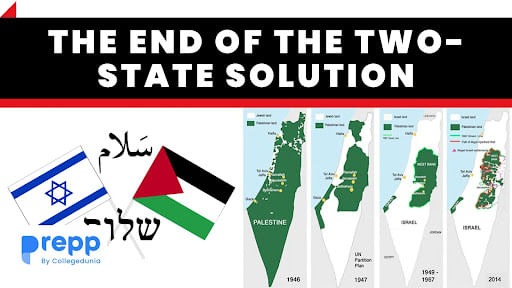
- The Two-State solution is a proposed framework to resolve the Israel-Palestine conflict by creating two independent states - Israel and Palestine.(In 1936, the Peel Commission which was set up by the UK government recommended the partition of Palestine into Jewish and Arab states) .
- The two-state solution required Israel to abandon its opposition to Palestinian claims of national sovereignty.
- In 1947, Britain referred the issue to the United Nations, which suggested the Partition Plan (Resolution 181).
- In 2000, UNSC Resolution 1397 became the first UNSC resolution to agree on a two-state solution, after the U.S.A. extended support.
- Practical solution: It was considered the most workable solution that could fulfill the basic desires of both the Jews and Arabs by creating separate states in which neither Jews nor Arabs are in the minority.
- Moral reasoning: The two-state solution will ensure that the aspirations of one community will not be overridden in pursuit of the other’s aspirations.
Challenges
- Borders: The delineation of borders between the proposed states is a major point of contention between Israel and Palestine.
- Although some advocate for a return to the pre-1967 lines, this has been complicated by Israel's retention of disputed territories like the West Bank, Gaza Strip, and Golan Heights.
- Jerusalem: Both Israel and Palestine have claimed the ancient city of Jerusalem as their capital.
- The city holds religious and cultural significance for both the Arabs and Jews.
- Israel has declared that undivided Jerusalem is its capital and has undertaken construction activity in the disputed area.
- Demographic challenges: Refugees from the 1948 War and their descendants have demanded the right to return to their ancestral homes.
- However, Israel has opposed such claims as it feels that the return of these nearly 5 million refugees would lead to demographic shifts in favor of the Arabs and make Jews a minority.
- Security: Israel faces a significant security threat from militant groups such as Hamas in Gaza and the Iran-sponsored Hezbollah.
- The recent attacks have highlighted the security challenges which adversely affect the implementation of a fair “two-state solution”.
Is the two-state solution viable now?
Historical shifts
- Initially, Jewish leaders accepted the idea of partition, while Arab leaders rejected it.
- However, in recent decades, there has been a shift in this dynamic with the Arab world, Palestinian leadership, and Western powers endorsing the two-state solution while Israel has rejected it.
The Israeli Public
- The Palestinian people, the Palestinian leadership including Hamas, the Israeli public, the Israeli government, Arab countries, Iran, and international powers like the U.S., and China can be classified as stakeholders in the process.
- However, in terms of realpolitik, the general public of Israel is the most crucial stakeholder due to it being the most powerful entity.
- Israel is a democratic country, therefore, any solution requires the consent of its citizens.
- The recent terror attacks by Hamas could have made the Israeli public more hesitant to support the creation of a sovereign and independent Palestine state.
- The rise of religious extremists within Israeli politics reflects a growing Israeli distrust of Palestinians as potential peace partners.
Impact of Trauma
- Although some analysts have suggested that the attacks by Hamas would build a sympathetic understanding of the plight of everyday Palestinians and the need for a sovereign Palestine for lasting peace, others have argued that the opposite is more plausible.
- According to them, the attacks by Hamas are likely to reinforce the belief in the Israeli public that an independent Palestine could pose a much larger threat to the security of Israel.
Hamas's position
- Hamas has refused to recognize Israel's right to exist and has attacked the southern borders of the country, which are not disputed areas.
- This has raised concerns about the viability of a two-state solution as the alignment of the moderate Palestinian Authority with Hamas is likely to deepen Israel’s security concerns.
- The decades of occupation have led Palestinians to believe that Israelis must share their suffering in order to understand their plight and thus halt the occupation.
- However, each instance of violence is likely to further discourage Israel from ending the occupation.
Conclusion
- The attacks by Hamas have reinforced Israeli suspicions and have left them with two choices, the moral question of ruling over another people or the existential threat of creating a sovereign Palestinian state.
- In order to achieve a lasting and peaceful solution, it is necessary that the Palestinian leadership convince Israel that there is a possibility of peaceful coexistence.
- However, this is a challenging task given the tensions between the two sides over the casualties suffered.
Israel-Palestine conflict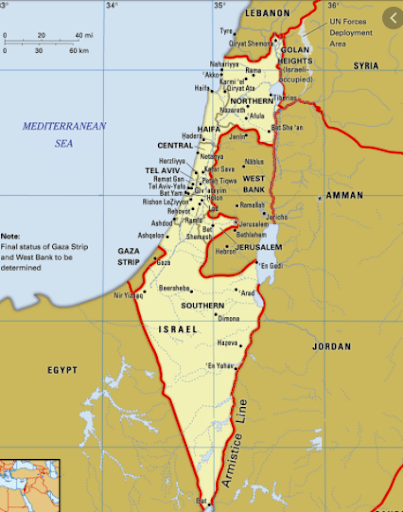
|
(*Click this link to read prelims specific weekly current affairs articles)
FAQs
Question: Why is Jerusalem important to both Palestine and Israel?
Answer:
Jerusalem has been claimed by both Palestine and Israel as its capital. The city also holds religious and cultural importance for both sides. It houses the Qibli mosque and the Dome of the Rock making it significant for Palestinians and the Western Wall, a site important to the Jews who believe it was built by King Solomon.
Question: What is realpolitik?
Answer:
Realpolitik is derived from German terms meaning realistic or practical, and politics. It refers to the approach of conducting diplomatic or political policies based on circumstances and factors, rather than strictly following ideological notions or moral and ethical premises. It shares some similarities with other philosophies such as realism and pragmatism.
MCQs
Question: The term "two-state solution" is sometimes mentioned in the news in the context of the affairs of (UPSC CSE 2018)
(a) China
(b) Israel
(c) Iraq
(d) Yemen
Answer: (b) See the Explanation
The two-state solution demands the creation of the Palestine state in the Gaza Strip and West Bank, alongside the state of Israel as a solution to the conflict in the region.
Therefore, option (b) is the correct answer.
Question: Consider the following pairs sometimes mentioned in the news:
Town Country
- Aleppo Syria
- Kirkuk Yemen
- Mosul Palestine
- Mazar -i- Sharif Afghanistan
Which of the pairs given above are correctly matched? (UPSC CSE 2018)
(a) 1 and 2
(b) 1 and 4
(c) 2 and 3
(d) 3 and 4
Answer: (b) See the Explanation
- Aleppo is in Syria. Hence statement 1 is correct.
- Kirkuk is in Iraq in Iraq, not Yemen. Hence statement 2 is incorrect.
- Mosul is also in Iraq, not Palestine. Hence statement 3 is incorrect.
- Mazar-i-Sharif is in Afghanistan. Hence statement 4 is correct.
Therefore, option (b) is the correct answer.
Download the PREPP App and attempt FREE IAS Exam Mock Tests and get complete study material!

Full Test - 04: UPSC CSE Prelims CSAT (Paper-II)
Full Test - 03: UPSC CSE Prelims CSAT (Paper-II)
UPSC CSE Prelims 2026 GS Paper 1 Question Paper (24-May-2026)
UPSC CSE Prelims 2026 CSAT Paper 2 Question Paper (24-May-2026)

17 February 2025 | The Hindu Must Read Articles | Current Affairs

16 February 2026 | The Hindu Must Read Articles | Current Affairs

13 February 2026 | The Hindu Must Read Articles | Current Affairs









Comments