The State Of India’s Scheduled Areas
Relevance: GS2 - Indian Constitution; Polity & Governance; Issues Related to SCs & STs
(Source: The Hindu, 10/10/2023)
Click here for Daily Current Affairs
Why in the news?
- This article is based on ‘The State of India’s Scheduled Areas,’ which was published in ‘The Hindu,’ on 10/10/2023.
- In India, there are 705 Scheduled Tribe (ST) communities, comprising 8.6% of the total population, and they are distributed across 26 states and six Union Territories.
- Article 244, which deals with the governance of Scheduled and Tribal Areas, holds utmost constitutional significance for Scheduled Tribes (STs).
Table of Contents
- What are Scheduled Areas?
- Issues faced by Scheduled Tribe (ST) Populations
- What did the Bhuria Committee in 1995 recommend?
- How are Scheduled Areas Governed?
- Powers and Responsibilities of Governors
- How have the provisions of PESA changed governance of Scheduled Areas?
- Who decides a Scheduled Area?
- How are Scheduled Areas identified?
- FAQs
- MCQs
What are Scheduled Areas?
- Scheduled areas and tribal areas are administered according to Article 244 of the Indian Constitution.
- Scheduled areas are home to 'aboriginals' who are socially and economically disadvantaged, the scheduled regions are treated differently from the rest of the country, and special efforts must be made to improve their position.
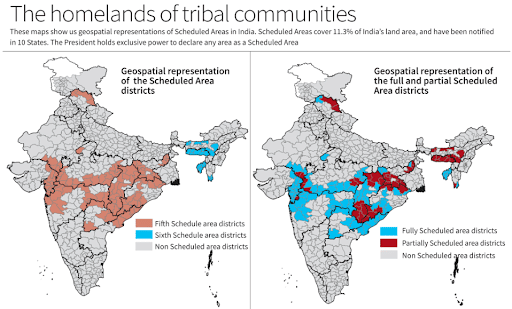
- Scheduled Areas in India encompass approximately 11.3% of the country's land area and have been officially designated in 10 States, including Andhra Pradesh, Telangana, Odisha, Jharkhand, Chhattisgarh, Madhya Pradesh, Rajasthan, Gujarat, Maharashtra, and Himachal Pradesh.
- There has been a proposal by Kerala to designate additional areas as Scheduled Areas, which is pending approval from the Indian government.
Issues faced by Scheduled Tribe (ST) Populations
- Despite persistent demands from Adivasi organizations, many villages with Scheduled Tribe (ST) populations have been excluded from the Scheduled Areas in these 10 States and in other areas with ST communities.
- Consequently, 59% of India's ST population does not benefit from the rights and protections provided under laws applicable to Scheduled Areas, such as the Right to Fair Compensation and Transparency in Land Acquisition, Rehabilitation and Resettlement Act 2013, and the Biological Diversity Act 2002.
What did the Bhuria Committee in 1995 recommend?
- In 1995, the Bhuria Committee recommended extending the provisions of panchayat raj (local self-governance) to these excluded villages, but this recommendation has not been implemented.
- The argument often used by authorities is that these excluded areas lack viable ST-majority administrative units, which has also led to calls for the denotification of parts of Scheduled Areas where STs have become a minority due to the influx of non-tribal individuals.
How are Scheduled Areas Governed?
- Scheduled Areas in India are designated by the President of India.
- Tribal Advisory Council: In States with Scheduled Areas, a Tribal Advisory Council is established, comprising up to 20 Scheduled Tribe (ST) members. This council advises the Governor on matters related to ST welfare.
- Governor's Annual Report: The Governor of the respective State submits an annual report to the President, detailing the administration of Scheduled Areas and seeking guidance.
Powers and Responsibilities of Governors
- Directive Authority: The national government can issue directives to the State concerning the administration of Scheduled Areas.
- Legislative Control: The Governor has the authority to repeal or amend any law enacted by Parliament and the State Legislative Assembly in its application to the Scheduled Area of that State.
- Regulatory Powers: Governors can make regulations specifically for Scheduled Areas. This includes the ability to restrict or prohibit the transfer of tribal land among Scheduled Tribes members and regulate land allotments and money-lending to STs.
How have the provisions of PESA changed governance of Scheduled Areas?
- Historical Context: The governance provisions for Scheduled Areas largely remained unimplemented until the enactment of the Panchayats (Extension to Scheduled Areas) Act (PESA) in 1996.
- PESA Empowerment: PESA empowered gram sabhas (village assemblies) to exercise significant authority through direct democracy. It specified that higher-level structures should not assume the powers and authority of the gram sabha.
- Actualization of Intent: It played a crucial role in actualizing the constitutional intent and the vision of the Constituent Assembly for effective governance of Scheduled Areas. However, its implementation has varied across different States and regions.
- Effective Local Governance: It aimed to enhance the role of gram sabhas in decision-making, especially in matters related to land, natural resources, and social and economic development in Scheduled Areas.
Who decides a Scheduled Area?
- The designation of a Scheduled Area in India is exclusively determined by the President of India. The Fifth Schedule of the Indian Constitution grants the President the authority to declare any area as a Scheduled Area.
- For instance: In a 2016 case, the Jharkhand High Court dismissed a challenge to the notification of a Scheduled Area, asserting that the declaration of a Scheduled Area falls within the exclusive discretion of the President, even if the Scheduled Tribe (ST) population in certain blocks is less than 50%.
- This underscores the President's prerogative in determining and designating Scheduled Areas in India.
How are Scheduled Areas identified?
- Dhebar Commission Report: Scheduled Areas lack specific constitutional or legal criteria. However, the 1961 Dhebar Commission Report suggests guiding norms, including a preponderance of tribal population, reasonable size, administrative viability, and economic backwardness relative to neighboring areas.
- Scheduled Areas and Scheduled Tribes Commission: There is no specific law prescribing a minimum percentage of Scheduled Tribes (STs) or a cut-off date for identification. The 2002 Scheduled Areas and Scheduled Tribes Commission suggested considering areas with 40% or more tribal population as Scheduled Areas, according to the 1951 Census, but this recommendation was not universally adopted by states.
- Bhuria Committee: It acknowledged community-based self-governance as the basic unit in Scheduled Areas. However, administrative boundaries have divided resource-rich tribal areas, leading to arbitrary political and administrative decisions about the unit of governance, such as revenue villages, panchayats, talukas, or districts with a majority of Scheduled Tribe population.
- PESA: It defined a village as a habitation or group of habitations managing affairs according to traditions and customs. The gram sabha, comprising those on the electoral rolls, governs these villages. The Scheduled Tribes and Other Traditional Forest Dwellers (Recognition of Forest Rights) Act, 2006, also known as the FRA Act, adopted a similar definition for forest rights.
- Gram Sabhas: Gram sabhas have not delineated their traditional boundaries on revenue lands due to a lack of appropriate laws. FRA 2006 mandates the demarcation of 'community forest resources,' encompassing customary forest land within the village's traditional boundaries and seasonal use areas. This boundary defines the village's territorial jurisdiction in Scheduled Areas.
(*Click this link to read prelims specific weekly current affairs articles)
FAQs
Question: What is Scheduled area?
Answer:
Scheduled areas are home to 'aboriginals' who are socially and economically disadvantaged, the scheduled regions are treated differently from the rest of the country, and special efforts must be made to improve their position. As a result, a state's whole administrative system is not extended to scheduled territories, and the Central government has significantly more authority for these regions.
Question: What is the Fifth Schedule?
Answer:
The Fifth Schedule of the Constitution deals with the administration and control of scheduled areas and scheduled tribes in any state except the four states of Assam, Meghalaya, Tripura and Mizoram.
Question: What is the PESA act?
Answer:
The Panchayats (Extension to Scheduled Areas) Act, 1996 (PESA) is a law created by the Government of India to ensure self-government through traditional Gram Sabhas for people residing in India's Scheduled Areas.
MCQ
Question: The provisions in Fifth Schedule and Sixth Schedule in the Constitution of India are made in order to: (UPSC 2015)
(a) Protect the interests of Scheduled Tribes
(b) Determine the boundaries between States
(c) Determine the powers, authority and responsibilities of Panchayats
(d) Protect the interests of all the border States
Answer: (a) See the Explanation
Fifth Schedule Article 244(1) provides that the provisions of the fifth schedule shall apply to the administration and control of the scheduled areas and scheduled tribes in any state other than the states of Assam, Meghalaya, Tripura and Mizoram. Sixth Schedule Article 244(2) provides that the provisions of the sixth schedule shall apply to the administration of the tribal areas in the state of Assam, Meghalaya, Tripura and Mizoram. They are to protect the interest of Scheduled Tribes.
Therefore, option (a) is the correct answer.
Download the PREPP App and attempt FREE IAS Exam Mock Tests and get complete study material!

Full Test - 04: UPSC CSE Prelims CSAT (Paper-II)
Full Test - 03: UPSC CSE Prelims CSAT (Paper-II)
UPSC CSE Prelims 2026 GS Paper 1 Question Paper (24-May-2026)
UPSC CSE Prelims 2026 CSAT Paper 2 Question Paper (24-May-2026)

17 February 2025 | The Hindu Must Read Articles | Current Affairs

16 February 2026 | The Hindu Must Read Articles | Current Affairs

13 February 2026 | The Hindu Must Read Articles | Current Affairs









Comments