Sri Lanka To Take Over As Chair Of Indian Ocean Rim Association
Relevance: GS2 - India and its neighborhood- relations. Bilateral, regional and global groupings and agreements involving India and/or affecting India’s interests
(Source: The Hindu, 10/10/2023)
Click here for Daily Current Affairs
Why in the news?
- The Indian Ocean Rim Association Council of Ministers Meeting 2023 is scheduled to be held in Colombo on 11th October 2023.
- Sri Lanka will take over the chairmanship of the IORA, a regional multilateral organization, for the next two years replacing Bangladesh.
Table of Contents
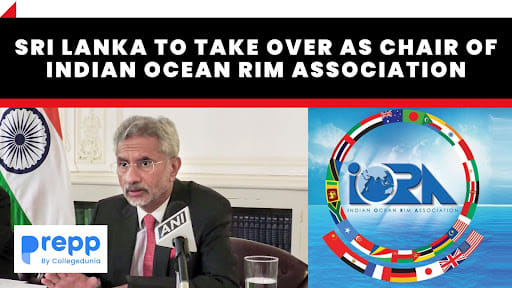
IORA Council of Ministers Meeting 2023
- The Indian Ocean Rim Association (IORA) Council of Ministers meeting is scheduled for October 11, 2023, in Colombo, Sri Lanka.
- Foreign ministers of 16 countries including India, Bangladesh, Mauritius, Iran, Malaysia, and South Africa, as well as ministerial representation from other members and dialogue partners, will participate.
- The Foreign Minister of Sri Lanka, Ali Sabry will chair the Council taking over from the Foreign Minister of Bangladesh.
- Sri Lanka will serve as chair for the next two years.
What is the Indian Ocean Rim Association?
- The Indian Ocean Rim Association (IORA) is an inter-governmental organization established in 1997 with its secretariat in Mauritius.
- It was initially known as the Indian Ocean Rim Association for Regional Cooperation (IOR-ARC).
- It operates as a tripartite forum that brings together representatives from Government, Business, and Academia to foster cooperation and interaction.
- It was conceptualized by India and South Africa and is founded upon the values of open regionalism to boost economic cooperation through trade facilitation, investment, and regional social development.
Membership
- It comprises 23 Member States bordering the Indian Ocean and 12 Dialogue Partners.
- Members: Australia, Bangladesh, Comoros, French Republic, India, Indonesia, Iran, Kenya, Madagascar, Malaysia, Mauritius, Mozambique, Oman, Seychelles, Singapore, Somalia, South Africa, Sri Lanka, Tanzania, Thailand, the United Arab Emirates, the Maldives, and Yemen.
- All sovereign States of the Indian Ocean Rim are eligible for membership and members must adhere to the principles and objectives of the IORA Charter.
- Dialogue partners: China, Germany, the United States of America, Egypt, Japan, Turkey, France, the United Kingdom, Russia, Italy, Saudi Arabia, and South Korea.
- Dialogue Partners provide valuable assistance in fields such as technology transfer, environmental issues, the promotion of trade and investment, technical cooperation, and assistance to the Special Fund.
Objectives
- Strengthen regional cooperation and promote sustainable development within the Indian Ocean region.
- Development through economic cooperation
- Help member countries achieve an enhanced flow of goods, services, investment, and technology by:
- Promoting liberalization
- Removing impediments
- Lowering barriers
Priority Areas
- Maritime Security: Ensure the safety and security of maritime routes and combat threats such as piracy.
- Trade and Investment Facilitation: Promote economic cooperation, trade liberalization, and investment within the Indian Ocean region.
- Fisheries Management: Collaborate on sustainable fisheries practices to protect marine resources.
- Disaster Risk Reduction: Enhance resilience and preparedness for natural disasters in the region.
- Academic and Scientific Cooperation: Encourage research, education, and knowledge-sharing among Member States.
- Tourism Promotion and Cultural Exchanges: Promote tourism in member countries and foster stronger cultural ties in the region.
- Blue Economy: Promote smart, sustainable, and inclusive growth and employment opportunities within the Indian Ocean region’s maritime economic activities.
- Women empowerment: The IORA is committed to gender equality and women’s economic empowerment and released a Gender Pledge in 2022.
Structure
- Council of Foreign Ministers: The IORA’s apex body is the Council of Foreign Ministers (COM) which meets annually to discuss the developments of IORA.
- The chairman of the COM serves for a two-year term with the next Chairman serving as the Vice-Chair.
- Committee of Senior Officials: The CSO meets twice a year to discuss actions to advance the IORA’s agenda and recommendations by Working Groups and other forums to improve the lives of people within the region.
- Troika: The "Troika" consists of the Chair, the Vice-Chair, and the previous Chair.
- It has been established by the Council of Ministers.
- It meets in the Chair country or another agreed-upon country in the periods between regular meetings of the COM and the CSO.
- It reports to the COM and the Member States on any important matters such as achievements, policies, appointments, and terms of office of the Secretary-General.
Significance
- Increased Membership: The membership of the IORA has expanded from seven (Magnificent 7) to 23 member states and 12 dialogue partners.
- The participation of nations such as the U.S.A., Japan, Germany, etc which are outside the Indian Ocean Region has increased the influence and scope of the organization beyond economy and trade to non-conventional security concerns as well.
- Economic: 40% of global trade takes place through the Indian Ocean including 80% of India’s energy exports.
- This makes the region significant from an economic point of view for member nations and dialogue partners such as the U.S.A., and Japan.
- Population: The Indian Ocean Region houses around 2.7 billion people and is rich in culture, languages, religions, traditions, arts, and cuisines.
- Security: One of the major issues faced by the IOR countries is piracy, particularly around the Horn of Africa and the Gulf of Aden.
- The IORA has undertaken successful initiatives for international cooperation in anti-piracy
- Members have also signed an accord on cooperation against terrorism and sharing information among members.
- Other concerns in the region include territorial disputes in the region, Chinese aggression, and the rules-based order.
Initiatives
- Indian Ocean Dialogue(IOD): The IOD is a stand-alone Track 1.5 debate that was started at the 13th Council of Ministries conference in 2013.
- It brings together academics and decision-makers from member states to engage in discussions on issues that affect the Indian Ocean Region and IORA member nations.
- IORA sustainable development program(ISDP): The ISDP was established in 2014 in order to share best practices and thus close the gap between developed and least developed countries.
- It focuses on information sharing and peer-to-peer learning.
- Fisheries support unit(FSU): A Fisheries Support Unit was established at the National Centre for Marine Sciences and Fisheries in Muscat, Oman, financed by the Special Fund.
- It aims to improve fisheries cooperation and research among member countries.
- Regional Center for Science and Technology Transfer(RCSTT): The IORA Regional Center for Science and Technology Transfer (IORA RCSTT) was established in October 2008 in Tehran.
What are the challenges associated with the IORA?
- China’s aggression: The IORA Council meeting in 2023 will coincide with the potential visit of the Chinese research vessel Shi Yan 6 to Sri Lanka.
- This is a major security concern for India, which views this as part of Chinese incursion into its sovereign waters.
- India and the U.S. have raised the matter with Sri Lanka.
- Competition: Sri Lanka could be affected by the competing strategic interests of India and China in the Indian Ocean Region.
- It is difficult for the IORA Chair and members to balance the diverse interests and priorities of member countries
- Potential conflicts and disputes among member countries are a challenge for the IORA.
- Effectiveness: The IORA has faced difficulties in ensuring the effective implementation of regional initiatives and projects.
- The IORA’s limited resources and capacities have adversely affected the IORA’s ability to address regional challenges.
- Geopolitical challenges: The IORA is also facing the challenge of opposing geopolitical influences contrary to the interests of individual members.
- These could include U.S. attempts to build influence in the region as well as Chinese initiaitves like the Maritime Silk Route.
- Overlapping organizations: The funding and activities of the IORA are compromised by the presence of other organizations in the Indian Ocean Region such as the Indian Ocean Commission and the Indian Ocean Naval Symposium.
India’s role in IORA
- India has advocated a policy of “coordination, cooperation, and partnership” in the Indian Ocean Region with its partner countries in the IORA to ensure development that is equitable and sustainable while addressing major concerns like security.
- India has attempted to establish itself as the first responder and provider of humanitarian assistance and disaster relief in the region.
- India’s partnership with the IORA will help it advance towards this goal.
- The Information Fusion Center has been established in Gurugram to provide member nations with real-time crisis information.
- IORA members are active participants which will help India become the primary source of information in the IOR.
- India has developed the Security and Growth for All in the Region (SAGAR) policy which aims to make the IOR more inclusive and safe.
Conclusion
- The Indian Ocean Region is a critical element in global trade, which makes China’s growing aggression and other security concerns a major challenge for countries like India.
- The IORA plays a crucial role in fostering cooperation and sustainable development in the region while maintaining regional security and ensuring adherence to international maritime laws.
(*Click this link to read prelims specific weekly current affairs articles)
FAQs
Question: What is the blue economy?
Answer:
The term "Blue economy" denotes the responsible and sustainable utilization of marine resources in order to drive economic development, enhance the quality of life for communities, facilitate transportation, and safeguard the well-being and integrity of marine ecosystems.
Question: What is the Horn of Africa?
Answer:
The Horn of Africa or the Somali Peninsula is a large peninsula of East Africa. It is the fourth-largest peninsula in the world and spans across Ethiopia, Eritrea, Somalia, and Djibouti.
UPSC Mains Practice Question:
|
MCQs
Question: With reference to 'Indian Ocean Rim Association for Regional Cooperation (IOR-ARC)', consider the following statements: (UPSC CSE 2015)
- It was established very recently in response to incidents of piracy and accidents of oil spills.
- It is an alliance meant for maritime security only.
Which of the statements given above is/are correct?
(a) 1 only
(b) 2 only
(c) Both 1 and 2
(d) Neither 1 nor 2
Answer: (d) See the Explanation
- The IOR-ARC, now known as the IORA, is a regional cooperation initiative of the Indian Ocean Rim countries which was established in Mauritius in March 1997 with the aim of promoting economic and technical cooperation. Hence statement 1 is incorrect.
- It is a pan-Indian ocean grouping that aims to create a platform for trade, and socio-economic and cultural cooperation in the Indian Ocean rim area. Hence statement 2 is incorrect.
Therefore, option (d) is the correct answer.
Question: Consider the following in respect of the Indian Ocean Naval Symposium (IONS):
- The inaugural IONS was held in India in 2015 under the chairmanship of the Indian Navy.
- IONS is a voluntary initiative that seeks to increase maritime cooperation among navies of the littoral states of the Indian Ocean Region.
Which of the above statements is/are correct? (UPSC CSE 2017)
(a) 1 only
(b) 2 only
(c) Both 1 and 2
(d) Neither 1 nor 2
Answer: (b) See the Explanation
- The inaugural IONS was held in 2015 in South Africa and co-chair Tanzania. Hence statement 1 is incorrect
- The IONS was set up in 2008 by taking all the littoral countries of the Indian Ocean onboard to promote friendly relationships and discuss regional issues in the maritime domain. Hence statement 2 is correct.
Therefore, option (b) is the correct answer.
Question: South-East Asia has captivated the attention of global community over space and time as a geostrategically significant region. Which among the following is the most convincing explanation for this global perspective? (UPSC CSE 2011)
(a) It was the hot theatre during the Second World War
(b) Its location between the Asian powers of China and India
(c) It was the arena of superpower confrontation during the Cold War Period
(d) Its location between the Pacific and Indian oceans and its pre-eminent maritime character
Answer: (d) See the Explanation
The primary reasons for the global attention on the South East region were its location between the Pacific and Indian oceans and the pre-eminent maritime character of the region and regional states.
Therefore, option (d) is the correct answer.
Download the PREPP App and attempt FREE IAS Exam Mock Tests and get complete study material!

Full Test - 04: UPSC CSE Prelims CSAT (Paper-II)
Full Test - 03: UPSC CSE Prelims CSAT (Paper-II)
UPSC CSE Prelims 2026 GS Paper 1 Question Paper (24-May-2026)
UPSC CSE Prelims 2026 CSAT Paper 2 Question Paper (24-May-2026)

17 February 2025 | The Hindu Must Read Articles | Current Affairs

16 February 2026 | The Hindu Must Read Articles | Current Affairs

13 February 2026 | The Hindu Must Read Articles | Current Affairs









Comments