Claudia Goldin Wins 2023 Economics Nobel Prize For Research On Workplace Gender Gap
Relevance: Prelims, GS1 - Role of Women; Issues Related to Development
(Source: The Hindu, 10/10/2023)
Click here for Daily Current Affairs
Why in the news?
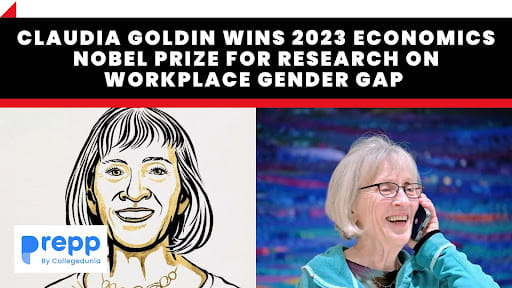
- Recently, Harvard economist Claudia Goldin has been awarded the Nobel Prize in economics for her work examining the gender pay gap.
- She was recognised for her research showing that women are paid less than men on average despite having higher education levels and that most of the gap appears after childbirth.
Table of Contents
Who is Claudia Goldin?
- Claudia Dale Goldin is an American economic historian and labor economist who is currently the Henry Lee Professor of Economics at Harvard University.
- In 1990, she made history when she became the first woman to be awarded tenure in the economics department of Harvard University. Getting tenure implies having a permanent appointment as a university professor that can be terminated only under extraordinary circumstances.
- Goldin has been a pioneer in studying the role of women in the economy and has written several books on the topic, such as Understanding the Gender Gap: An Economic History of American Women (Oxford, 1990), and Career & Family: Women’s Century-Long Journey toward Equity (Princeton University Press, 2021).
- Claudia Goldin is the third woman to be awarded the Nobel Prize in economics, which has the fewest number of female laureates, after Elinor Ostrom in 2009 and Esther Duflo in 2019.
Key Findings of Claudia Goldin’s Research
- Older data gave more perspective: The older data revealed that before industrialisation, more women were likely to have been involved in economic activity related to agriculture and various cottage industries. With greater industrialisation, work was concentrated in factories, and women found it difficult to leave their homes and travel to work.
- Limitations of marriage: In the early 20th century, only about 5% of married women were employed, compared to around 20% of all women. This was partly due to "marriage bars" in legislation that restricted married women's employment, especially in teaching and office roles. These restrictions were most prominent during the 1930s Great Depression.
- Another important factor in the slow reduction of the gap between men’s and women’s rates of employment, namely women’s expectations for their future careers.
- Women’s expectations were based on the experience of their mothers, and thus their educational and professional decisions were not taken with the expectation of having a long, uninterrupted, and fruitful career.
- Contraceptive pills: In the late 1960s, the availability of contraceptive pills gave women more control over family planning, allowing them to balance careers and motherhood. They also pursued careers in fields like law, economics, and medicine, diversifying their employment opportunities. Despite these advancements, a significant gender-based pay gap persisted then and still exists today.
- Pay gap and parenthood: The gender pay gap was relatively small when men and women worked in factories with pay tied to daily output. It widened when monthly pay contracts became common. One major factor behind this gap was childbirth. After having children, women often faced slower career advancement and lower earnings compared to men with the same education and profession, as demonstrated by Goldin and her co-authors in a 2010 study.
What are Nobel Prizes?
Other 2023 Nobel Prize Announcements
|
Significance of Goldin’s Research
- Goldin's work has brought attention to the ongoing issue of gender pay inequality. Despite women achieving higher levels of education, the fact that they continue to be paid less than men on average underscores the persistence of this problem.
- Goldin's research has significant policy implications, which suggests the need for policies and practices that address the gender pay gap, support women's career advancement, and provide greater work-life balance for parents.
(*Click this link to read prelims specific weekly current affairs articles)
FAQs
Question: Who is Claudia Goldin?
Answer:
Claudia Dale Goldin is an American economic historian and labor economist who is currently the Henry Lee Professor of Economics at Harvard University.
Question: Who is awarded the 2023 Economics Nobel prize?
Answer:
In October 2023, Claudia Goldin was awarded the Nobel Memorial Prize in Economic Sciences "for having advanced our understanding of women's labour market outcomes".
Question: What is the Nobel Prize?
Answer:
It is a prize for outstanding contributions to chemistry, physics, physiology or medicine, literature, economics, and peace that is awarded annually.
MCQ
Question: Consider the following statements:
- Claudia Goldin has been awarded the 2023 Nobel Prize in economics for her work examining the gender pay gap.
- Claudia Goldin is the third woman to be awarded the Nobel Prize in economics.
Which of the statements given above is/are correct?
(a) 1 only
(b) 2 only
(c) Both 1 and 2
(d) Neither 1 nor 2
Answer: (c) See the Explanation
- Recently, Harvard economist Claudia Goldin has been awarded the Nobel Prize in economics for her work examining the gender pay gap.
- She was recognised for her research showing that women are paid less than men on average despite having higher education levels and that most of the gap appears after childbirth.
- Claudia Goldin is the third woman to be awarded the Nobel Prize in economics, which has the fewest number of female laureates, after Elinor Ostrom in 2009 and Esther Duflo in 2019.
Therefore, option (c) is the correct answer.
Download the PREPP App and attempt FREE IAS Exam Mock Tests and get complete study material!

Full Test - 04: UPSC CSE Prelims CSAT (Paper-II)
Full Test - 03: UPSC CSE Prelims CSAT (Paper-II)
UPSC CSE Prelims 2026 GS Paper 1 Question Paper (24-May-2026)
UPSC CSE Prelims 2026 CSAT Paper 2 Question Paper (24-May-2026)

17 February 2025 | The Hindu Must Read Articles | Current Affairs

16 February 2026 | The Hindu Must Read Articles | Current Affairs

13 February 2026 | The Hindu Must Read Articles | Current Affairs









Comments