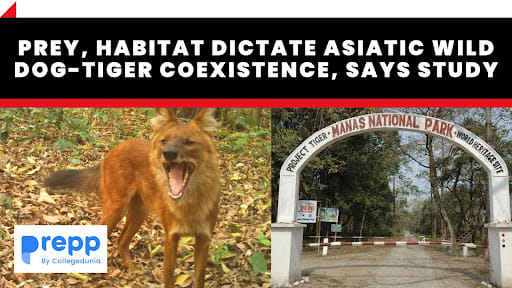
Prey, Habitat Dictate Asiatic Wild Dog-Tiger Coexistence, Says Study
Relevance: GS3 - Environment and Conservation; Prelims
(Source: The Hindu, 10/11/2023)
Click here for Daily Current Affairs
Why in the news?
- Recently, a study conducted in Western Assam’s Manas National Park, titled ‘Do dholes segregate themselves from their sympatrids? Habitat use and carnivore co‑existence in the tropical forest’ has found that dholes (Asiatic wild dogs) and tigers may have a positive association due to overlapping prey availability of suitable habitats.
- The study utilized camera traps and examined dhole behavior and interactions with other sympatric carnivores (species living in the same or overlapping geographical areas).
Table of Contents
Key Findings of the Study
- Dhole Activity Patterns: The study found that the diurnal activity of dholes had the highest temporal overlap with leopards and the lowest with clouded leopards.
- Cooperative Behavior with Tigers: The study uncovered a positive relationship between dhole habitat use and tigers, which suggests that factors such as overlapping prey availability or suitable habitats might facilitate cooperation or coexistence between dholes and tigers.
- Dhole Endangerment: Dholes, as the only pack-living canid species in tropical Indian forests, are endangered and at high risk of extinction. Their populations have become fragmented due to habitat loss, declining prey availability, persecution, disease, and competition with other species.
About Asiatic Wild Dog (Dhole)
- The dhole or Asiatic wild dog (Cuon alpinus) is a wild carnivorous animal and is a member of the family Canidae and the class Mammalia.
- In India, Dholes are found in three clusters namely the Western and Eastern Ghats, central Indian landscape and North East India.
- According to a 2020 study, Karnataka, Maharashtra and Madhya Pradesh rank high in conservation of dhole.
- Dholes play an important role as apex predators in forest ecosystems.
- Protection Status:
- IUCN Status: Endangered
- CITES: Appendix II
- Wildlife Protection Act: Schedule II
About Manas National Park
 |
(*Click this link to read prelims specific weekly current affairs articles)
FAQs
Question: What is Dhole?
Answer:
The dhole or Asiatic wild dog (Cuon alpinus) is a wild carnivorous animal and is a member of the family Canidae and the class Mammalia. In India, Dholes are found in three clusters namely the Western and Eastern Ghats, central Indian landscape and North East India.
Question: What is the protection status of Dhole?
Answer:
- IUCN Status: Endangered
- CITES: Appendix II
- Wildlife Protection Act: Schedule II
Question: Where is Manas National Park?
Answer:
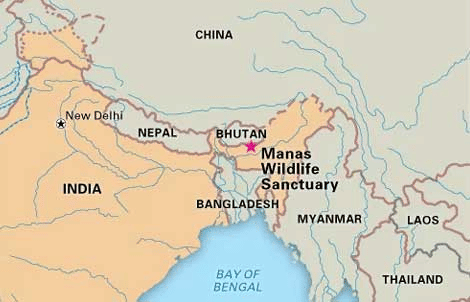
Manas National Park is a national park, Project Tiger reserve, and an elephant reserve in Assam, India. It is a UNESCO World Heritage Site, and one of the largest areas of conservation significance in South Asia, offering a range of habitats ideal for dholes.
MCQ
Question: Which of the following groups of animals belong to the category of endangered species? (UPSC 2012)
(a) Great Indian Bustard, Musk Deer, Red Panda, and Asiatic Wild Ass
(b) Kashmir Stag, Cheetal, Blue Bull, and Great Indian Bustard
(c) Snow Leopard, Swamp Deer, Rhesus Monkey, and Saras (Crane)
(d) Lion-tailed Macaque, Blue Bull, Hanuman Langur, and Cheetal
Answer: (a) See the Explanation
The Great Indian Bustard, Musk Deer, Red Panda, and Asiatic Wild Ass belong to the category of endangered species.
Therefore, option (a) is the correct answer.
Download the PREPP App and attempt FREE IAS Exam Mock Tests and get complete study material!

Full Test - 04: UPSC CSE Prelims CSAT (Paper-II)
Full Test - 03: UPSC CSE Prelims CSAT (Paper-II)
UPSC CSE Prelims 2026 GS Paper 1 Question Paper (24-May-2026)
UPSC CSE Prelims 2026 CSAT Paper 2 Question Paper (24-May-2026)

17 February 2025 | The Hindu Must Read Articles | Current Affairs

16 February 2026 | The Hindu Must Read Articles | Current Affairs

13 February 2026 | The Hindu Must Read Articles | Current Affairs









Comments