What Is Hamas, The Palestinian Militant Group?
Relevance: GS2 - Effect of policies and politics of developed and developing countries on India’s interests, Indian diaspora.
(Source: The Hindu, 10/11/2023)
Click here for Daily Current Affairs
Why in the news?
- Recently, the Palestinian Islamist militant organization, Hamas, launched Operation Toofan-Al-Aqsa against Israel.
- In this article the formation and evolution of Hamas, which now controls significant parts of the Gaza Strip and the West Bank has been discussed.
Table of Contents
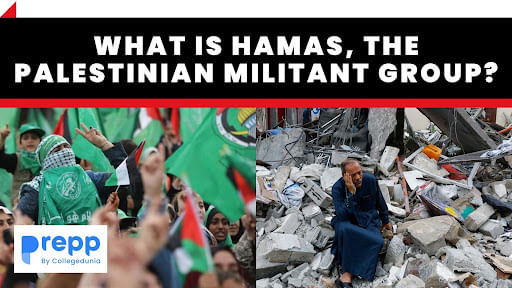
What is Hamas?
- Hamas is the largest Palestinian militant Islamist group.
- It governs more than two million Palestinians in the Gaza Strip and has undertaken an armed resistance against Israel.
- It has been designated as a terrorist group by Israel, the United States, the European Union, the United Kingdom, and other countries.
Roots of Hamas
- Muslim Brotherhood: The origins of Hamas can be traced back to the Muslim Brotherhood, a prominent Islamist organization founded in 1928 by Hasan al-Banna.
- The Brotherhood was initially focused on reorienting Muslim society and built a presence in British-ruled Palestine in the 1930s.
- However, it refrained from direct political involvement and remained critical of the Palestine Liberation Organization (PLO) and its secular nationalist agenda.
- It also stayed away from the guerrilla war launched by the PLO to liberate Palestine following the 1967 war.
- In the 1967 war, Israel had captured the West Bank and East Jerusalem from Jordan, and Gaza Strip from Egypt.
Rise of Hamas
- Hamas was established during the first Intifada in 1987, which was a mass uprising against Israeli occupation.
- Under the leadership of Sheikh Ahmed Yassin, the leader of the Islamic Brotherhood, Hamas under the name “Harakat al-Muqawamah al-Islamiyyah (the Islamic Resistance Movement)” issued a leaflet in December 1987, calling for Palestinians to resist the occupation.
- In 1988, they officially adopted the name "Hamas," which meant "zeal" in Arabic.
- In 1989, Hamas conducted its first attack on Israeli soldiers, leading to a crackdown by Israel.
Evolution of Hamas
- In the 1990s and early 2000s, Hamas conducted numerous suicide attacks against Israeli targets.
- During the Second Intifada in 2000, Hamas played a significant role in the Palestinian resistance.
- Hamas continued to target Israeli troops and settlers despite the targeted assassination of Hamas leaders by Israel.
- Consequently, Israel unilaterally pulled out of Gaza in 2005.
- In the 2006 legislative elections in the Palestinian territory, Hamas won a majority with its election manifest dropping the call for the destruction of Israel.
- However, the Hamas government was dissolved by the President of the Palestinian Authority, and a state of emergency was declared following tensions between Hamas and Fatah, the political wing of the PLO.
- This was followed by Fatah ousting Hamas from the West Bank and Hamas ousting Fatah from Gaza in 2007.
- Hamas has since then governed Gaza, which has been subjected to a blockade by Israel turning the region into an open prison.
- Although Hamas refuses to recognize Israel it has offered a hudna or lasting ceasefire if Israel returned to the 1967 border.
- In 2017, it adopted a new charter that did not contain anti-Semitic remarks as the earlier charter and claimed that it opposed Zionism and not ordinary Jews.
- It also did not mention the Muslim Brotherhood, Hamas’s parent organization.
How does Hamas differ from the PLO?
- Inspiration: While the PLO was inspired by the leftist guerilla national movements that had taken place in the third world, Hamas was inspired by the idea of creating an Islamic Waqf land for the Palestinian Mosles.
- Peace efforts: While the PLO was willing to participate in peace efforts with the aim of finding a solution to the crisis, Hamas adopted a hardline position.
- Hamas opposed the Oslo Accords which allowed the formation of the Palestinian Authority with limited powers within the occupied territories.
- Israel: When the PLO recognized Israel, Hamas rejected the two-state solution and vowed to liberate the whole of Palestine stretching from the Jordan River to the Mediterranean Sea.
- Organization: Hamas has built an organization with several branches including a social wing involved in Islamic education and charity, and a military wing in charge of military planning and weapons acquisitions.
Impact of the recent attacks
- The recent attacks could be an indication that Hamas is willing to return to its earlier policies of indiscriminate violence.
- Although Hamas has emerged as the main pillar of Palestine’s political landscape, it may lack the ability to push Israel back to the 1967 borders.
- The attacks emphasize that a solution to Palestine cannot be achieved without taking Hamas into account as it has survived and grown despite the repeated losses of its leaders to Israeli attacks.
Oslo Accords
|
(*Click this link to read prelims specific weekly current affairs articles)
FAQs
Question: What is the intifada?
Answer:
The Intifada, also spelled intifadah refers to either of the two popular uprisings of Palestinians in the West Bank and Gaza Strip with the aim of ending Israel’s occupation of those territories. It aimed to create an independent Palestinian state. The first Intifada concluded with the signing of the Oslo Accords in 1993.
Question: What is Zionism?
Answer:
Zionism is a religious and political ideology that brought thousands of Jews from around the world to their ancient lands in the Middle East. It aimed to re-establish Israel as the central location for Jewish identity. It is attributed to Theodor Herzl, a Jewish journalist from Austria. It has been criticized as a discriminatory and aggressive ideology and the cause of the strife and tensions in the Middle East,
Question: What is the Palestine Liberation Organization?
Answer:
The Palestine Liberation Organization is a Palestinian nationalist coalition, headquartered in the West Bank, that is internationally recognized as the official representative of the Palestinian people. It was founded in 1964, with the aim of establishing an Arab state over the entire territory of the former Mandatory Palestine. It was recognized by Israel through the Oslo Accords in 1993.
UPSC Mains Practice Question:
|
MCQs
Question: The term "two-state solution" is sometimes mentioned in the news in the context of the affairs of (UPSC CSE 2018)
(a) China
(b) Israel
(c) Iraq
(d) Yemen
Answer: (b) See the Explanation
The two-state solution demands the creation of the Palestine state in the Gaza Strip and West Bank, alongside the state of Israel as a solution to the conflict in the region.
Therefore, option (b) is the correct answer.
Download the PREPP App and attempt FREE IAS Exam Mock Tests and get complete study material!

Full Test - 04: UPSC CSE Prelims CSAT (Paper-II)
Full Test - 03: UPSC CSE Prelims CSAT (Paper-II)
UPSC CSE Prelims 2026 GS Paper 1 Question Paper (24-May-2026)
UPSC CSE Prelims 2026 CSAT Paper 2 Question Paper (24-May-2026)

17 February 2025 | The Hindu Must Read Articles | Current Affairs

16 February 2026 | The Hindu Must Read Articles | Current Affairs

13 February 2026 | The Hindu Must Read Articles | Current Affairs









Comments