Women MPs Contribution in Parliament
Relevance: GS1,2, Indian Polity and Governance, Women and associated issues, Women's empowerment and political representation, Government schemes and their benefits, Role of women in Parliament and their increasing contributions, Importance of gender balance in democracy
(Source: The Indian Express, 11/10/2023)
Click here for Daily Current Affairs
Why in the news?
- This article is based on ‘Women in the House’ which was published in ‘The Indian Express’ on 11/10/2023.
- It focuses on the rise in contributions and influence of women leaders in India's Parliament over recent years.
- In recent times, there have been a significant positive impact of policies implemented which has aided in improving women's lives.
Table of Contents
- Role of MPs
- Current Scenario of Women’s Representation in Parliament
- International Comparison and Progress
- Performance of Women in Parliament
- Importance of Political Empowerment of Women
- Constitutional Provisions Related to Women's Rights and Their Representation
- Reasons for Low Representation of Women in Parliament
- Government Initiatives
- Policies Benefitting Women
- Conclusion
- FAQs
- MCQs
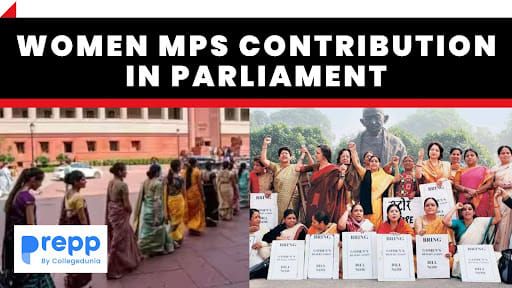
Role of MPs
- MPs represent their constituents' interests and ensure government accountability.
- It is crucial for MPs to question the government, irrespective of political affiliation or gender.
- MPs can introduce bills in Parliament. These bills, when passed, become acts/laws.
- MPs play a crucial role in the process of amending the Constitution. A majority of not less than two-thirds of the members of each House present and voting is required for an amendment to pass.
- MPs play a significant role in highlighting issues of national and international importance in Parliament.
- MPs engage in debates and discussions on various issues, helping shape public opinion and policy direction.
Current Scenario of Women’s Representation in Parliament
- As of 2023, the Lok Sabha (lower house) has less than 15% women members, and this gender disparity is more pronounced in some state assemblies where women's representation falls below 10%.
- The total count of women parliamentarians as of 2023 is 102, with 78 in the Lok Sabha out of 542 members and 24 in the Rajya Sabha out of 224 members.
- After the last national election, only around 13% of India's 788 MPs were women, which ranked India 110th in the world for women’s representation in parliament.
International Comparison and Progress
- Despite women comprising over 48% of India’s population, their representation in parliament stood at 15.1% which is below the international average of 24%5.
- There has been a slow but steady increase in the representation of women, moving from 5% in the 1st Lok Sabha to 14% in the 17th Lok Sabha.
- The passing of the Women's Reservation Bill has propelled India to have the 5th highest representation of women in parliament globally as of October 2023, with the representation rate jumping to 48.3%
Performance of Women in Parliament
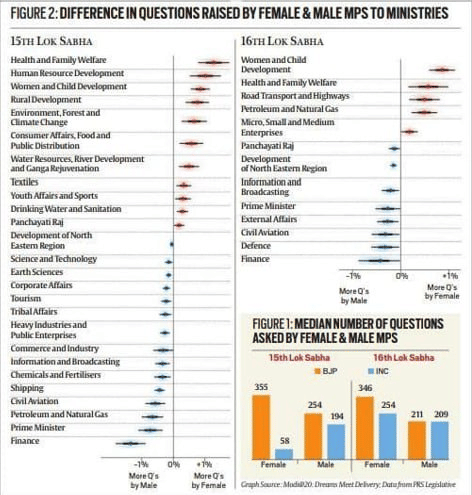
The key findings based on the data from 15th Lok Sabha (2009-2014) and 16th Lok Sabha (2014-2019) are:
- In the 15th Lok Sabha, women MPs asked fewer questions than male MPs (135 vs 250).
- In the 16th Lok Sabha, women MPs' level of questioning was comparable to male MPs (218 vs 219).
- Women MPs focus on different issues than male MPs, including healthcare, education, roads, and MSMEs, while male MPs focus more on finance, defense, and external affairs.
Importance of Political Empowerment of Women
- Reflecting Diversity: To have a true representative democracy, the diversity of the population should be mirrored in decision-making bodies.
- Breaking Stereotypes: Women in political roles can challenge societal norms and gender stereotypes, paving the way for greater gender equality.
- Holistic Policies: Women politicians tend to focus more on social welfare, health, and education. Their involvement ensures a more comprehensive approach to development.
- Collaborative Approach: Women often employ a more collaborative and inclusive decision-making style, fostering unity and consensus.
- Upholding Global Standards: Many international conventions and commitments emphasize the importance of women's political participation. Empowering women politically helps nations uphold these standards.
Constitutional Provisions Related to Women's Rights and Their Representation
- Article 14: Guarantees “equality before the law” and “equal protection of the laws” to all persons, including women.
- Article 15(1): Prohibits discrimination against any citizen on the grounds of religion, race, caste, sex, or place of birth.
- Article 15(3): Allows the state to make special provisions for women and children, thereby enabling affirmative action in favor of women.
- Article 16: Ensures equality of opportunity for all citizens in matters of employment or appointment to any office under the State. This includes public offices where political representation matters.
- Article 39(a) & (d): Mandates that the State shall direct its policy towards ensuring that men and women have the right to an adequate means of livelihood and equal pay for equal work, respectively.
- Article 243D: Provides reservation of seats in the local bodies of Panchayats and Municipalities for women, ensuring women representation in local governance. This has led to a significant number of women entering the political space at the grassroots level.
- 73rd and 74th Constitutional Amendment Acts (1992): These were significant amendments that provided for reservation of one-third of seats at the local government level (Panchayats and Municipalities) for women.
Reasons for Low Representation of Women in Parliament
- Traditional Mindset: India's largely patriarchal society often perceives politics as a male domain. This mindset can discourage women from entering politics or being taken seriously when they do.
- Gender Roles: Predefined gender roles, which expect women to prioritize domestic responsibilities, can act as barriers for women to actively participate in politics.
- Ticket Allocation: Political parties often hesitate to give election tickets to women, doubting their ability to win, especially in constituencies where the competition is tough.
- Internal Party Dynamics: Women often face discrimination within political parties themselves, with fewer opportunities to rise to prominent positions.
- Safety Concerns: The threat of violence, harassment, or character assassination during election campaigns can deter women from participating in politics.
- Discouragement: Even if women choose to participate, they might face discouragement from family members who fear for their safety.
- Campaign Financing: Elections require significant financial resources for campaigns, and women often have less access to such resources.
- Economic Dependence: Economic dependence on male family members can also curtail women's ability to make independent political decisions.
- Education: Lower literacy and education rates among women compared to men can be a factor, as education often correlates with political awareness and participation.
- Mobility: In many parts of India, women's mobility is restricted, limiting their ability to campaign effectively.
- Media Portrayal: The media, at times, can focus more on the personal lives of women politicians or their appearance, rather than their political stance or achievements, which undermines their credibility.
- Absence of Strong Legal Provisions: Though there are reservations for women at local governance levels (Panchayats and Municipalities), similar provisions at state or central legislative levels are absent. The Women's Reservation Bill, which proposes to reserve 33% of all seats for women in the Lok Sabha and state legislative assemblies, has not been passed.
Government Initiatives
- A significant step towards increasing women's representation was taken with the introduction of the Constitution (One Hundred and Twenty-Eighth Amendment) Bill, 2023, which aimed to reserve one-third of the seats in the Parliament for women.
- This was followed by the passing of the Women's Reservation Bill, 2023, on 21 September, ensuring that women would occupy at least 33% of the seats in the state legislatures.
- The legislation, also referred to as the Constitution (One Hundred and Sixth Amendment) Act, 2023, aimed at allocating 33% of the seats in the Lok Sabha and state legislative assemblies for women.
- This bill was passed by the Lok Sabha and the Rajya Sabha and signed by the President on 28 September 2023, with its implementation planned after the 2024 Lok Sabha elections following a new census and delimitation exercise.
Policies Benefitting Women
- Increase in accessibility to LPG cooking fuel has improved women's health.
- Enhanced toilet accessibility improves women's health and safety.
- Majority beneficiaries of the Pradhan Mantri Jan Dhan Yojana are women.
- Houses under PM Awas Yojana are primarily owned by women heads of families.
- Mahila e-Haat is an online marketing platform for women entrepreneurs to showcase their products, directly reaching out to buyers without any intermediaries.
Conclusion
Women MPs' contribution in the Parliament has seen a notable increase, particularly in questioning the government. The future looks promising for India with increasing women-led democracy, especially with initiatives like the women's reservation bill.
(*Click this link to read prelims specific weekly current affairs articles)
FAQs
Question: What government policies have been implemented to promote women's empowerment in India?
Answer:
Policies such as increasing accessibility to LPG cooking fuel, enhancing toilet accessibility, the Pradhan Mantri Jan Dhan Yojana, and the PM Awas Yojana which have collectively contributed to the economic empowerment and improved health and well-being of women across India.
Question: How are women MPs contributing to the parliamentary process in India?
Answer:
Women MPs in India have been actively engaging in the parliamentary process by questioning the government, participating in debates, and introducing private member bills. Their level of engagement has shown a remarkable increase in the 16th Lok Sabha compared to the 15th Lok Sabha, with their question-asking activity coming on par with male MPs. Moreover, female MPs tend to focus on critical matters like healthcare, education, roads, and MSMEs, which cater to the vulnerable segments of society.
Question: What significance does the political empowerment of women hold in a democratic setup like India?
Answer:
The political empowerment of women reinforces civil and human rights and plays a crucial role in representing the interests of marginalized sections of society, such as women and children. It also ensures a diversified representation in the parliament, which is essential for a robust and inclusive democracy.
UPSC Mains Practice Question:
|
MCQs
Question: Consider the following statements:
- The Women's Reservation Bill proposes to reserve 33% of all seats in the Lok Sabha and state legislative assemblies for women.
- The 73rd and 74th Constitutional Amendments provide for at least one-third reservation for women in local self-governing bodies.
- The National Commission for Women was set up in 1992 to address the issues of women's rights and representation.
How many of the statements given above are correct?
(a) Only one
(b) Only two
(c) All three
(d) None
Answer: (c) See the Explanation
The Women's Reservation Bill, also known as the Constitution (108th Amendment) Bill, proposes to amend the Constitution to reserve 33% of all seats in the Lok Sabha and state legislative assemblies for women. The main aim of this bill is to improve the representation of women in legislative bodies and thereby empower them politically. Hence, statement 1 is correct.
The 73rd and 74th Constitutional Amendments Act, 1992, provide for at least one-third reservation for women in all local self-governing bodies such as Panchayats and Municipalities. These amendments were landmark steps towards ensuring women's participation in local governance, which is crucial for their political empowerment. Hence, statement 2 is correct.
The National Commission for Women (NCW) was set up in January 1992 as a statutory body to review the constitutional and legal safeguards available for women, recommend remedial measures to address the issues affecting women, and facilitate redressal of grievances. It plays a significant role in ensuring women's rights and representation in various fields. Hence, statement 3 is correct.
Therefore, option (c) is the correct answer.
Download the PREPP App and attempt FREE IAS Exam Mock Tests and get complete study material!
Live Test : UPSC IAS : GS - Modern History - Subject Knowledge Test

Live Test : UPSC CSE Prelims CSAT (Paper-II) (Oct 14 - 17)
Full Test - 04: UPSC CSE Prelims CSAT (Paper-II)
Full Test - 03: UPSC CSE Prelims CSAT (Paper-II)
UPSC CSE Prelims 2026 GS Paper 1 Question Paper (24-May-2026)
UPSC CSE Prelims 2026 CSAT Paper 2 Question Paper (24-May-2026)

17 February 2025 | The Hindu Must Read Articles | Current Affairs

16 February 2026 | The Hindu Must Read Articles | Current Affairs

13 February 2026 | The Hindu Must Read Articles | Current Affairs









Comments