Swaminathan Walked Ahead Of His Time: Scientific Community
Relevance: GS3 - Agriculture; Food Security; Achievements of Indians
(Source: The Hindu, 09/29/2023)
Click here for Daily Current Affairs
Why in the news?
- Recently, Dr. M. S Swaminathan or Mankombu Sambasivan Swaminathan, the renowned agricultural scientist known as the Father of India’s Green Revolution, passed away at his residence in Chennai on September 28 at the age of 98.
- He played a crucial role in heralding the Green Revolution that helped India combat food insecurity.
Table of Contents
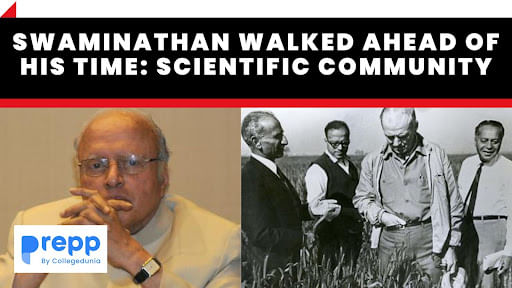
Who was MS Swaminathan?
- MS Swaminathan was born to M.K. Sambasivan, a surgeon, and Parvati Thangammal in Kumbakonam in the then Madras Presidency.
- After completing his matriculation, Swaminathan pursued a higher education in zoology from Maharaja’s College in Trivandrum.
- With a keen interest in agriculture, farming and moved by the plight of the farmers, he later completed a Bachelor of Science degree in Agricultural Science from University of Madras in 1944.
- Having witnessed the Bengal famine of 1943, Swaminathan dedicated his life to improving India’s farming methods to battle food shortage.
- After Independence, Swaminathan joined the Indian Agricultural Research Institute (IARI) in New Delhi to focus on plant genetics and breeding.
- He further specialized in cytogenetics to help crop improvement, gaining a post-graduate degree in it.
About Green Revolution
- It was a period that started in the 1960s and saw the transformation of Indian agriculture into a contemporary industrial system through the application of technology.
- It included the employment of high-yielding variety (HYV) seeds, mechanized farm equipment, irrigation systems, pesticides, and fertilizers.
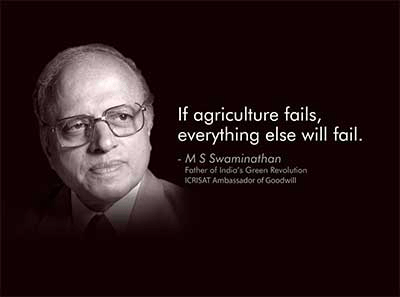
- This phase was a part of the greater Green Revolution initiative started by Norman E. Borlaug, which used agricultural science and technology to boost agricultural output in the developing world, and was primarily directed by agricultural scientist M. S. Swaminathan in India.
*To read more about Green Revolution, click here
Swaminathan’s Contributions to the Green Revolution
- In 1954, M.S. Swaminathan began work at the Central Rice Research Institute, Cuttack, focusing on transferring genes for fertilizer response from Japonica to Indica rice varieties. This marked his initial effort to develop high-yielding varieties responsive to soil fertility and water management.
- Post-independence, Indian agriculture faced productivity challenges due to years of colonial rule and limited resources. Consequently, staple crops had to be imported.
- In 1960, M.S. Swaminathan collaborated with Norman Borlaug and other scientists to create High-Yielding Variety (HYV) wheat seeds, which he promoted among farmers nationwide.
- In 1965, he organized numerous exhibitions in northern India to educate small-scale farmers about the benefits of genetically engineered grains.
- These demonstrations were a significant turning point as they led to a threefold increase in crop yields in the first year of the green revolution.
- Increase in wheat production: From 1947 to 1962, wheat production increased from 6 million to 10 million tonnes annually. Between 1964 and 1968, it further surged to 17 million tonnes per year.
- Swaminathan also trained farmers, overcoming literacy barriers, resulting in a remarkable increase in agricultural production from 12 million to 23 million tonnes in just four crop seasons.
- Formulating agricultural policies: Following this success, Swaminathan worked closely with Prime Minister Indira Gandhi to formulate agricultural programs and policies aimed at ensuring long-term agricultural self-sufficiency.
- He held various key positions, including Principal Secretary in the Ministry of Agriculture from 1979 to 1980, Director-General of the Indian Council of Agricultural Research from 1972 to 1979, and a role in the Planning Commission from 1980 to 1982, where he focused on agricultural and rural development.
- Swaminathan's contributions played a vital role in transforming Indian agriculture and increasing food production.
How India benefitted from the contributions of M.S. Swaminathan?
- High-Yielding Crop Varieties: Developing high-yielding varieties of wheat and rice, which helped to increase agricultural productivity and reduce food shortages in India.
- Sustainable Agriculture Advocacy: Promoting the use of sustainable agricultural practices, such as integrated pest management and crop diversification.
- M.S. Swaminathan Research Foundation: He set up the M.S. Swaminathan Research Foundation in Chennai in 1988 to provide a collaborative platform for global leaders, rural farmers to coordinate research on issues such as micro-level farming, ecotechnology. The foundation also works to impart technical training to the farming community on low-cost methods to ensure food security.
- Improved farmers distress: Dr. Swaminathan worked to educate farmers on weather and crop patterns by setting up thousands of ICAR centres across India.
- National Commission on Farmers: Serving as the chairman of the National Commission on Farmers, which led to the development of several policies aimed at improving the lives of farmers in India. His reports recommended several reforms such as increased rural credit to farmers, increased investment in Agricultural research, measures to attract and retain youth in farming etc.
- Women’s role in Farming: In 2007, nominated to Rajya Sabha by President Dr. APJ Abdul Kalam, Dr. M.S. Swaminathan introduced the Women Farmers’ Entitlements Bill 2011. This bill aimed to empower women in farming amid male migration to cities, addressing land rights, credit access, insurance, technology, and market concerns.
Some Awards and Recognition received by M.S Swaminathan
- He was awarded with the Ramon Magsaysay Award for Community Leadership in 1971 and the inaugural World Food Prize in 1987.
- He was also honored with the Padma Shri in 1967, Padma Bhushan in 1972, and Padma Vibhushan in 1989.
- He has received multiple accolades like, the Albert Einstein World Science Award in 1986, UNEP Sasakawa Environment Prize in 1994, UNESCO Gandhi Gold Medal in 1999, Indira Gandhi Prize for Peace, Disarmament, and Development in 1999, the Franklin D. Roosevelt Four Freedoms Award in 2000, etc.
(*Click this link to read prelims specific weekly current affairs articles)
FAQs
Question: What is the Green Revolution?
Answer: The term "green revolution" describes the dramatic rise in food grain output, particularly for wheat and rice, that began in the middle of the 20th century and was largely attributed to the introduction of new, high-yielding variety (HYV) seeds into developing nations.
Question: Who was M.S Swaminathan?
Answer: Recently, Dr. M. S Swaminathan, the renowned agricultural scientist known as the Father of India’s Green Revolution, passed away at his residence in Chennai on September 28 at the age of 98. He played a crucial role in heralding the Green Revolution that helped India combat food insecurity.
Question: How has India benefited from the Green Revolution?
Answer: The inland irrigation systems surrounding Indian farmland were significantly enhanced by the Green Revolution. The introduction of technology and equipment, such as tractors, harvesters, drills, etc., comes last. This significantly aided in promoting industrial farming in the nation.
UPSC Mains Practice Question:
|
Download the PREPP App and attempt FREE IAS Exam Mock Tests and get complete study material!

Full Test - 04: UPSC CSE Prelims CSAT (Paper-II)
Full Test - 03: UPSC CSE Prelims CSAT (Paper-II)
UPSC CSE Prelims 2026 GS Paper 1 Question Paper (24-May-2026)
UPSC CSE Prelims 2026 CSAT Paper 2 Question Paper (24-May-2026)

17 February 2025 | The Hindu Must Read Articles | Current Affairs

16 February 2026 | The Hindu Must Read Articles | Current Affairs

13 February 2026 | The Hindu Must Read Articles | Current Affairs









Comments